

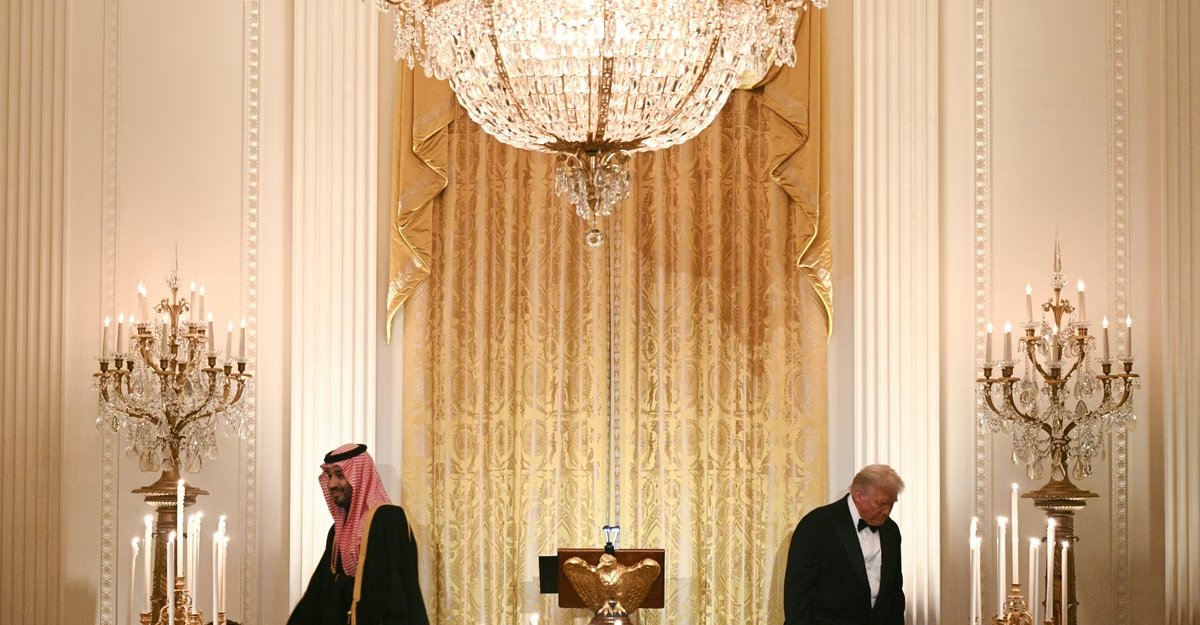
Unfaithful, chaotic and corrupt: Donald Trump’s character also defines his foreign policy. The latest victim is Saudi Arabia – perhaps not a sympathetic victim, but a victim nonetheless.
On July 22, US Energy Secretary Chris Wright and his Saudi counterpart signed an agreement on the Saudi-American civil nuclear partnership. The multibillion-dollar, decades-long deal allows U.S. companies to develop and operate commercial nuclear power plants inside Saudi Arabia, potentially including a uranium enrichment plant. The Saudis have been pushing for such a deal for almost 20 years. Presidents of the United States since Barack Obama have expressed their openness to this, but under two conditions: any deal must include guarantees against Saudi Arabia’s use of enrichment for nuclear weapons, as well as normalization of relations with Israel.
With Donald Trump’s return to the presidency in 2024, the Saudis undoubtedly hoped their moment had arrived. Saudi Arabia has invested heavily in Trump and the Trump family, including licensing deals with the Trump Organization potentially worth billions of dollars and a huge commitment to a private equity firm founded by Trump’s son-in-law Jared Kushner. This week, those investments appear to have paid off. Details about Wednesday’s agreement are sparse, but Washington Post reported that the pact, by clearing the way for nuclear enrichment, opened the way to the possible creation of Saudi nuclear weapons. The deal also reportedly removed a precondition for Saudi recognition of Israel.
The Saudis essentially got everything they wanted with little sacrifice in return. But as soon as the agreement was signed, the retreat began. In a Truth Social post yesterday, Trump insisted that the deal does not actually include uranium enrichment and that it is “entirely contingent on Saudi Arabia joining the highly respected and successful Abraham Accords,” i.e. normalizing relations with Israel. Complete chaos and confusion erupted over what Trump intended to achieve with these words. Is Trump trying to sabotage the just-signed deal after hearing Republicans criticize it on Fox News and elsewhere, as CNN suggests? Or was this outburst just Trump’s bluster with no real consequences?
Nobody seems to know. Trump did not consult with Saudi Arabia’s leadership before adding the final condition to the deal they just flagged. What this means for the deal’s fate in Congress is also unclear. Congress could block it, but that would require veto-proof majorities in both the House and Senate—assuming Trump even wants the deal to happen.
The Saudis must be puzzled. They paid their “pound” to the Trump family. Where is their “quo”? Can criticism on Fox News undo the billions paid to favor the Trump family?
This turnaround comes at a very bad time for Saudi Arabia. The country is already stranded and exposed by the failure of Trump’s war with Iran, which has emboldened Iran to tighten its grip on the Strait of Hormuz, Saudi Arabia’s most important maritime link to global oil markets. Saudi Arabia needs protection. Its traditional defender turned out to be fickle and weak. The kingdom may now view its own nuclear forces as a condition for its survival in the post-American Middle East.
American supporters of the US-Saudi nuclear deal have long warned that if the United States does not partner with Saudi Arabia, the Saudis could turn to Russia or China for nuclear technology and stronger military ties. But previous attempts by Saudi Arabia to find alternative security measures have failed. Saudi Arabia signed a rapprochement deal with Iran brokered by China in 2023, but China’s friendly relations with Tehran have failed to protect Saudi Arabia from Iranian missile attacks in recent months.
Saudi Arabia’s other options look even worse. The country, which reportedly financed Pakistan’s nuclear weapons program in the 1990s, is believed to have some sort of claim for the weapons if it ever needs them. Last year, the two countries officially signed a joint defense pact. But the future of the Pakistani military protectorate is not promising, especially since India is among Saudi Arabia’s top three export markets and is likely its fastest growing export market.
This brings us back to Saudi Arabia’s Plan A. Is the nuclear plan ready? Trump often announces things on social media that don’t come true in real life. During his first term, he announced on Twitter in 2019 that he had ordered all American businesses to leave China. Three days later the “order” was canceled. In June 2025, Trump announced the suspension of immigration controls on farms, hotels and restaurants. A few days later the pause was canceled. Trump has repeatedly announced tariff hikes that have since been delayed and military strikes that never materialized, including a pledge last November to invade Nigeria with “guns blazing” to wipe out the country’s Islamic insurgents. The same could be true of Trump’s post-deal demand that Saudi Arabia recognize Israel as an additional price for a deal lubricated by a flow of funds to Trump’s companies and relatives.
America’s traditional democratic allies feel betrayed and confused by the unpredictability of Trump’s pay-to-play diplomacy. But those who are willing to pay may themselves suffer from betrayal and embarrassment. If even the Saudis, who showered Trump and his family with money and gifts, can’t trust Trump’s diplomacy, who else on earth can feel any confidence at all?