

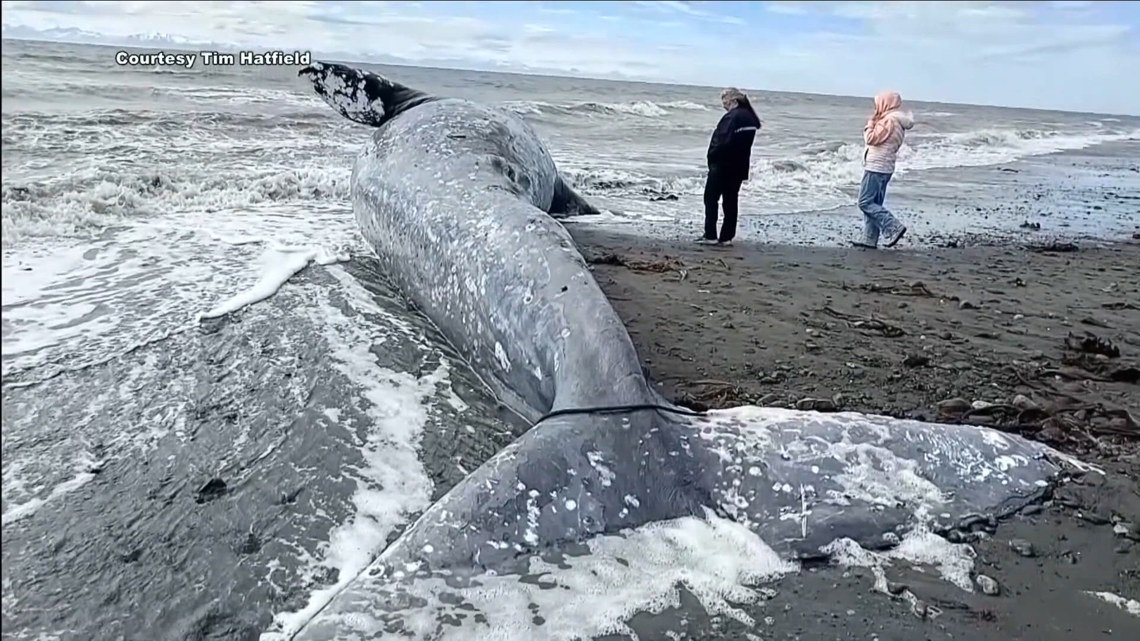
At this rate, experts say 2026 could be one of the deadliest years on record for marine mammals.
SAN DIEGO — Researchers are revealing alarming statistics about gray whales, saying there is a “catastrophic mortality rate” along the West Coast as the number of whale strandings soars this year. The National Oceanic and Atmospheric Administration reports that 145 gray whales have been found dead along the West Coast, including parts of Mexico and Canada, a significant increase that could make 2026 one of the deadliest years on record for these marine mammals.

This story continues below.
The current level of strandings stands in stark contrast to the previous two decades, when between 2006 and 2023 the average number of strandings per year was about 43. In 2025, that number rose to 179, causing further concern among scientists and conservationists.
Miyoko Sakashita of the Center for Biological Diversity points out that starvation is a leading factor in the death of whales. She attributes the food shortage to climate change, especially a warming Arctic, which has negatively impacted the whales’ food supply during the summer feeding months. “Due to the melting of sea ice, there is not as much production,” Sakashita said.
The second major problem affecting gray whales is ship strikes. Although 24 whales were reported struck by ships along the coasts of California, Oregon and Washington last year, scientists believe this is a significant undercount and estimate that about 80 whales may die each year in the western U.S. due to such strikes, Sakashita said.
In a similar effort Wednesday, researchers and students from the Scripps Institution of Oceanography at the University of California, San Diego, excavated the skeleton of a whale that was struck by a ship in San Diego Bay two years ago. Dr Margaret Morris, who helped lead the excavation, described the whale’s severe injuries, noting: “Some of the vertebrae were broken in half and these are big bones, they’re very strong.”
The purpose of the excavation project is educational: to create 3D models of the bones for educational purposes and ultimately to formulate a skeleton for display to raise awareness of the dangers associated with ship strikes.
As part of ongoing efforts to protect gray whales, the Center for Biological Diversity is suing the Coast Guard to reduce vessel speeds in areas of high whale activity. The organization is also calling on lawmakers to take stronger action against climate change, as the gray whale population has reportedly declined by 50 percent over the past ten years. “We are really concerned about the future of these gray whales,” Sakashita said.