

PressSplit
Follow us on Google
On September 20, the state of Mecklenburg-Vorpommern will elect a new state parliament. The trend in the polls is quite obvious. But changes before state elections still seem possible.
Schwerin – According to current polls, the first place seems to be already taken: ahead of the state elections in Mecklenburg-Vorpommern on September 20, the figures point to a victory for the AfD. However, the leadership of the right-wing party is not unchallenged. The SPD is currently also hoping for success, but is still several points behind the AfD.
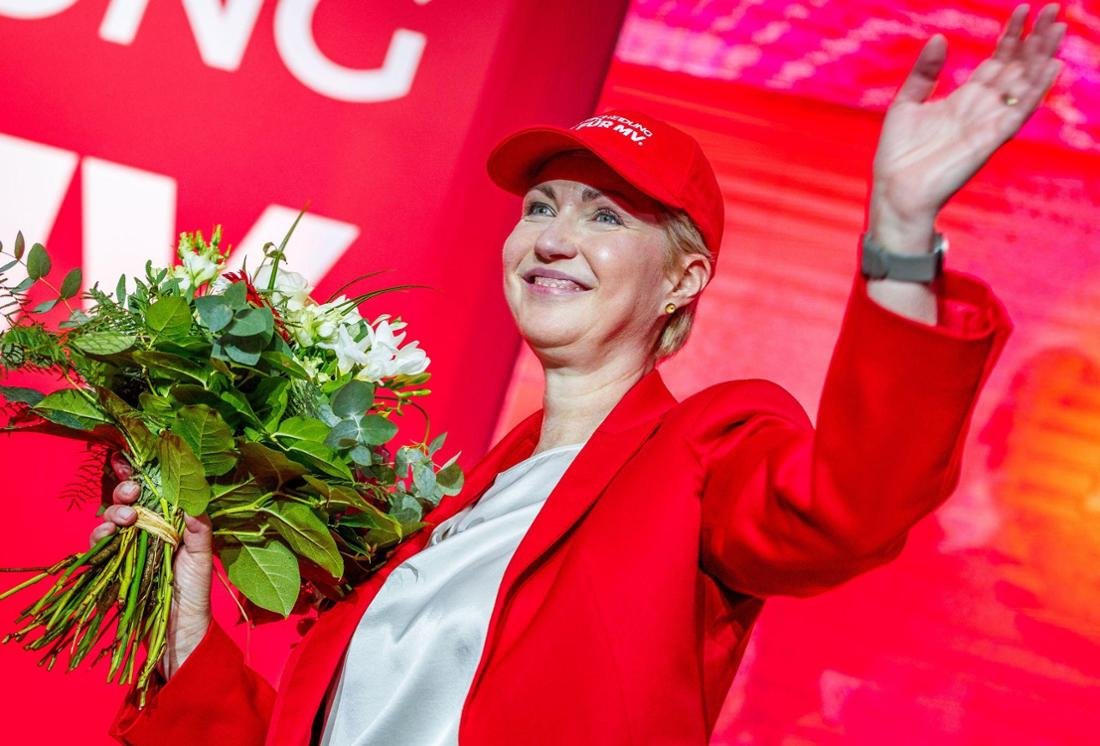 Prime Minister Manuela Schwesig leads the SPD in the elections in Mecklenburg-Vorpommern. But in the polls it lags behind the AfD. © Jens Büttner/dpa
However, Prime Minister Manuela Schwesig has a clear goal: “The MV elections on September 20 are about deciding on direction,” she told a party conference in mid-June. “Either Manuela Schwesig as Prime Minister with a strong SPD and a strong, democratic and reliable government, or the AfD autocracy, which wants to divide our country and which wants to allow extremists to come to power in our country.”
Polls ahead of 2026 general elections point to duel at the top
A look at the polls for the state elections in Mecklenburg-Vorpommern in 2026 makes it clear how difficult Schwesig’s task really is. The AfD leads with 35 percent, ahead of the SPD, which has about 27 percent. But Schwesig hopes the situation will improve. The leader of the state party wants to make the SPD the strongest force in the Schwerin state parliament again. Schwesig currently heads the government with the Left Party as a partner.
The ruling left is battling the CDU for third place in the polls. BSW can enter the Schwerin state parliament as a fifth party. But this is not certain. On the other hand, according to current polls, the Greens and FDP will leave the state parliament. Thus, Schwesig’s red-red coalition would no longer have a majority. Besides the AfD, other bipartisan alliances are also missing. The CDU, in turn, rules out coalitions with the Left Party, such as a tripartite alliance with the SPD.
State elections in Mecklenburg-Vorpommern: three parties are fighting for entry into parliament – what the polls say
The following table shows the two latest polls covering the state elections in Mecklenburg-Vorpommern in 2026. These are from INSA (June 22) and Infratest dimap (May 7):
| 35% | 36% |
| 28% | 27% |
| 11% | 13% |
| 10% | 10% |
| 6% | 5% |
| 4% | 4% |
| 3% | – |
| 3% | 5% |
Pay attention to the polls
Institute: INSA. Client: Northern Courier. Survey period: from June 11 to June 18. Number of cases: 1000 respondents. Statistical error: ± 3.1 percentage points.
Institute: Infratest dimap. Client: non-delivery report. Survey period: from May 7 to May 11. Number of cases: 1153 respondents. Statistical error: two to three percentage points.
The polls are representative of the voting population in Mecklenburg-Vorpommern.
Elections in the World War II: polls should reflect the results fairly accurately
Surveys are typically always subject to uncertainty. Among other things, weakening party ties and increasingly short-term voting decisions are making it difficult for pollsters to weigh the data they collect. In principle, polls reflect only opinion at the time the poll was taken and are not predictions of election results. In addition, a statistical margin of error of up to three percentage points must always be taken into account.
Polls conducted in Germany have recently proven to be quite accurate. This was the average standard deviation of all institutions in the 2021 state elections, according to the online portal. Continue just 0.73 percentage points. All those institutions that published the Sunday question 30 days before the election were taken into account. It can therefore be assumed that the polls will reflect the results of the Saxony-Anhalt elections in 2026 quite well. (Sources: Infratest dimap, INSA, Dawum, dpa) (KS)