
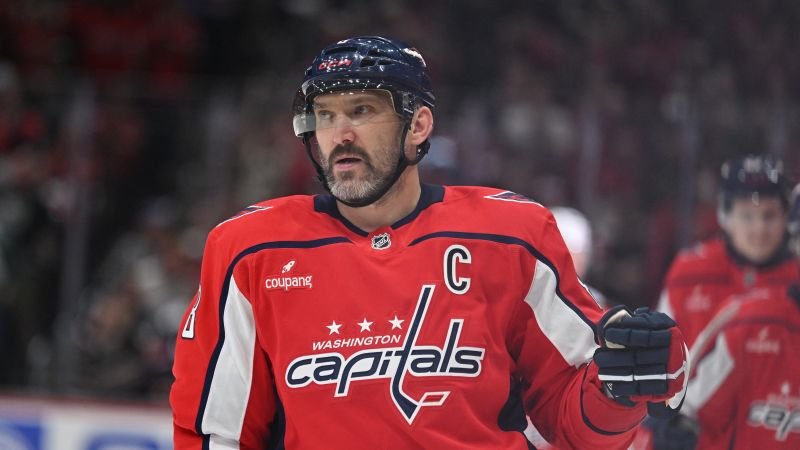
Alexander Ovechkin Faces Backlash Over United Russia Election Ad
NHL superstar Alexander Ovechkin is drawing sharp criticism after appearing in an election video for United Russia, the party closely aligned with President Vladimir Putin. The controversy has moved beyond sports because the ad was released ahead of Russia’s parliamentary elections and featured Ovechkin endorsing Foreign Minister Sergey Lavrov during a period of intense international scrutiny over Russia’s war in Ukraine.
The Washington Capitals captain has not apologized for the appearance. Instead, he said he supports his country and expects to live in Russia after retirement, reinforcing concerns that his public image is being tied to Russian political institutions.
What did Ovechkin appear in?
The video, released ahead of Russia’s parliamentary elections, shows Ovechkin endorsing Lavrov, one of United Russia’s leading candidates. Lavrov warns Moscow’s enemies to “expect no mercy,” giving the campaign spot a confrontational political tone.
“I’m Russian. I support my country,” Ovechkin told reporters. “I’m gonna live there, my kids are gonna live there. I’m for peace and love and I hope everything’s going to be okay.”
His remarks did not explicitly endorse the war, but they linked his identity as a Russian citizen with support for his country’s political system. That distinction has not prevented critics from viewing the election appearance as public alignment with the Kremlin and its governing party.
Why the ad triggered criticism
The timing and content are central to the backlash. Russia’s full-scale invasion of Ukraine began in 2022, and the war has produced sanctions, international legal proceedings and widespread condemnation of Moscow’s conduct. The International Criminal Court has brought charges against Putin and other Russian officials; Russia denies allegations that it is committing war crimes.
The video also features prominent Kremlin supporters, including state broadcaster RT editor-in-chief Margarita Simonyan and actor Vladimir Mashkov. Mashkov has been sanctioned by Europe over his backing for Russia’s war in Ukraine. For critics, Ovechkin’s participation places a globally recognized athlete alongside figures closely associated with Russian state propaganda.
Responses from governments and hockey figures
Latvia announced on Thursday that it had banned Ovechkin from entering the country. The Latvian Foreign Ministry also named Umar Kremlev in the same statement. Latvia’s entry ban is the clearest official measure described in the reporting.
In Canada, the Ukrainian Canadian Congress, which says it represents roughly 1.3 million Canadians of Ukrainian identity, called for Ovechkin to be sanctioned and barred from entering the country. It described him as “a disgusting supporter of Russia’s genocidal war against Ukraine.”
US Rep. Joe Wilson (R-SC) sent NHL Commissioner Gary Bettman a letter calling it “incredibly alarming” that Ovechkin had supported “the party of war criminal Putin.” Wilson asked the league to review its policies. NHL Hall of Fame goaltender Dominik Hasek also criticized Ovechkin on X, arguing that the star bears a significant share of responsibility through his public stance for the deaths and injuries caused by the conflict.
Olga Saladukha, head of the Ukrainian Athletics Federation, said the video illustrated why sport and politics cannot be separated when Russia is involved. She described Russian sport as another element of state propaganda, militarism and imperial ambitions.
What did the Washington Capitals say?
The Washington Capitals said Ovechkin was asked to film the video while he was in Russia for the summer. Capitals general manager Chris Patrick told ESPN that Ovechkin had not informed the team about the filming. Patrick called it a difficult situation and said he understood why people were upset.
The team’s response highlights a practical challenge for international athletes: appearances made abroad can create diplomatic and reputational consequences even when a player presents himself as acting privately. The Capitals now face pressure to address criticism while continuing to support one of their franchise’s defining players.
Why Ovechkin’s influence matters
Ovechkin is one of the most recognizable athletes in ice hockey. He has captained the Capitals for 16 seasons and remains one of the NHL’s most decorated players. He became the league’s all-time points leader in April 2023 and scored his 900th career goal in December 2024.
His relationship with Putin is public. His Instagram profile has displayed a photograph with the Russian leader, and he has campaigned for Putin in the past. Since Russia’s full-scale invasion of Ukraine, however, Ovechkin has generally used more cautious language, speaking of friends in Russia and Ukraine and expressing hope that the war would end soon.
That history helps explain why the election ad has been so consequential. The appearance suggests a shift from restrained personal statements to a highly visible political endorsement at a time when many Western sports organizations have distanced themselves from Russian state-linked activity.
What happens next for Ovechkin and the NHL?
At the stage described by the reporting, Latvia’s entry ban is the confirmed government action. Calls for Canadian sanctions, an NHL policy review and broader condemnation remain demands and criticism rather than proof that those institutions have imposed new penalties.
The controversy is testing the boundary between athletic fame and political symbolism. For Ovechkin, the immediate questions are reputational: how the Capitals, NHL and fans respond, and whether further travel or commercial consequences follow. For sport more broadly, the case highlights how athletes from countries at the center of international disputes can become symbols in debates over propaganda, sanctions and the politics of competition.
Conclusion: Sport, celebrity and state power
Ovechkin’s United Russia ad places a hockey icon at the center of a controversy extending far beyond the rink. His comments and the election video have made his Russian identity and political associations impossible to separate for many critics, especially in the context of Ukraine. The episode shows how quickly sports celebrity can become part of a geopolitical dispute when a public figure lends fame to a state-backed campaign.
Sports, News, Government, Society, People, Law, Alexander Ovechkin, Washington Capitals, National Hockey League, United Russia Party, Vladimir Putin, Sergey Lavrov, Russia-Ukraine War, Russian Parliamentary Elections, Latvia, Canada, United States, International Relations, International Sanctions, Sports and Politics, Ukrainian Canadian Congress, Controversial, Critical

