

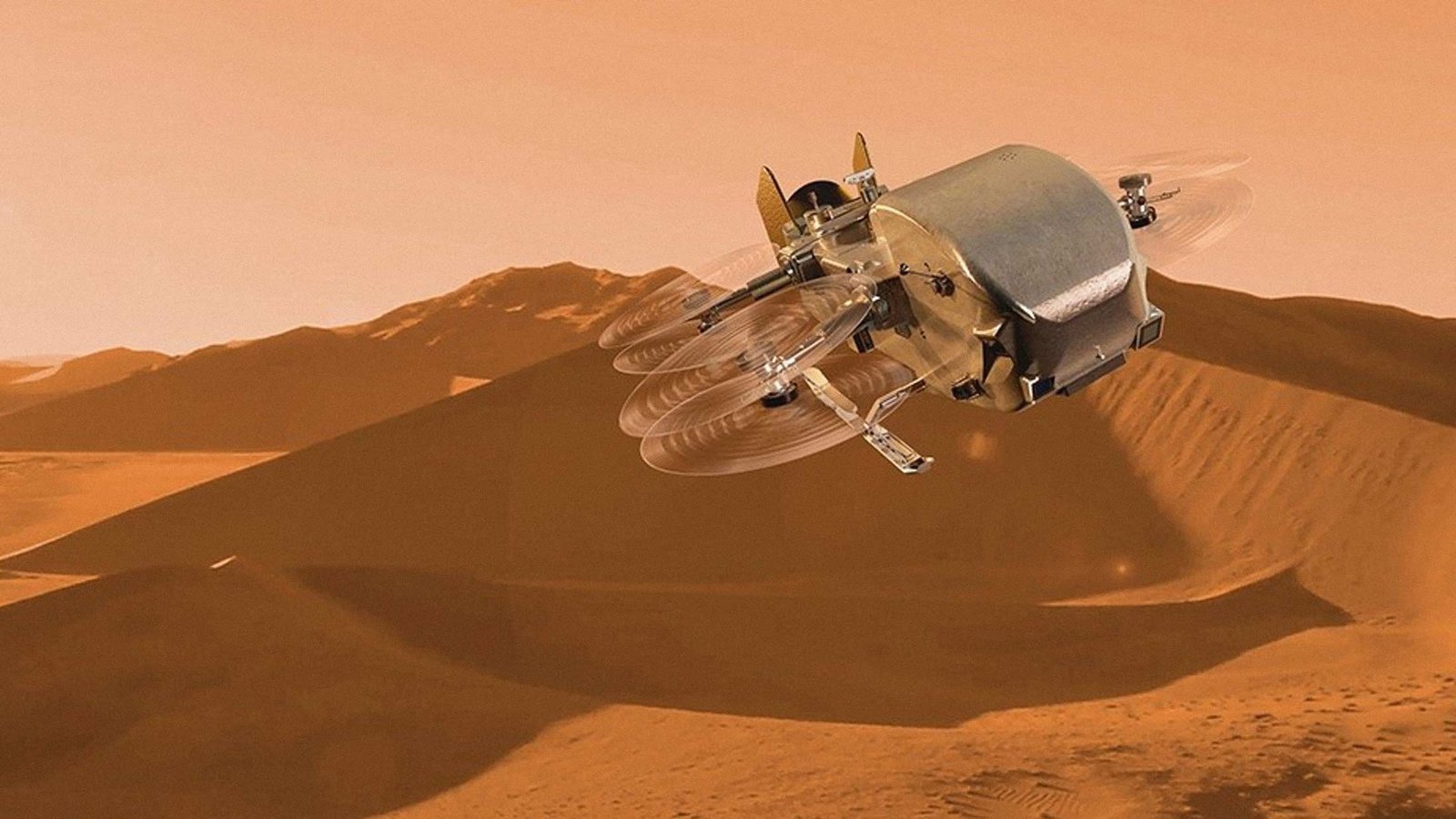
Today at 2:00 pm ET, NASA and the Johns Hopkins Applied Physics Laboratory will broadcast a behind-the-scenes look at the Dragonfly mission, which is building what appears to be a nuclear-powered drone the size of a small car. The craft will explore Saturn’s largest moon, Titan, when it arrives in late 2034.
(embed live broadcast)
The program, called “Dragonfly Eyes Live,” will be hosted by NASA’s Tahira Allen and will feature Zibi Turtle (APL), Melissa Trainer (NASA), and Simmie Berman (APL). The broadcast is from APL Building 30, where the spacecraft is assembled and tested, and will be shown on NASA’s Science YouTube channel, with simulcasts on NASA’s social channels.
Check it out here:
The spaceship is starting to look real
APL’s Dragonfly team delivered the nearly 13-foot-long fuselage on June 29, ahead of schedule, after a month of structural testing. “It was really exciting to see the lander as we designed it become real,” said Hunter Reeling, head of Dragonfly’s thermomechanical integration and testing department. Following the completion of structural testing on July 1, the team began integrating mechanical, thermal and electrical systems.
Advertising
Construction of the spacecraft began on March 10, 2026. An important milestone came June 1 when engineers announced that thermal structural testing of the heat shield had been completed in New Mexico using Sandia National Laboratory’s Solar Tower facility. During testing, the temperature on segments of the heat shield material was approximately 4,500 degrees Fahrenheit to simulate re-entry into Titan’s thick atmosphere.
Dragonfly will launch on a SpaceX Falcon Heavy rocket between July 5 and July 25, 2028. NASA has confirmed the mission, which has a total life-cycle cost of $3.35 billion.
Why Titan Matters
Titan is an unusual two-ocean world, with a liquid ocean of water beneath its surface and a thick atmosphere that supports a methane cycle similar to the water cycle on Earth, with clouds, rain, and rivers flowing into lakes and seas. It is the only extraterrestrial body in the solar system with an abundant, complex chemistry, rich in carbon, and a surface dominated by water ice, making it a high-priority target for astrobiology and origin-of-life research.
During its planned 3.3-year ground mission, Dragonfly’s rotors will carry it several miles across Titan, exploring geologically interesting areas including the dunes and Selk Crater. The rotorcraft can travel between locations up to 110 miles—further than any mission on the planet’s surface. This is the first time NASA will send a scientific vehicle to another planetary body. The rotorcraft has eight rotors and flies like a large drone.
Advertising
Busy period of deep space missions
Dragonfly is part of a larger wave of ambitious planetary exploration at NASA. Europa Clipper, launched on Falcon Heavy in October 2024, is already on its way to Jupiter’s moon Europa. The largest interplanetary spacecraft ever launched by NASA used gravity assist from Mars in March 2025 and will use another from Earth in December 2026. The spacecraft will fly 1.8 billion miles to reach Jupiter in April 2030, then enter Jupiter orbit and make 49 close flybys of Europa.
NASA also plans to launch the Nancy Grace Rome Space Telescope, an infrared space observatory for cosmology and exoplanet exploration, in September 2026. The agency’s Artemis program continues to gain momentum. Artemis 3, scheduled for 2027, will test systems in low Earth orbit to prepare for the landing of Artemis 4 in 2028.
For now, the focus is on the methodical work taking place in APL’s cleanrooms. The Dragonfly team fills this 13-foot structure with flight electronics, wiring harnesses and scientific instruments. There are two more years of integration and testing ahead before the rotorcraft heads to Kennedy Space Center. Today’s livestream offers a checkpoint along the way.