
McDonald’s Faces Its Biggest Test: Reclaiming Value and Trust as Stock Plummets
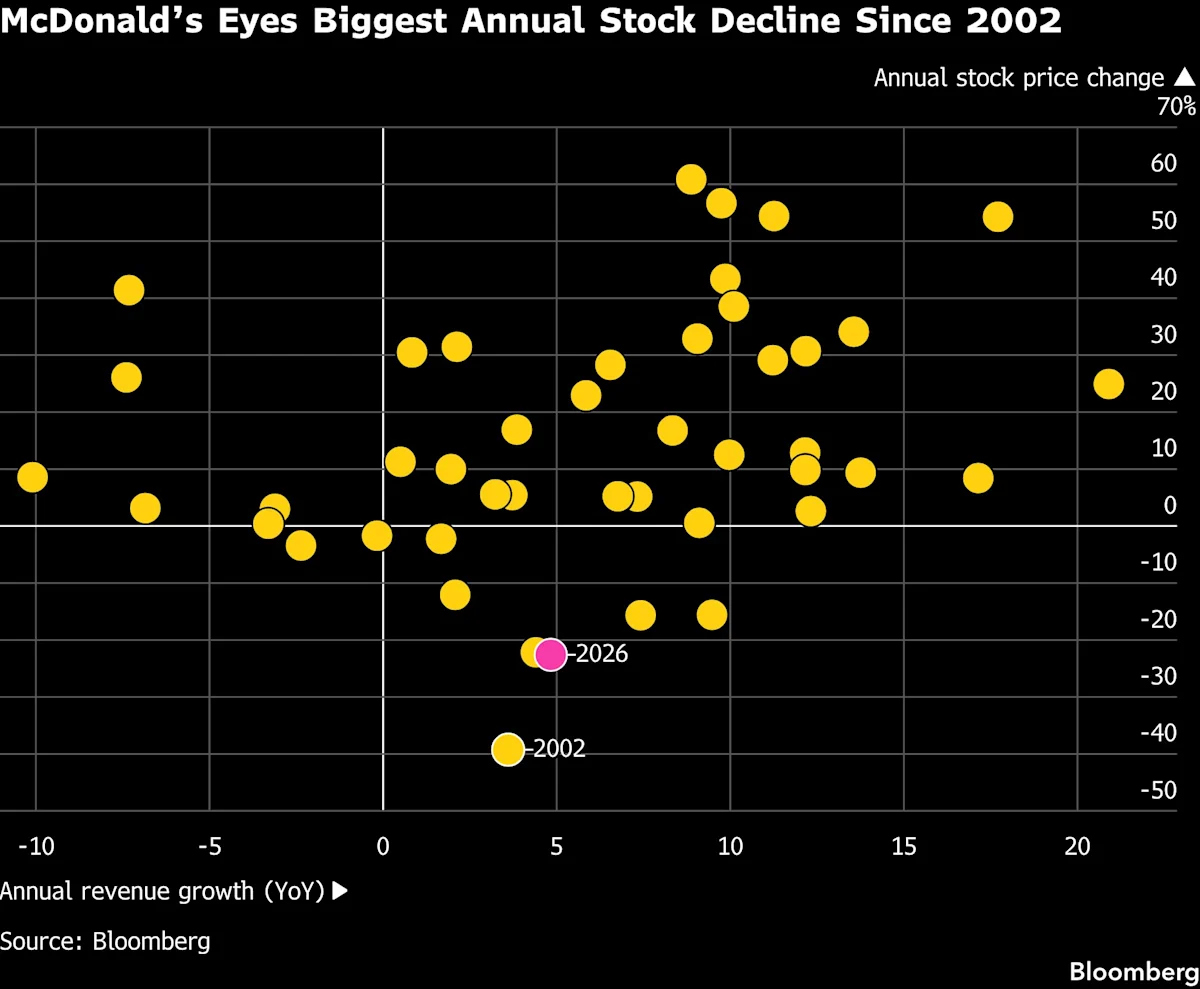
McDonald’s Corp. is confronting what may be its most formidable challenge in decades. Once the undisputed king of fast food, the Golden Arches now finds itself fighting to win back cost-conscious diners who believe its menu has drifted out of reach — and its stock price reflects the urgency of the problem. With shares down nearly 31% from their February peak and heading toward their worst annual performance since 2002, the burger giant is racing to redefine what it stands for in an increasingly competitive restaurant landscape.
A Sagging Stock and Slowing Sales Raise Alarms
The numbers tell a sobering story. McDonald’s guided for “slightly negative” US sales for the current quarter during a recent investor day event, and comparable sales in the previous quarter rose just 0.8% — the slowest pace in more than a year. The company’s stock has fallen roughly 23% year-to-date, dramatically underperforming the S&P 500’s 13% gain and leaving investors searching for signs of a turnaround.
Jacob Aiken-Phillips of Melius Research, who holds the only “sell” rating on McDonald’s among analysts tracked by Bloomberg, captured the core issue bluntly: “Their prices have gone up substantially, and it’s no longer viewed as the best value in food. I could go to Texas Roadhouse instead and have an actual sit-down experience with my family that’s not that much more expensive.”
The Price Perception Problem Runs Deep
The perception that McDonald’s has become unaffordable is not without basis. The Economist’s widely cited Big Mac Index shows that the price of the iconic sandwich in the US has risen by approximately 23% between 2019 and the end of 2025. The chain began hiking menu prices after the pandemic to offset surging costs for beef, labor wages, and fuel — but the cumulative effect has reshaped how Americans view the brand.
McDonald’s has not been blind to these concerns. In 2024, the company pushed back against viral social media posts highlighting an $18 Big Mac meal, clarifying that the price came from a single location among more than 13,700 in the US. That year also saw the introduction of $5 meal deals aimed at countering the narrative that the menu had become too expensive.
A McDonald’s spokesperson reiterated on Friday that the company plans “to act with urgency to put the US business in a stronger position exiting 2026.”
Competitors Are Winning the Value War
While rising prices have pressured the entire restaurant industry, McDonald’s rivals appear to be navigating the moment more effectively. Restaurant Brands International’s Burger King posted US comparable sales growth of 8.5% in the latest quarter, beating estimates thanks to a revamped Whopper and a strategic Star Wars promotion. Yum! Brands-owned Taco Bell reported a 7% increase in same-store sales, driven by its $5, $7, and $9 meal boxes.
The contrast is stark. While those companies’ shares moved in mixed directions year-to-date, McDonald’s stock has dropped 23%, amplifying concerns that the chain is losing ground precisely when consumer price sensitivity is at its peak.
Franchisee Friction Undermines Value Strategy
A critical friction point lies between McDonald’s corporate leadership and its franchisees. Nearly 95% of McDonald’s restaurants are franchised, and operators have pushed back against discount initiatives that grow traffic but erode already-thin profit margins. This year’s menu of 10 items under $3, for instance, saw about a third of franchisees ignore pricing guidance, while consumer awareness of the promotions fell short of targeted levels, CEO Chris Kempczinski acknowledged during the last earnings report.
Beyond pricing, customers have voiced complaints about less tangible aspects of the McDonald’s experience. Many once-loyal patrons lament the loss of playgrounds and other family-friendly features that were shuttered during the pandemic and never reopened in many locations. The erosion of what some describe as the “magic” of a McDonald’s visit — the Happy Meals, the PlayPlaces, the childhood memories — has become a symbol of a brand that has lost some of its emotional resonance.
The “Next” Initiative: A Bold $8.5 Billion Bet
In response to these mounting challenges, McDonald’s unveiled an $8.5 billion multiyear initiative dubbed “Next.” The plan targets a comprehensive reinvigoration of the brand through technology investments, restaurant modernization, expansion in the chicken and beverage categories, and the revival of PlayPlaces.
Seaport Global analyst Eric Gonzalez expressed cautious optimism, noting that the initiative addresses many of the brand’s shortcomings but could take at least a year before yielding measurable results. He added that a slew of negative factors — including an expected step-up in capital expenditures and near-term pressure on sales — are already reflected in McDonald’s valuation, with shares trading at roughly 17 times forward earnings, well below their five-year average.
Wall Street Remains Cautiously Optimistic
Despite the stock’s decline, Wall Street has largely held its ground. McDonald’s carries 24 buy-equivalent ratings, 16 holds, and just one sell rating. The average price target implies a 28% return from where shares closed recently.
Rebecca Walser, chief investment officer at Walser Wealth Management and a McDonald’s shareholder, emphasized that investors want to see tangible evidence of improvement: “Investors now want to see improved food quality and value, as well as signs of a durable recovery in traffic.”
“McDonald’s is part of the American parlance: the Happy Meals, the Hamburglar, Ronald McDonald, the PlayPlaces,” Walser said. “They need to re-engineer that experience. We really do believe that McDonald’s will find its way through this.”
What Lies Ahead for the Golden Arches
McDonald’s stands at a crossroads. The company must balance the need to deliver value to price-sensitive consumers against the profitability demands of its franchisees, all while investing billions in a transformation that may not yield dividends for at least a year. The competitive landscape has never been fiercer, with rivals aggressively courting customers through value menus and bold promotions.
The “Next” initiative represents the most ambitious attempt in years to redefine the McDonald’s experience — but the clock is ticking. With the stock at its lowest valuation in half a decade and consumer confidence at a fragile point, the path back to growth will require more than a new slogan or a limited-time offer. It will demand a fundamental rethinking of what McDonald’s means to the millions of people who still walk through its doors every day.
Business, Finance, McDonald’s, Stock Market, Fast Food, Restaurant Industry, Value Meals, Franchise Operations, Food Pricing, US Economy, Consumer Trends, Wall Street, Burger King, Taco Bell, Big Mac Index, Competitive Analysis, Corporate Strategy, Investment Ratings, Capital Expenditure, Brand Strategy

