

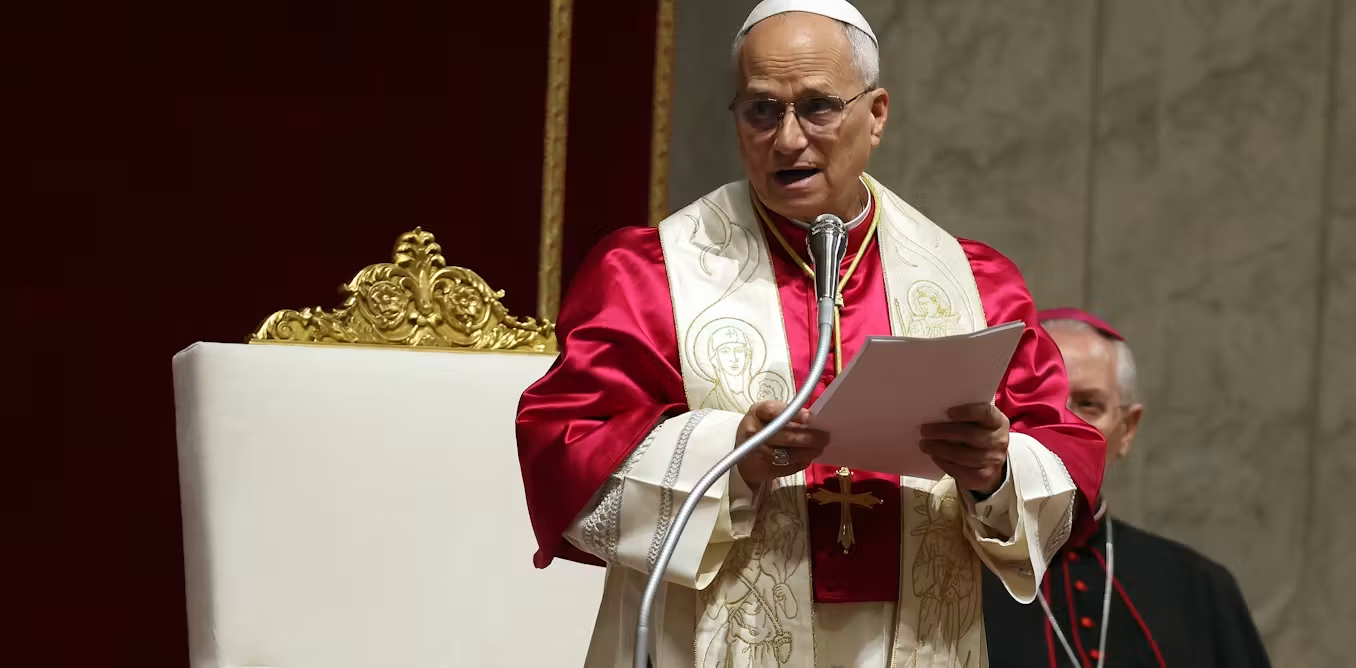
In May 2026, in his first encyclical Magnifica Humanitas, signed on the 135th anniversary of Pope Leo XIII’s Rerum Novarum, Pope Leo XIV warned the world about the dangers of the prospects of artificial intelligence (AI), categorically calling machine learning “a form of statistical adaptation based on data and feedback, which can be very effective, but does not imply internal growth.” In criticizing AI that replaces religious pluralism with a technological monolith, Pope Leo XIV addresses one of the most interesting dynamics of our modern societies: what role can religion play in a world in which technology seems to have its own spiritual project?
This “spiritual” AI is in many ways the Tower of Babel that the Pope fears. It has one specific future and a specific goal, and has adopted different names and ideologies, ranging from Peter Thiel’s doomsday scenario with the rise of the Antichrist to transhumanist and techno-optimistic visions in which society is materially satisfied and markets are free.
These ideologies have one thing in common that surprisingly links AI to some forms of organized religion: messianism.
To be clear, many other social projects have borrowed certain aspects of the same religious dimension to promote legitimacy and widespread acceptance, often with good intentions.
As Joseph Weiler has well noted, Robert Schumann’s project of a “Europe of many nations” was itself a messianic promise, a dream of a “European promised land.” The same can be said of American constitutionalism and its “constitutional faith,” as Levinson puts it, as well as the quasi-religious role of the Founding Fathers, the Constitution, or the Declaration of Independence.
Political messianism has the potential to unite people around a specific goal, focusing our attention more on the end goal rather than on the path, especially when that path is fraught with danger and suffering. However, there seems to be something entirely new about AI messianism.
First, the entire general AI project is itself ultimately a project to achieve human intelligence. Unlike other technological advances of the past, such as the harvesting of electricity or fire, AI, at its scientific core, seeks to replicate humanity and perhaps one day surpass it.
Tests like the famous Turing test were specifically designed to see how far a machine could go in convincing people that it was one of them. Leonardo da Vinci had difficulty discovering how such an imitation game could cause a negative reaction in the people themselves, namely when he (allegedly) presented humanity’s first “robot” to the Sforza court, much to the horror and surprise of the guests. It’s not so different from the almost instinctual reaction we get today when we gasp at Claude writing a poem or Python code.
Secondly, technology produces a special Messiah. There is a concept in AI research that was once confined to science fiction books and is now making its way into everyday news. The concept of artificial general intelligence or AGI, or even superintelligence, is ultimately Kurzweil’s concept of the “singularity”, the moment when human intelligence is no longer the most capable on Earth. This AGI is the Messiah who will heal the Earth of all ills (as Google DeepMind CEO Demis Hassabis tells us over and over again). Following this Messiah then becomes our mission, our religious quest, no matter what the cost to the environment or to ourselves. When Andreessen says that “our enemy is the Precautionary Principle, which would have prevented virtually all progress since man first harnessed fire,” it is a call to action to move faster and further as far as possible to follow this principle. The Singularity is ultimately God, with AI as his Son and this new machine-controlled Earth as our Promised Land.
Now one might ask: isn’t it strange to present technology in this way? Who benefits from this messianic view of technology?
It is quite easy to understand the appeal of political messianism. It provides a guiding purpose, unites people and rallies the masses to fight for a common ideal or cause. He can also manipulate them into doing terrible things. People die for a country because they want to contribute to something lasting, larger than themselves, to achieve some end goal. But they also do it to follow the leader, often to destroy minorities. Likewise, religious messianism serves a purpose for believers: to guide behavior, to provide solace in a difficult life, by promising that one day in eternal life the future will be better than the present.
To some extent, the Catholic Church itself benefited greatly from this idea, as did early Christianity in its infancy by reaching out to the poor of the Roman Empire. It also led to great suffering when it justified atrocities in the name of God.
But technology really shouldn’t be touching this, especially when most tech optimists advocate the wonders of technological neutrality as a value of the project itself.
The answer may lie in the Pope’s recognition that “when it comes to decisions regarding economic flows and digital platforms, as well as the management of data and algorithms, we cannot allow a handful of actors to dictate these processes on their own.” In this case, we are talking about power and control, positions in which messianism can be used for the same political purposes of manipulation and exploitation (for example, you will not be replaced by AI, but by someone who uses AI). This in turn leads to further uncritical acceptance and continuous striving towards an unknown end. This monocultural race, in which we believe that the path is one and the final destination is determined, is precisely one of the known dangers of messianism.
In fact, this may be the ultimate hidden goal of AI messianism, which has long since strayed from its countercultural goals and now represents a monocultural technological ideology led by the US and China to which the rest of the world must bow or face oblivion.
Like any good old messianic project, it never tells the whole story. There are alternatives to this path—several, in fact—from alternative clouds to alternative social media solutions, from alternative large language models (LLMs) to alternative cybercommunities, each following their own path, sometimes agreeing, sometimes disagreeing, but never conforming to one single religious vision of how the world should be.
Perhaps today is a time to exercise some caution and take time for reflection and critical thinking.
AI is without a doubt a huge advancement that has the potential to transform civilization, but we cannot allow it to lead us down a cult-like path to our own destruction—not because it is taking over, but because we are destroying ourselves and our humanity in the process.
What is needed is what Michael Walzer has called the “art of separation” in liberalism: the preservation of technology as one sphere among many, rather than a totalizing sphere that colonizes politics, faith, and meaning itself.
Perhaps pluralism, rather than a single vision of technological progress, is the counter-theology we need today.

A weekly email in English featuring expert insights from scientists and researchers. It introduces the diversity of research taking place on the continent and examines some of the key issues facing European countries. Get the newsletter!