

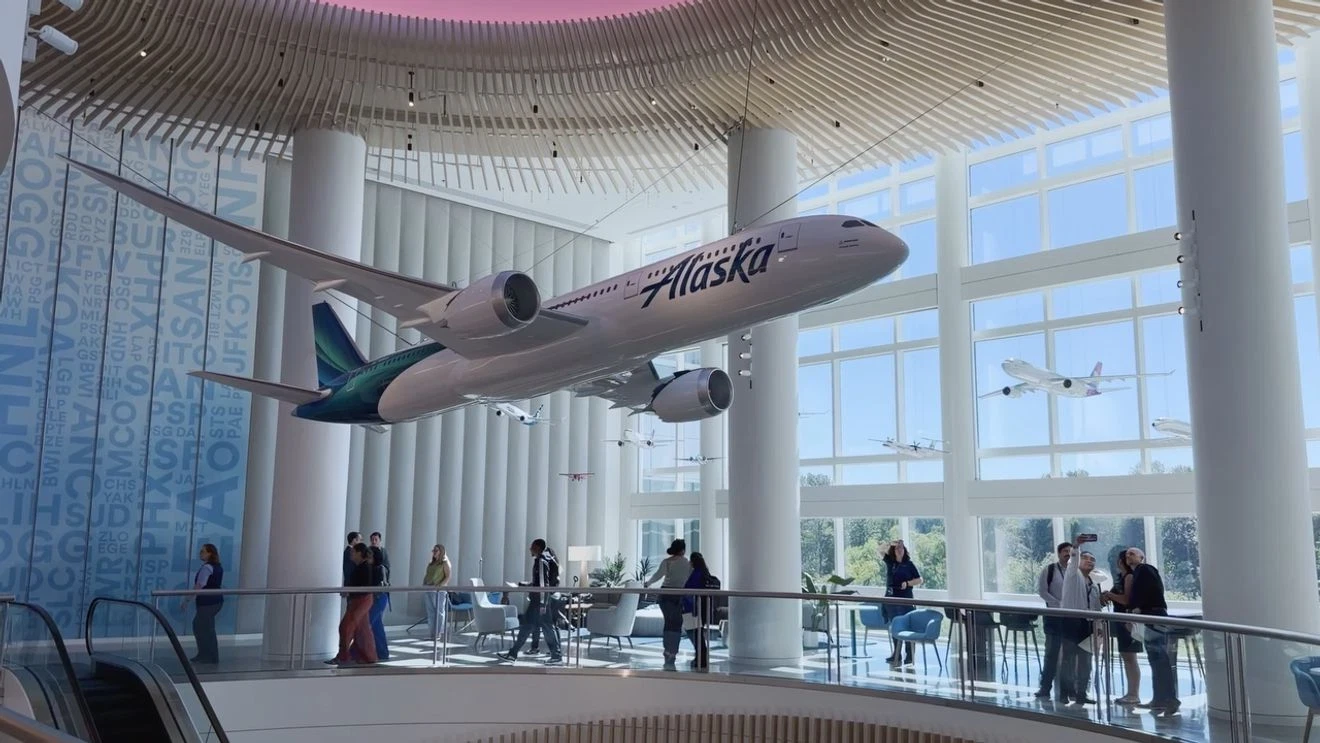
SEATTLE — Even Alaska Airlines’ chief operating officer could find himself at the company’s new Global Training Center.
“Let’s see how well I can navigate,” Jason Berry said as he walked down one of the long corridors of the huge Renton complex. A few moments later he laughed, realizing he had taken a wrong turn.
It’s easy to get lost in the building.
RELATED | Alaska Airlines COO talks global expansion, fuel prices, schedules and Boeing orders
The new Alaska training facility spans 670,000 square feet and includes classrooms, mock-up airport gates, check-in counters, emergency training rooms, flight simulators and uniform fitting areas. About 60,000 square feet remain undeveloped, leaving room for future expansion.
The airline said it has invested $200 million in the facility, which is intended to train employees of Alaska Airlines and Hawaiian Airlines, as the combined carrier plans ambitious expansion through 2030.
That growth plan includes new international routes, hundreds of additional employees and a larger facility that will require more workers to be trained before they set foot in an airport or on a plane.
For Berry, the building has already changed the way he works.
“Here in the office, I probably take 10,000 to 15,000 steps a day just running,” Berry said. “I don’t even write to anyone anymore. Most of my vice presidents are here. If I need something, I just get up, go and look for it.”
Inside the center, new employees begin their careers by earning their badges, meeting with instructors and learning about the airline’s safety culture. One wall depicts the history of Alaska accidents, serving as a reminder of the company’s past and the importance of safety.
Berry said the airline is using the story as a teaching tool rather than avoiding it.
Instead, he said, it reinforces the importance of preparation, training and following procedures.
Some of the most complex instruction takes place in full-fledged flight simulators, where pilots train in virtual cockpits that closely simulate real aircraft. The simulators can place crews at gates in Seattle or in complex flight scenarios involving turbulence, severe weather, runway traffic, missed approaches and other emergencies.
This technology requires significant investment.
Berry said individual simulators cost about $20 million, and some can cost as much as $30 million.
But the training center is for much more than just pilots.
Flight attendants start at the uniform fitting center, where each new crew member is fitted with a custom-made uniform.
“Every new flight attendant or pilot comes in and gets a custom uniform,” Berry said.
Flight attendants then move on to emergency training.
One room is dedicated to water evacuation exercises.
“This is a skating room,” Berry said. “They train here in case of landing on water.”
Berry said Alaska has about 9,000 flight attendants, all of whom must be trained on the safety equipment used throughout the airline’s fleet.
In another area there is a mock-up of the aircraft fuselage, where crews practice evacuation, decompression scenarios, on-board fires and other emergencies without even leaving the ground.
During the demonstration, instructors showed how the simulator can project emergency scenarios outside the cockpit windows, including an aircraft skidding off the runway. Inside, crews can respond to simulated fires in the baggage compartment, including those involving lithium-ion batteries, and practice emergency decompression procedures where oxygen masks are deployed throughout the cabin.
Training for new flight attendants lasts about six weeks, Berry said.
The global training center also includes simulated ticket counters and gates where employees practice customer service, boarding procedures and airport operations before interacting with passengers.
Berry said the goal is to train employees at every step of the journey, from the ticket counter to the lounge, from routine customer service to emergency emergencies.
The investment comes as Alaska Airlines continues to integrate Hawaiian Airlines and prepare to expand its international network. Company executives said the combined airline plans to expand both its global presence and its workforce, with the Renton training center being a key part of that strategy.
For Alaska, this facility is more than a corporate campus. It’s a training ground for the airline the company hopes to become. And inside a building so large that even its chief operating officer is still learning to navigate, Alaska is betting that its future growth will depend on the people training there today.