
Babson’s ‘Good Company, Good Game’ Course Turns Arthur Blank’s Values into Living Leadership Lessons
Eighteen Babson College students recently gathered in the Rullo Classroom at the Herring Entrepreneurial Leadership Village for a five-hour session that capped a transformative weeklong immersion in Atlanta. The course, Good Company, Good Game: Law, Ethics and Leadership in Sports Businesses, has just completed its fifth year under the direction of Associate Professor Leslie Garbarino, with support from the Arthur M. Blank School for Entrepreneurial Leadership and the Glavin Office of International Education.
What began as an academic exploration of sports business evolved into something deeper: a master class in how core values—when authentically lived—cascade from ownership through executive leadership to front-line associates, shaping culture and decisions across a multibillion-dollar family of businesses.
Six Core Values, One Owner’s Obsession
The framework comes directly from Arthur M. Blank ’63, H’98—co-founder of The Home Depot, owner of the Atlanta Falcons and Atlanta United, and founder of the Blank Family of Businesses. His six core values are unambiguous: Put People First, Listen and Respond, Include Everyone, Innovate Continuously, Lead by Example, and Give Back to Others.
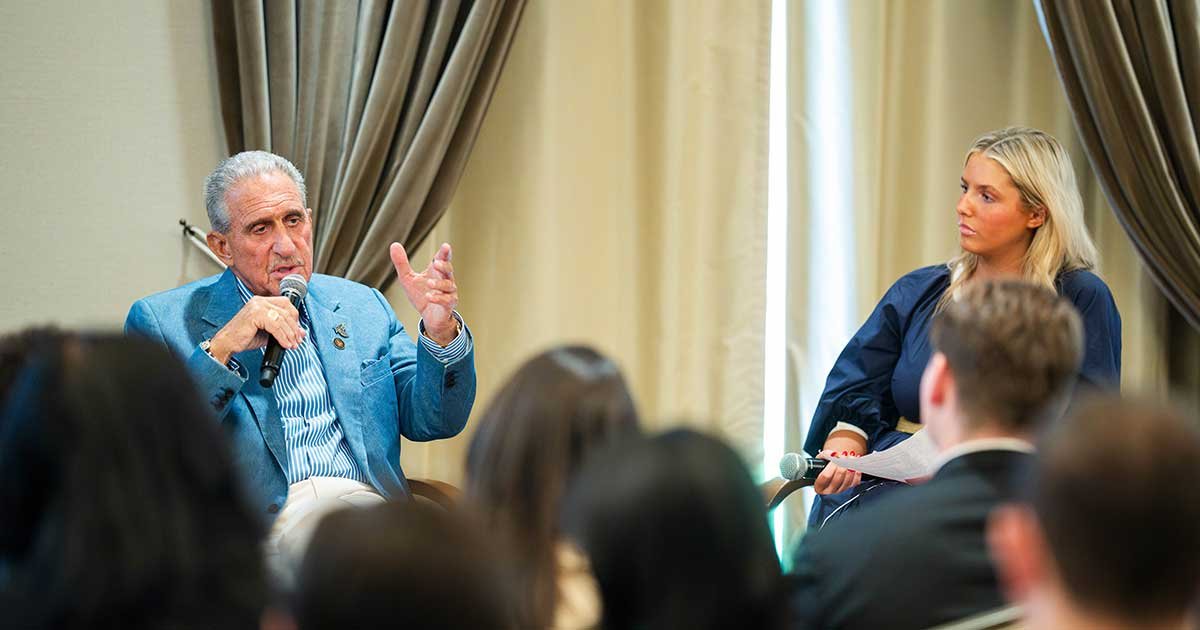
These aren’t lobby decorations. Brett Jewkes, executive vice president and chief brand and communications officer for the Blank Family of Businesses and AMB Sports and Entertainment, flew in specifically for the final class session—on roughly 70 minutes of sleep after a Thursday Night Football game in Green Bay.
“I am literally on fumes after flying in after the Thursday Night Football game. So, I’m on an hour and six minutes of sleep. But this is my favorite class, and I wouldn’t have missed this.”
Jewkes shared a revealing anecdote: on the private flight back from the Falcons-Packers game, Blank called him to the back of the plane. The question wasn’t about the game, operations, or revenue. “How do we re-enforce the core values?” Blank asked. As Jewkes told the students, “It wasn’t anything operational. Not about the football game. … Why does Arthur bleed so passionately about this? Because the world needs it.”
Atlanta Immersion: Where Values Meet Operations
The course’s signature component is a weeklong Atlanta visit where students witness the values “leap off the walls and into real-life moments” at PGA Superstore, Mercedes-Benz Stadium, and Atlanta’s Westside community—where Blank’s philanthropic and development efforts converge.
For Charlotte Li ’27, the trip meant moderating multiple panels, stretching beyond her comfort zone. “This trip has shown me the possibilities in sports,” she said during the final debrief. “And it has shown me what I want to do. I still can feel really lost in what I want to be. But like I said in the video, values only matter if you live by them.”
Dalton Fitzpatrick ’27 entered the course with no sports background and left with a newfound appreciation for baseball—and for how philanthropy and purpose drive the organization. “People are passionate about different things and goals,” he reflected. “They were so philanthropic and wanting to give so much back. It was really inspiring to me.”
Student Transformations: From Observers to Practitioners
The final presentations revealed how deeply the experience resonated. Eric Hense ’28 captured the central revelation in his video: “I assumed we would be talking about the business. I found out that core values come first. They are not just words on a wall. The associates live by them. And I saw them play out in real moments.”
Nicolas Pacheco ’28 framed the privilege of the experience itself: “This is something you get to do, not something that you have to do. In the middle of this experience, it hit me that I was super blessed that I get to do this.”
These reflections weren’t performative. Throughout the Atlanta week, Garbarino required daily debriefs built around a single question: “How did you live the values today?”
The Ripple Effect: A Framework for Paying It Forward
Garbarino visualized the course’s theory of change through three concentric circles. At the center: Arthur M. Blank Sports + Entertainment. The first ripple: Self in Context. The outer ripple: Values in Action.
“There are a small number of students who have had this experience. It’s our obligation to pay it forward, and it’s why this ripples out.”
The model positions the Atlanta immersion not as a culmination but as a catalyst. Students who internalize the values during the course are expected to carry them into internships, careers, and communities—extending the ripple far beyond the Rullo Classroom.
Why This Model Matters Now
At a moment when corporate values statements often ring hollow, the Blank Family of Businesses offers a rare case study in alignment. The consistency between Blank’s private plane conversation, Jewkes’ 70-minute-sleep commitment to a student class, and the daily behaviors students observed at PGA Superstore and Mercedes-Benz Stadium suggests a culture where values function as an operating system—not a marketing tactic.
For business education, the course demonstrates that experiential learning anchored in authentic leadership can accomplish what case studies alone cannot: make values visceral, memorable, and actionable.
The 18 students who completed the fifth cohort now join a growing alumni network charged with a simple mandate: live the values, and let the ripple continue.
Business, Education, Entrepreneurship, Leadership, Sports Business, Babson College, Arthur M. Blank, Values-Based Leadership, Experiential Learning, Atlanta, Georgia

