

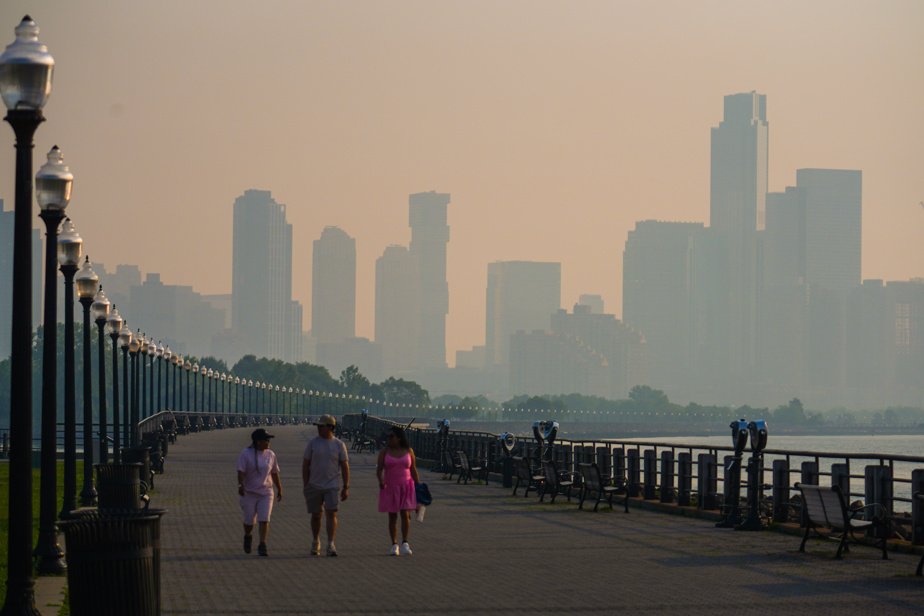
(New York and Washington) Donald Trump on Friday attacked Canada over severe air pollution in the northeastern United States caused by wildfires burning in its neighbor.
Posted at 12:08 pm.
Updated at 4:41 p.m.
“We hold Canada accountable for not properly maintaining its forests (…) while the United States finds itself subject to an unjustified intrusion of dirty, polluted and hazardous air (…) that is completely unacceptable!” the American president attacked on his Truth Social platform.
“I will call the prime minister today to find out what they (the Canadians) are planning to do,” he added.
In his message, Donald Trump also threatens Canada with higher tariffs to cover “the cost of this pollution.”
Smoke from wildfires in Ontario has plunged several American cities, from Chicago to Washington through New York, into a thick shroud of pollution. It is in the suburbs of the metropolis that the World Cup final between Spain and Argentina is scheduled for Sunday afternoon.
According to the latest data from local authorities, the situation in Canada continues to deteriorate: across the country, out of 897 active fires, 207 are out of control.
Map of forest fires in Canada
Smoke from wildfires in Canada plunged several American cities into a thick haze of pollution on Friday, raising concerns ahead of this weekend’s World Cup finals near New York.
Fear of the final
Organizers are “closely monitoring” developments, Andrew Giuliani, who heads the White House team responsible for organizing the World Cup, said at a press briefing.
“There have been discussions about this, we have someone from the national meteorological services with FIFA,” he added.
In New Jersey, where the final between Spain and Argentina will be played at an outdoor stadium on Sunday, air quality was still considered “unhealthy” on Friday morning. However, it was a slight improvement from Thursday, when Manhattan’s skyscrapers were barely visible from some areas.
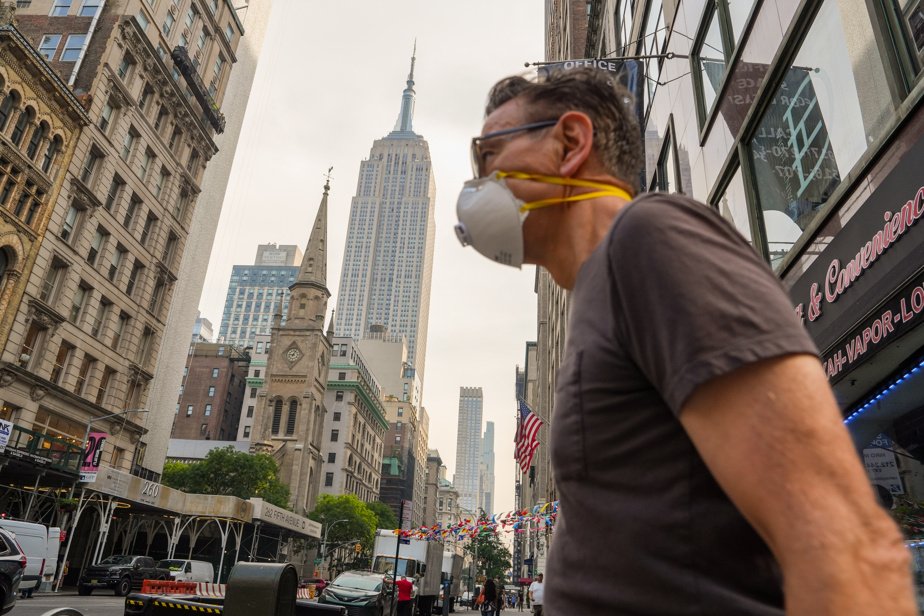
PHOTO BY RYAN MURPHY, ASSOCIATED PRESS.
A masked man walks past the Empire State Building in New York on July 17, 2026.
Since Thursday, the official safety app for supporters has been posting warnings about the fumes, urging them to stay home or wear a mask.
“We can’t see the horizon”
The National Weather Service (NWS) warns that “smoke may thicken again overnight and into Saturday morning,” but the forecast at this point does not expect conditions to worsen on Sunday.
Shrouded in yellowish fog, Detroit and Chicago have air quality readings classified as “hazardous.” According to the specialized website IQAir, on Friday they were among the most polluted cities in the world.
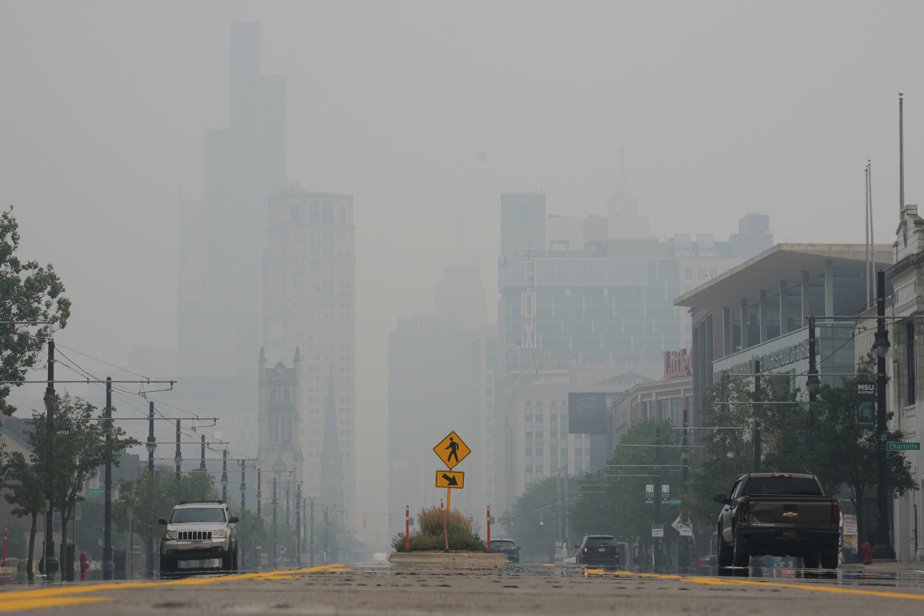
PHOTO BY PAUL SANCIA, ASSOCIAID PRESS ARCHIVES
View of Detroit, July 16, 2026
Winds blowing south also carried smoke into the capital Washington, where air quality is considered “very unhealthy.” At this level, authorities recommend that the entire population avoid all non-essential outdoor activities and that some passersby wear masks.
Rain expected this weekend will help disperse the thicker smoke, said Mark Parrington, a scientist at the European Copernicus Atmospheric Monitoring Service. “But what happens next will depend on the development of the fires and their intensity,” he told AFP.
The question for Sunday’s finale will be whether more smoke will come out of Canada after this rain, confirms Joel Driessen, air quality forecaster for Maryland. “Some models are starting to show that smoke levels will start to drop,” he adds.
Climate change connection
As smoke blankets large swathes of Canada and the United States, experts and environmentalists are highlighting the connection between increased wildfire-related pollution incidents and climate change.
“The increasingly smoky skies underscore the need for a rapid transition to clean energy rather than building new fossil fuel infrastructure that further exacerbates climate change,” said Paul Mathewson, director of science programs for Clean Wisconsin.
According to the scientist, climate change favors the lengthening of the fire season due to increased temperatures and decreased soil moisture.