
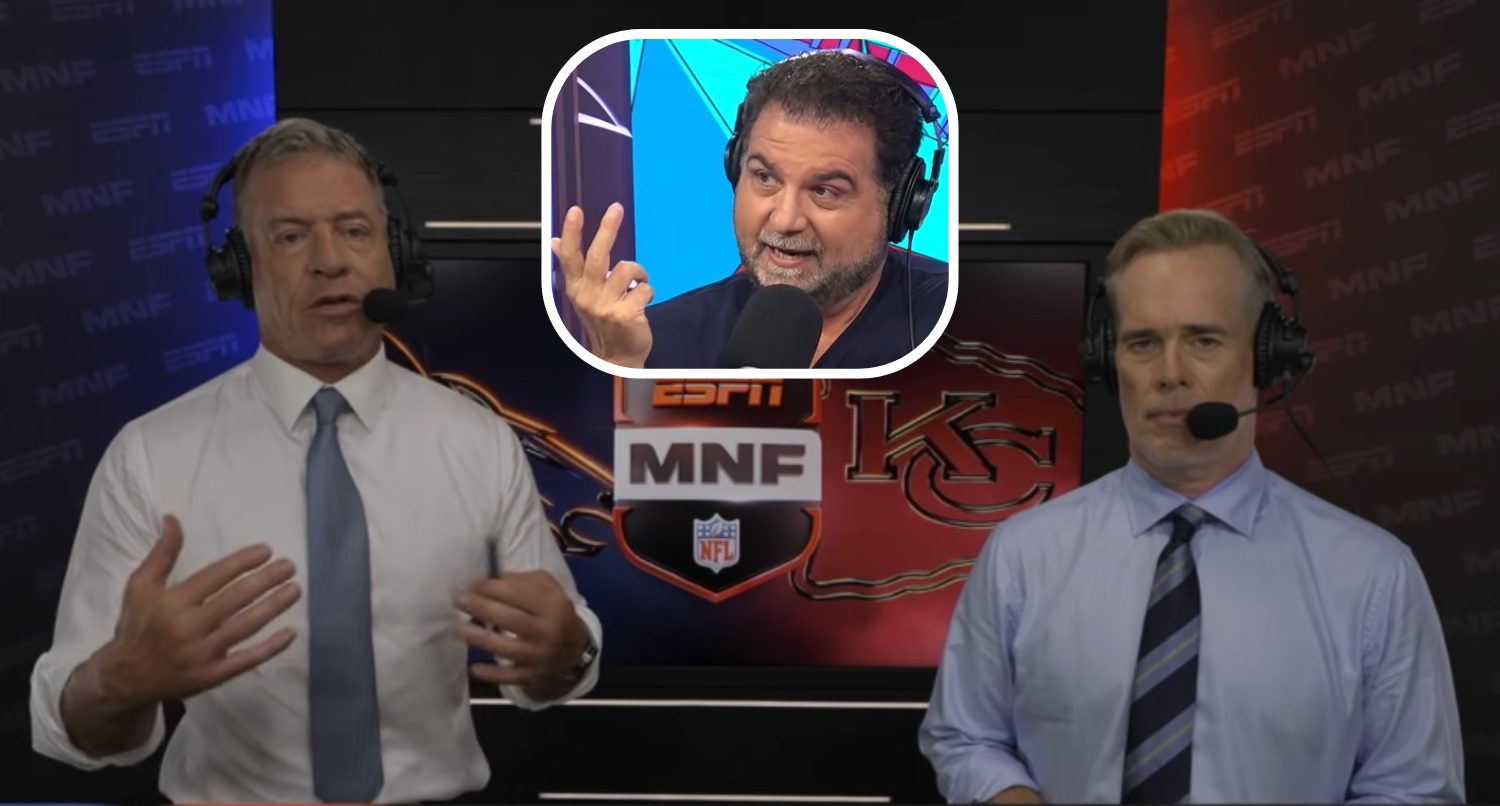
Troy Aikman’s Broadcasting Overhaul: The Superlative Storm on Monday Night Football
When ESPN’s Troy Aikman and Joe Buck called a recent Monday Night Football matchup between the Kansas City Chiefs and Denver Broncos, the broadcast quickly became the talk of the sports world — not for its game call, but for Aikman’s relentless string of praise for the Broncos. As the network’s incoming Super Bowl voice pair sought to establish dominance in the AFC West narrative, one of its own analysts appeared to lose all objectivity, drawing sharp rebuke from veteran sportscaster Dan Le Batard.
The incident raises a larger question about the role of NFL analysts: Should they sell the story of a game, or should they tell it honestly? The answer matters now more than ever, as ESPN positions itself for its biggest annual broadcasting event.
The Monday Night Football Broadcast That Broke the Internet
The Week 1 Monday Night Football fixture in Kansas City was expected to signal a shift in the AFC West hierarchy. With Patrick Mahomes back under center and the addition of Kenneth Walker, the Chiefs were poised to reassert their authority over the division. For Buck and Aikman, the game represented an important proving ground as they sharpened their partnership ahead of what promises to be a landmark Super Bowl broadcast for ESPN.
While the final score rendered much of the pregame storylines moot — the game ended in a blowout — the broadcast itself generated a far more enduring controversy. It was not the touchdowns or turnovers that dominated the conversation. It was the sheer volume of superlatives flowing from Aikman’s mouth, directed squarely at the losing side.
Le Batard, during an episode of The Dan Le Batard Show, walked listeners through a breathtaking list of Aikman’s first-half commentary. In the first quarter alone, the ESPN analyst declared that:
“The Denver roster is as deep as any in football.”
“Reid understands as much as anyone in football that they’ve gotta run the football.”
“Pat Bryant had as good a camp as anyone in football.”
“Denver has as deep a wide receiver room as anyone in football.”
“Denver has as good a secondary as there is in all of football.”
“Trent McDuffie is as good as anyone in all of football.”
And according to Le Batard, that was just the opening quarter.
The second quarter brought an escalation. Aikman reportedly added that Denver was “as good as any defense in football,” praised Kenneth Walker‘s patience, lauded Riley Moss, complimented Denver’s offensive line, and even took time to extol Vance Joseph as a defensive coordinator and Sean Payton as a play-caller — all while the Broncos were being thoroughly beaten on the field.
Aikman vs. Collinsworth: A Tale of Two Broadcasting Philosophies
The reaction to Aikman’s commentary was compounded by the uncomfortable comparison that inevitably followed. Le Batard himself acknowledged that hearing Aikman heap unlimited praise on every player and coach on the field sounded strikingly like Cris Collinsworth, NBC’s perennially effusive analyst.
Collinsworth has long been recognized for his well-established tendency to celebrate virtually every aspect of both teams he calls. His warmth and generosity of praise have become signature elements of his style — and, for better or worse, his brand.
Aikman, however, built a very different reputation during his long tenure at Fox. The former Dallas Cowboys quarterback was widely known for his bluntness and critical eye. His move to ESPN marked a noticeable shift in tone. During previous seasons on Monday Night Football, Aikman frequently criticized referee decisions and voiced frustration over what he saw as unfavorable matchups. He became a figure fans loved to hate — not because he was wrong, but because he refused to soften his assessments.
That persona now appears to be under serious revision. Whether this softer approach is a genuine evolution or a calculated pivot to fit ESPN’s broader broadcast strategy ahead of the Super Bowl remains an open question — and one that critics are not shy about raising.
The Superlative Problem: When Every Player Is the Best
The core issue with Aikman’s broadcast style is not simply that he praised the Broncos — analysts will always find positives in a game involving two quality AFC teams. The problem is the death of distinction. When every defensive back is “as good as anyone in football,” when every camp is “as good as anyone in football,” and when every coach is “as good a play-caller as there is in all of football,” the language loses all meaning.
An analyst’s fundamental job is to explain a game and tell its story. That becomes nearly impossible when every trend on the field is described using the same ceiling-level superlatives. There is no hierarchy of skill, no meaningful contrast, no narrative tension — just an endless parade of excellence that flatters everyone and illuminates nothing.
It is worth noting that Le Batard himself was startled by what he was hearing. He admitted to listening passively, doubting his own ears, and writing down Aikman’s comments because he could not believe what he was absorbing. If a lifelong sports journalist found the commentary extraordinary, casual viewers may not have recognized the pattern at all — which raises the question of whether the issue even matters in the short term.
But over the span of an entire season, and especially during the most important broadcast of the year, the accumulation of hollow praise erodes the credibility of both the analyst and the network. Viewers who sense that nothing is being criticized begin to tune out. Those who value insight over flattery seek alternatives. And an analyst’s reputation, once built on candor, can shift overnight toward the very caricature he once rejected.
What This Means for ESPN’s Super Bowl Future
Buck and Aikman’s partnership at ESPN is under greater scrutiny than typical MNF pairings because of the stakes involved. The network is preparing to call the Super Bowl, and the credibility of its lead voices will be measured against the highest bar in sports broadcasting. If Aikman’s tendency toward universal praise continues into postseason coverage, it could undermine the very authority ESPN needs its analysts to project.
Great broadcasting analysis demands a willingness to assign credit where it is truly earned and to withhold it where it is not. Collinsworth’s longevity in the business proves that warmth can coexist with insight, but Aikman’s earlier career proved that sharp criticism can build a devoted audience. The challenge for ESPN is to allow its analysts to find a balanced voice — one that sells the excitement of NFL football without reducing every player, coach, and scheme to the finest in the league.
The Chiefs-Broncos broadcast may ultimately be remembered as a footnote in the larger arc of a network’s transition period. But for now, it serves as a vivid reminder: when everyone is the best, no one is.
Conclusion: Finding the Line Between Selling the Game and Selling Out
Troy Aikman’s recent Monday Night Football performance invites an essential conversation about what sports analysis should accomplish. The line between enthusiastically telling a game’s story and hollowly inflating every moment with superlatives is thin — and when crossed, it cheapens the product for everyone involved.
Aikman has the résumé, the credibility, and the sharp instincts that made him a fan favorite for years. Whether he can recalibrate his approach before the biggest broadcast of his career will determine whether this episode is a passing quirk or the beginning of a troubling trend. For fans of honest football analysis, the hope is simple: let the best teams win the praise, and let the rest speak for themselves.
Sports, Entertainment, News, People, Online, NFL, ESPN, Broadcasting, Sports Media, Monday Night Football, Super Bowl, Kansas City Chiefs, Denver Broncos, Troy Aikman, Dan Le Batard, Joe Buck, Patrick Mahomes, Kenneth Walker, Cris Collinsworth, AFC West, Andy Reid, Vance Joseph, Sean Payton

