
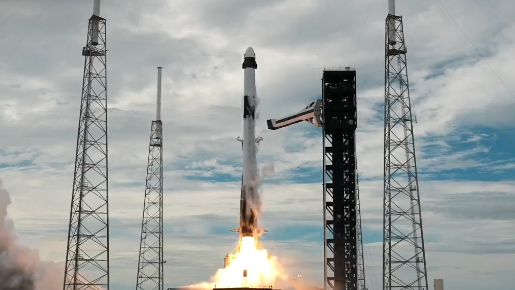
Crew-13 Successfully Launches from Kennedy Space Center on Mission to International Space Station
On Thursday morning, four astronauts lifted off from Florida’s Space Coast aboard a SpaceX Falcon 9 rocket, beginning Crew-13’s journey to the International Space Station (ISS). The launch took place at Kennedy Space Center’s Launch Complex 39A at 11:10 a.m. EDT, after a brief weather‑related hold that had raised concerns earlier in the day. The mission marks another routine crew rotation under NASA’s Commercial Crew Program, continuing the steady stream of international collaboration that keeps the orbiting laboratory staffed and productive.
About the Crew
The crew consists of two NASA astronauts, Commander Jessica Watkins and Pilot Luke Delaney, along with Joshua Kutryk of the Canadian Space Agency and Roscosmos cosmonaut Sergey Teteryatnikov, who serve as mission specialists. Watkins, a geologist, brings expertise in planetary science, while Delaney, a former test pilot, grew up in DeBary, Florida, and graduated from Deltona High School in 1997. Kutryk contributes experience from CSA’s astronaut corps, and Teteryatnikov adds Roscosmos’ long‑duration flight background.
Deltona High School’s Watch Party
Delaney’s alma mater organized a watch party for students, faculty, and community members to view the launch live. The event highlighted local pride in the astronaut’s achievement and offered an educational opportunity to discuss the goals of the Crew‑13 mission and the broader Artemis program.
About the Mission
Crew‑13 is tasked with supporting Expedition 75 aboard the ISS. The crew will perform station maintenance, assist with ongoing scientific research, and participate in technology demonstrations aimed at informing future deep‑space exploration. NASA notes that the mission helps prepare humans for eventual trips to the Moon and Mars by testing systems and procedures in a microgravity environment.
Research Focused on Longer Missions
Once docked, the astronauts will join the Expedition 75 team in a suite of investigations designed to understand how the human body adapts to extended periods in weightlessness. Key studies include:
- Venous Haemostasis – a NASA‑ESA collaboration examining blood flow, clotting, and circulation risks in microgravity.
- Manual Piloting – evaluating astronauts’ ability to perform lunar‑landing‑type simulations after months in orbit and assessing the benefit of refresher training.
- B‑Complex – testing whether a daily B‑vitamin supplement can mitigate spaceflight‑associated neuro‑ocular syndrome that can affect vision.
- Standard Measures – collecting consistent physiological and behavioral data to build baselines for future research.
- Spacecraft Occupant Risk – measuring forces during re‑entry and landing to improve spacecraft safety.
- Zero T2 – comparing health outcomes of crew members who use the station’s treadmill versus those who do not, to shape exercise protocols for future spacecraft with limited space.
Watkins emphasized the ISS’s value as an Earth‑observation platform, noting that data gathered aloft can inform lunar geology studies. Delaney added that contributing blood samples and other biomedical data, while not his favorite task, is essential for characterizing individual physiological responses to spaceflight.
Watching from Kennedy Space Center
Kennedy Space Center invited the public to view the launch from its visitor complex, offering live commentary from space experts, bleacher seating, and access to exhibits. The agency’s website listed additional details for those wishing to follow the event in person or online.
Mission Forecast
NASA’s mission forecast indicates that Crew‑13 will remain aboard the ISS for approximately six months, during which time the crew will support station operations, conduct the aforementioned experiments, and prepare for the arrival of the next crew rotation. The forecast also notes standard contingency plans for weather‑related launch delays and abort scenarios, though none were needed for this launch.
Related
For readers interested in further coverage, recent articles discuss the Crew‑12 mission that preceded this flight, updates on Artemis lunar exploration plans, and ongoing commercial crew activities involving SpaceX and Boeing spacecraft. Additional context on the International Space Station’s research portfolio and upcoming technology demonstrations can be found in NASA’s mission‑status reports.
Science, News, Space, Transportation, Technology, Education, Government, Health

