
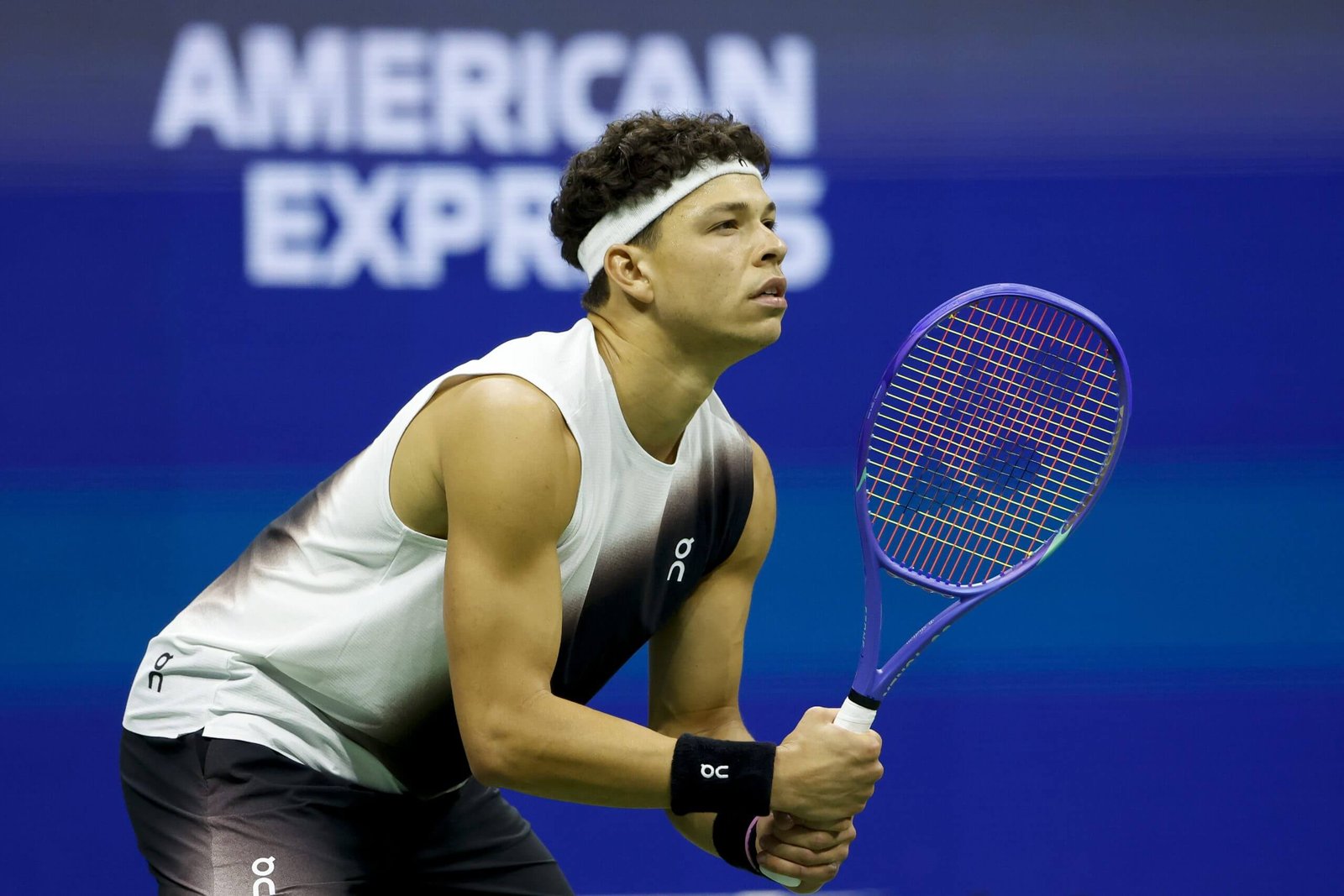
Ben Shelton Reaches First Grand Slam Final Against Alexander Zverev at 2026 U.S. Open
Ben Shelton has arrived at the biggest stage in men’s tennis. The 23-year-old American is into his first Grand Slam final at the 2026 U.S. Open, where he will face Alexander Zverev in a highly anticipated showdown at Arthur Ashe Stadium. Shelton’s road to New York included a stunning five-set quarterfinal victory over Carlos Alcaraz and a composed performance against fellow American Frances Tiafoe in the semifinals.
But the journey to this moment was anything but straightforward. Just months ago, Shelton was questioning whether his raw talent would ever be enough to compete with the sport’s elite. A painful early exit at Wimbledon became the catalyst for a transformation — both mentally and tactically — that has carried him to a major final for the first time in his career.
The Wimbledon Wake-Up Call
Shelton’s 2026 season had been a tale of two halves. On one hand, he captured four titles — the most in a single season of his young career — including successful runs on the ATP Tour. On the other, Grand Slam success continued to elude him. A second-round loss at the French Open to Raphaël Collignon was troubling enough, but it was what happened at Wimbledon that truly shook him.
Facing Finland’s Otto Virtanen, ranked No. 140 in the world, Shelton held a commanding lead in the fifth-set tiebreak. At 8-5, he looked up at the scoreboard and was struck by a single, undiplomatic thought: the quality of the moment was not lost on him. He had already let a two-sets-to-one advantage slip away. A standard seven-point tiebreak would have sent him through, but this was a 10-point version, and the extra room Virtanen had was all that separated them.
Shelton won just one more point. Virtanen took the tiebreak 11-9.
“I was a little bit shocked because, to be honest. When I look back at the match, I didn’t feel that there were many other first-round matches at Slams in the last two years where I’ve played much better,” Shelton said in a summer interview following the defeat.
The loss stung for another reason: Shelton, the No. 4 seed at the All England Club, had not lost a first-round match at a Grand Slam in three years. This time, the writing was on the wall — and he knew it.
Self-Awareness and the Search for Improvement
In the weeks that followed Wimbledon, Shelton did something that separates good players from great ones: he studied himself. Retreating home to Florida from London earlier than expected, he dove into training and began mapping the patterns of his Grand Slam struggles. Three critical vulnerabilities emerged: mental lapses under pressure, sub-par returning, and poor point construction on break points in his favor.
The 23-year-old has always been honest about where he stands. His father, Bryan Shelton, a former ATP Tour player who serves as his son’s coach, instilled in him a long-term perspective from the start.
“I think I’m still a raw talent,” Shelton said. “I don’t feel I’m really as refined as any of the guys in the top 10, and I feel like I have a lot of tools that are coming along, but not quite there yet.”
That self-awareness became the foundation for change. At Wimbledon, Shelton realized he had begun taking early-round opponents for granted — a dangerous mindset at any tournament, but a costly one at the majors. Players ranked well below him were pushing him around in half the games of each set, and he lacked the tactical frameworks to counter them consistently.
The Canadian Open in Montreal in August served as proof that the work was paying off. Shelton dominated a historically young field, not dropping a single set on his way to defending his title. On the slow hard courts of northern Canada, his big serve and heavy forehand operated at full capacity, and he controlled matches from start to finish.
“It’s weird, I think that match did help me a lot. I’m in a way better mental space now with my identity because of that loss,” Shelton said. “When I’m confident and feeling myself, I do a better job of taking it to guys.”
Surviving the Shapovalov Test
Shelton’s fourth-round match against fellow lefty Denis Shapovalov was a rigorous examination. The match started on Friday and ran past 2 a.m. Saturday at Arthur Ashe Stadium — delayed significantly by the Serena and Venus Williams doubles match, which lasted three hours. By the time the singles action began, both players were somewhat unprepared, and early errors were plentiful.
Shelton displayed many of his familiar vulnerabilities: flubbed leads, missed break points, and a general sense of uncertainty in the opening sets. The first two sets were decided by tiebreaks — 7-6(3), 6-7(5) — with each player swapping momentum. It wasn’t until the third set that Shelton began playing with the aggression and shot-making that defines his best tennis. He closed out the match 6-3, 6-4.
It was a rickety win, but a win all the same. More importantly, it sent Shelton into the last 16 at the U.S. Open for the first time since 2023, when he reached the semifinals. And unlike his earlier rounds, the subsequent matches against Tiafoe and Alcaraz showcased a player who was locked in — his backhand holding up, his ability to extend rallies improving markedly.
While the Shapovalov match did not represent growth so much as survival, it proved that Shelton could grind through adversity. That quality would be essential for what lay ahead.
Navigating a Dangerous Path to the Final
Shelton’s route through the second week of the 2026 U.S. Open tested every facet of his game. In the round of 16, he faced Tsitsipas, and then in the quarterfinals, the red-hot Carlos Alcaraz was waiting. The Spaniard, even while managing a wrist injury and returning from a long absence, represented a nightmare matchup on paper — and an even more difficult one in practice.
It was not Alcaraz’s world-beating talent that caused Shelton the most trouble. It was the Spaniard’s ability to be solid and aggressive for hours under pressure — precisely the kind of opponent that exposes a player who has not yet fully refined his game.
Shelton conquered that challenge in five sets, producing one of the biggest wins of his career. The semifinal against Tiafoe — a peer and friend — was more straightforward, a matter of disciplined execution rather than raw firepower.
Earlier in the year, between the Australian Open quarterfinal in January and the Wimbledon disappointment in June, Shelton had won two ATP 500 titles and a 250-level event in Stuttgart. But at four ATP Masters 1000 events during that stretch, the furthest he reached was the third round at Indian Wells. The gap between his success at smaller tournaments and his results at the sport’s biggest stages had become impossible to ignore.
That gap is now narrower than ever.
Facing Alexander Zverev in the Final
The U.S. Open men’s final will pit Shelton against Alexander Zverev, one of the most complete players on the ATP Tour. Zverev brings elite serving, a powerful baseline game, and major final experience — including previous appearances in championship matches at the highest level. For Shelton, it is an opportunity to test himself against a player who represents exactly the kind of refined, top-tier competition he has identified as his benchmark.
The timing could not be more significant. Shelton knows he can no longer rely on raw talent and hard work alone. The Wimbledon loss to Virtanen may have been the turning point for his 2026 season. Now, the U.S. Open final offers the chance to be a turning point for his career — the moment where self-awareness meets execution on sport’s biggest stage.
For a player who once described himself as unfinished, Shelton has built something worth finishing. Whether the final proves to be the next step or a valuable lesson remains to be seen, but one thing is certain: Ben Shelton is no longer just a prospect. He is a Grand Slam finalist.

Shelton’s returning is what could propel him to the next level of tennis. (Jean Catuffe / DPPI via Sipa)
What the Final Means for Shelton’s Legacy
At 23, Shelton stands at a crossroads that every young talent eventually faces. He has the games — four titles in 2026, a dominant run at the Canadian Open, and wins over top-tier opponents — to believe he belongs among the sport’s premier players. But he also knows that the innate gifts which propelled him to stardom will likely not be enough on their own.
The coming final against Zverev will be the truest test yet of where Shelton’s evolution stands. Can his improved mental framework hold under the pressure of a championship match? Has his returning and point construction progressed enough to handle a world-class opponent who will not give him free points? And can he convert his potential into a title — or does this final serve as confirmation that he is one step away, rather than one step past?
Whatever the outcome, Shelton’s 2026 U.S. Open run has already rewritten the narrative. He came into the tournament with question marks about his ability to win big. He will leave New York with a clearer answer.
Sports, Tennis, US Open, Ben Shelton, Alexander Zverev, Grand Slam, ATP Tour, Carlos Alcaraz, Frances Tiafoe, Denis Shapovalov, Canadian Open, Wimbledon, ATP Masters 1000, Florida, New York, Ashe Stadium, Positive

