

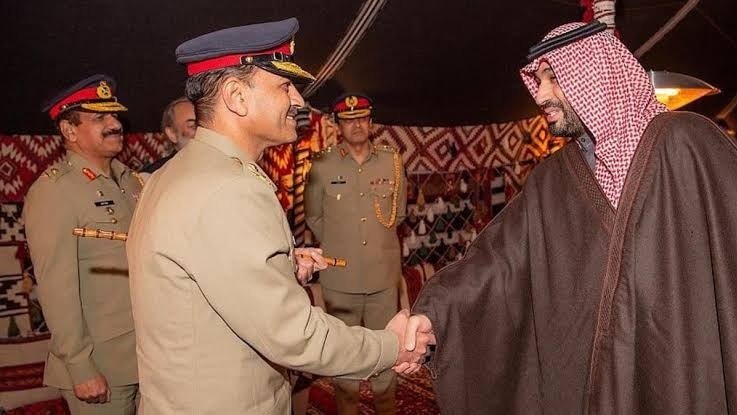
Pakistan’s hands and feet are trembling due to tensions between Saudi Arabia and the Houthis. Because Pakistan feels that if the war between Saudi Arabia and the Houthi militants intensifies, then it will be forced to join the fight. Now Pakistan is threatening Iran and saying that an attack on Saudi Arabia will be considered an attack on Pakistan and this will be Pakistan’s red line. This means that after this Pakistan will also fight on the side of Saudi Arabia. Note that this is the same Pakistan that a few months ago became the arbiter mediating the war between Iran and Pakistan.
read more
Last year, Pakistan signed a mutual defense agreement with Saudi Arabia. Along with thousands of Pakistani soldiers, a squadron of fighter jets is also stationed there. Pakistani soldiers are stationed on the Saudi Arabian border with Yemen. If the Houthi rebels attack Saudi Arabia, Pakistani soldiers will suffer.
Houthi rebels follow Iran’s orders. Therefore, if there are more attacks on Saudi Arabia by the Houthi rebels, then Pakistan will also have to enter this fight from the Saudi side.
Pakistan expressed anger over Iran’s attacks on Saudi Arabia earlier this year, but regional analysts and officials say this week’s attacks have further fueled Pakistan’s anger toward Iran as they raised the possibility of a new outbreak of conflict between Saudi Arabia and the Houthis.
Read also: Missiles and drones deployed at the mouth of Bab al-Mandeb, the Houthis are waiting for an attack order from Iran!
Houthi rebels fired rockets at Saudi Arabia on Monday. He claimed that Saudi Arabia blew up an airport under their control. This cross-border attack broke a four-year ceasefire, but so far it has been limited to one incident.
A Pakistani official told Reuters: “Our top civilian and military leaders have conveyed to Iran at the highest levels that an attack on Saudi Arabia means an attack on Pakistan. This is our “red line”.
Pakistani security analyst Muhammad Aamir Rana said: “Pakistan did not expect tensions to rise so suddenly.”
Pakistan’s frustration stems from growing concern that if the Houthis escalate their attacks on Saudi Arabia, they will be forced to enter the war. Two Pakistani officials said Pakistani soldiers are stationed near Saudi Arabia’s border with Yemen, raising the risk that they will be directly affected by the conflict.
Islamabad is also concerned that rising tensions over the Houthi group could disrupt shipping in the Red Sea. Iran has asked its Houthi proxies to close the Red Sea. If the Red Sea is closed, it could harm Saudi Arabia’s interests. In such a situation, if Saudi Arabia responds, the Houthis will also respond. Pakistan may then be forced to intervene militarily under the terms of their mutual defense agreement.
Retired Pakistani General Ghulam Mustafa said that “Pakistan’s senior leadership is currently trying to convince all parties.” However, he warned that the situation could change “if the Houthi group expands the scale of its attacks in Saudi Arabia.”
Another Pakistani source familiar with the mediation said: “Ending the war is in everyone’s interest. But if Saudi Arabia calls us, we will support them, there is no doubt about that.”
Two Pakistani government officials said there was a split in Iran’s leadership. Pakistani officials said Iranian political leaders, including President Massoud Pezheshkian, Foreign Minister Abbas Araghchi and Parliament Speaker Mohammad Baker Ghalibaf. Their ideas and goals are very different from those of the Islamic Revolutionary Guard Corps (IRGC).
Pakistani military analyst Muhammad Ali said: “The military appears to dominate the decision-making process in Iran.”
—- End —-