

Keys to the Origin of Life
High concentrations of salt in salty liquids could potentially create molecules critical to life on Earth. Brines allow phosphates to remain in solution and can catalyze chemical reactions between organics and precipitate minerals.
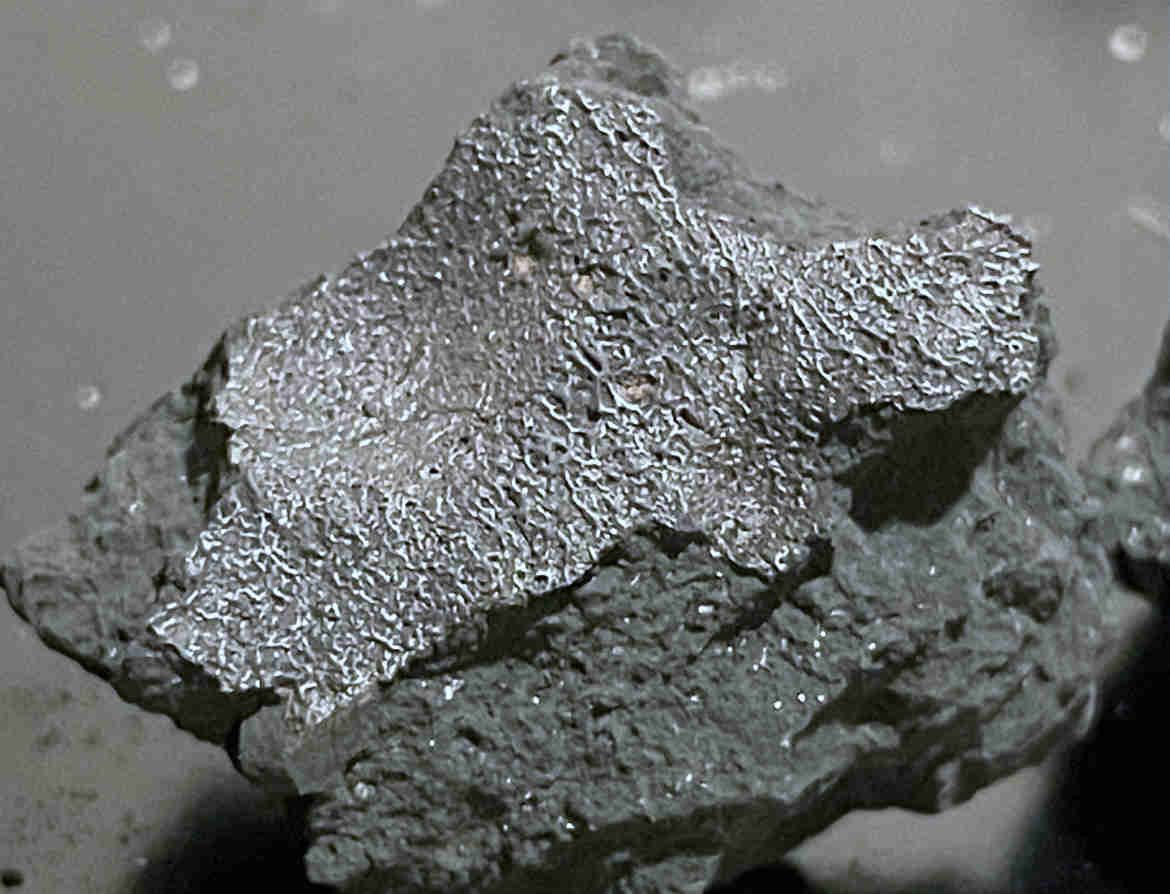
“Carbon and nitrogen isotope studies suggest that primitive carbonaceous chondrites, including CM types, delivered organic matter to the early Earth,” said cosmochemist Queenie Chan of Royal Holloway University in London, England, and biogeochemist Nana Ogawa of the Biogeochemistry Research Center of the Japan Agency for Marine Geoscience and Technology. “The Hillsboro meteorite contained 1.8% by mass carbon and 0.07% nitrogen, and had carbon and nitrogen isotopes typical of CM meteorites.”
The meteorite contained a wide range of soluble organic compounds, and the range of its composition confirms that the Hillsboro meteorite was exposed to more water than most other CM meteorites.
“Most of the compounds were products of organic chemistry with minerals,” said organic mass spectrometry specialist Phil Schmitt-Koplin from the Technical University of Munich. “We don’t know whether these organic magnesium compounds were introduced by brine chemistry or were simply left over from earlier impact processes.”
In living organisms, organometallic compounds are found in the blood and are used in photosynthesis. The soluble organic compounds also contained many amino acids similar to those found in the more moderately altered CM2 chondrites.
Astrobiologist Danny Glavin of NASA’s Goddard Space Flight Center in Greenbelt, Maryland, and his team at the Goddard Astrobiology Analytical Laboratory concluded that the delivery of amino acids, carboxylic acids and other soluble organic molecules by CM bodies may have contributed to prebiotic organic reserves that predate the emergence of life on Earth. Their analysis suggests a complex distribution of amino acids observed in the Hillsborough meteorite formed within the parent body, likely facilitated by the chemistry of the brine fluid.
Some fragments of the meteorite will be kept at the American Museum of Natural History in New York.
“We are thrilled that nature has delivered such a precious asteroid specimen to our doorstep,” said curator Denton Ebel.
Read the original article:
About the SETI Institute
Founded in 1984, the SETI Institute is a non-profit, interdisciplinary research and education organization whose mission is to lead humanity’s quest to understand the origin and prevalence of life and intelligence in the universe, and to share that knowledge with the world. Our research spans the physical and biological sciences and leverages expertise in data analytics, machine learning, and advanced signal detection technologies. The SETI Institute is a preeminent research partner with industry, academia, and government agencies, including NASA and the National Science Foundation.
About the Center for Biogeochemical Research JAMSTEC
 The Biogeochemical Research Center (BGC) of the Japan Agency for Marine Earth Science and Technology (JAMSTEC) investigates the origin and evolution of primary organic matter associated with life through chemical and isotope analysis. His research includes the study of asteroid samples (e.g., Ryugu, Bennu) and carbonaceous meteorite samples, which contributes to our understanding of the primary chemical processes in molecular evolution.
Contact information
Rebecca MacDonald
Communications Director
SETI Institute
(email protected)