

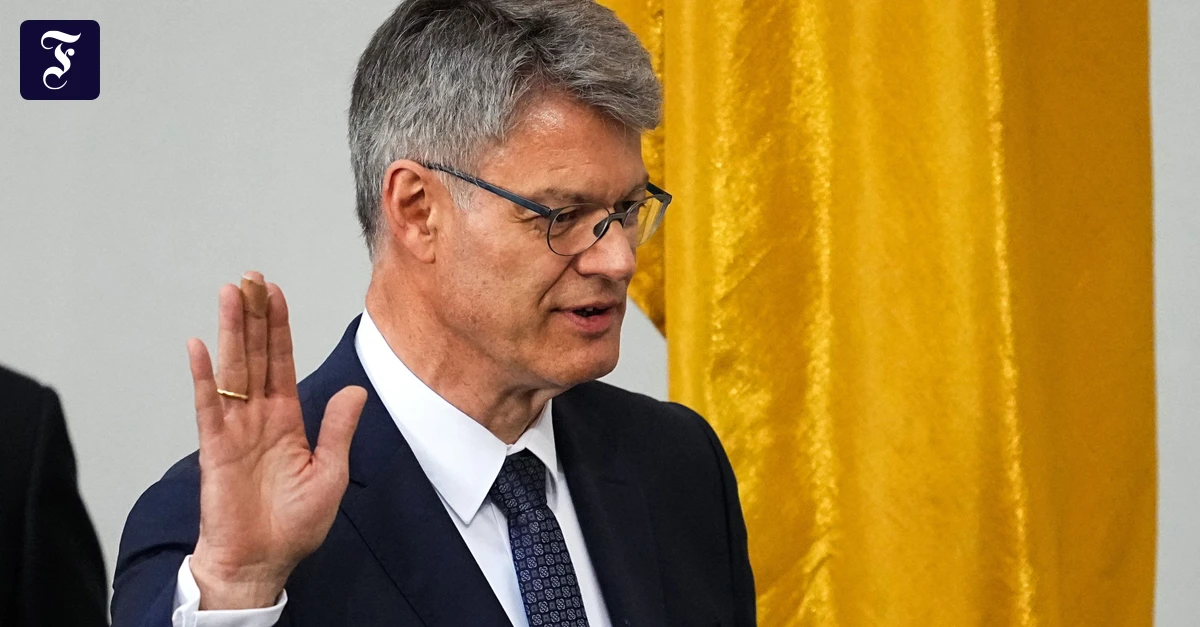
“Just do it,” the motto of health minister-designate Carsten Linnemann also seems to apply to the chancellor’s approach to the Basic Law. As part of a major revival caused by the resignation of Jens Spahn as chairman of the Union parliamentary group, the federal president is due to appoint several new federal ministers on Wednesday. However, the swearing-in of new ministers before the Bundestag, as required by the Basic Law, must be delayed until the Bundestag meets for its next regular session after the summer break in early September. As they say, for reasons of economy.
This six-week delay in swearing in new ministers, which has never happened in German state practice since 1949, is a dangerous disregard for the Basic Law and Parliament. The democratic legitimacy of the federal government comes from the German Bundestag. The Federal Chancellor takes office only through parliamentary elections, as Friedrich Merz painfully learned last year when he was elected Federal Chancellor only in the second round with the required absolute majority of deputies. The Chancellor can also be replaced by another person at any time by the Bundestag through a constructive vote of no confidence.
Freedom of hands in department design
The Basic Law gives the Chancellor complete freedom of action in forming the cabinet and does not require the approval of ministers by the Bundestag. Unlike the Weimar Constitution, individual ministers do not require the confidence of parliament to carry out their duties and cannot be removed from office by an individual vote of no confidence. The Chancellor’s principle is particularly pronounced here, as evidenced by the fact that the Federal Chancellor can freely create or adapt departments within the scope of his organizational powers.
It is for this reason that when ministers take office, their swearing-in before the Bundestag is of particular importance. This oath symbolically reminds us of the responsibility of all members of the federal government to the Bundestag. The main law here is laconic clarity. Federal ministers take the oath, as stated in Article 64(2), “on taking office before the Bundestag.” Taking office means actually taking on the official duties of the new minister. According to the Basic Law, it is absolutely clear that the oath may not take place after taking office, but coincides with it. Obviously, there is no exceptional emergency that could justify an exception to this rule.
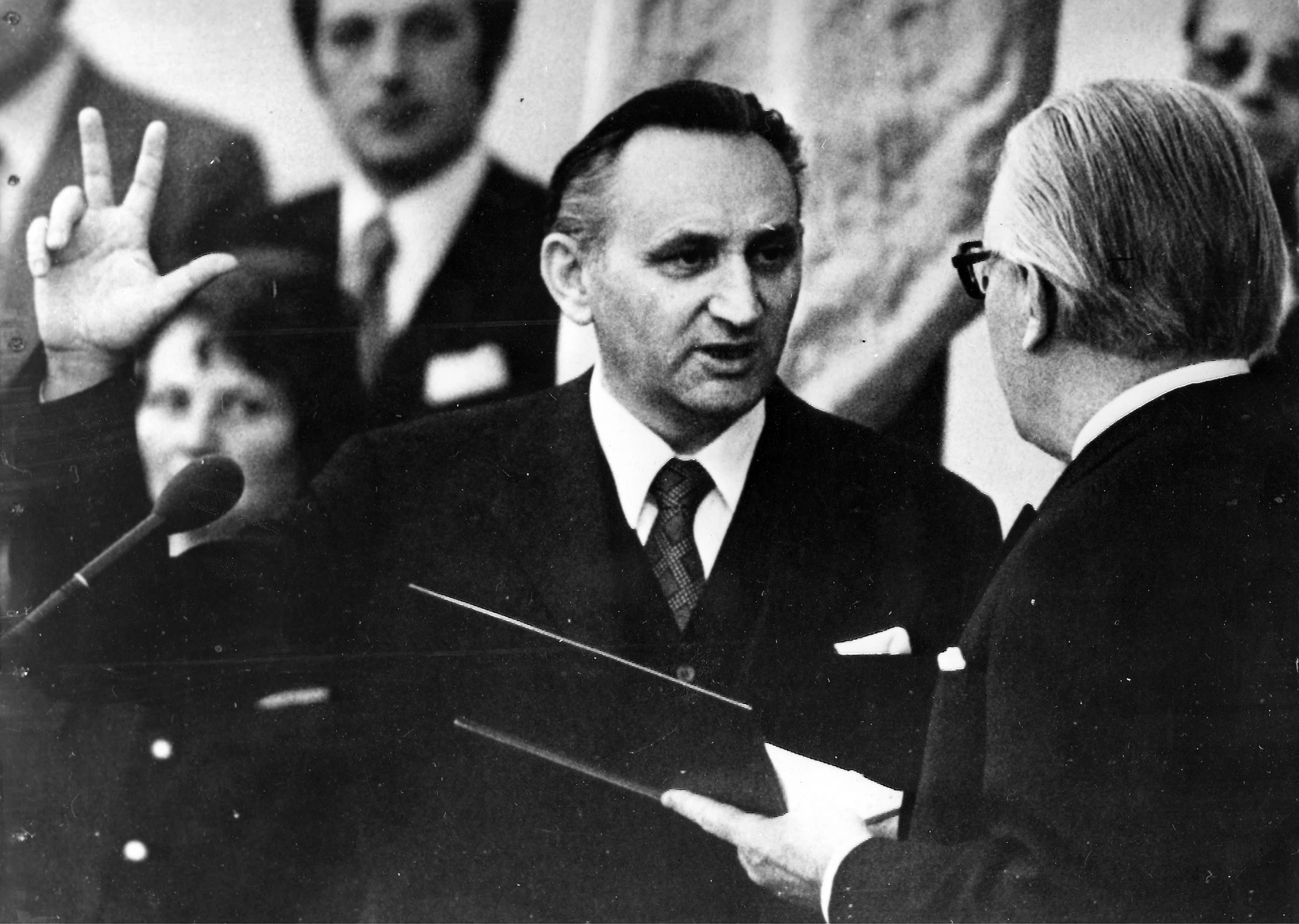 The Basic Law does not specify the number of fingers raised: Egon Bahr was sworn in as Federal Minister for Economic Cooperation on 10 July 1974 by Vice-President of the Bundestag Kai Ove von Hassell.
If the swearing-in ceremony here is postponed, it is solely for reasons of convenience for all participants: the summer holidays are simply planned differently. But convenience is constitutionally irrelevant. The same applies to expenses incurred for an extraordinary session of the Bundestag. It is not yet clear exactly what costs we are talking about. Regarding the travel expenses of deputies, each deputy is free to come to a special session of the Bundestag to swear in new federal ministers or not. MPs bear all travel costs themselves unless they use the services of Deutsche Bahn. This is in no way a reason to deviate from the constitutional requirement that the assumption of office by an appointed minister requires his being sworn in before the Bundestag. Thus, the Federal Chancellor violates the Basic Law if he actually hands over his portfolio to the appointed minister before he has taken the oath of office before the Bundestag.
The opposition is unlikely to be interested
However, formally this constitutional violation can only be established through the organ dispute procedure of the Federal Constitutional Court, which is unlikely to happen here since the opposition factions are probably not interested in it either. The fact that the federal government is even considering such a violation of the Basic Law is also based on the fact that, according to the Basic Law, taking the oath of office does not constitute a basis for ministerial status in the sense that all legally significant acts of an appointed but unsworn minister will therefore be invalid. The constitutional violation of taking office without taking an oath remains legally unsanctioned in actual day-to-day government. However, this regime of consequences of pragmatic error does not eliminate the constitutional violation itself.
Respecting the constitutional link between taking office and taking the oath of office by ministers is not just a legal formality. Because neglecting the symbolic dimension of the oath is almost more serious than violating the wording of the Basic Law. The oath taken by the new members of the federal government before the Bundestag not only confirms the ministers’ obligation to carry out their duties conscientiously. Rather, precisely because it occurs before Parliament, which meets in open session, it expresses the responsibility of the federal government in the parliamentary system of government of the Basic Law.
Democracy lives by its own rituals. In the Federal Republic, such festive moments in public life are rare, and they need to be cherished and cared for even more. Unfortunately, neither the Chancellor nor the President of the German Bundestag seems to know this.
Christoph Schönberger teaches public law and legal philosophy at the University of Cologne.