

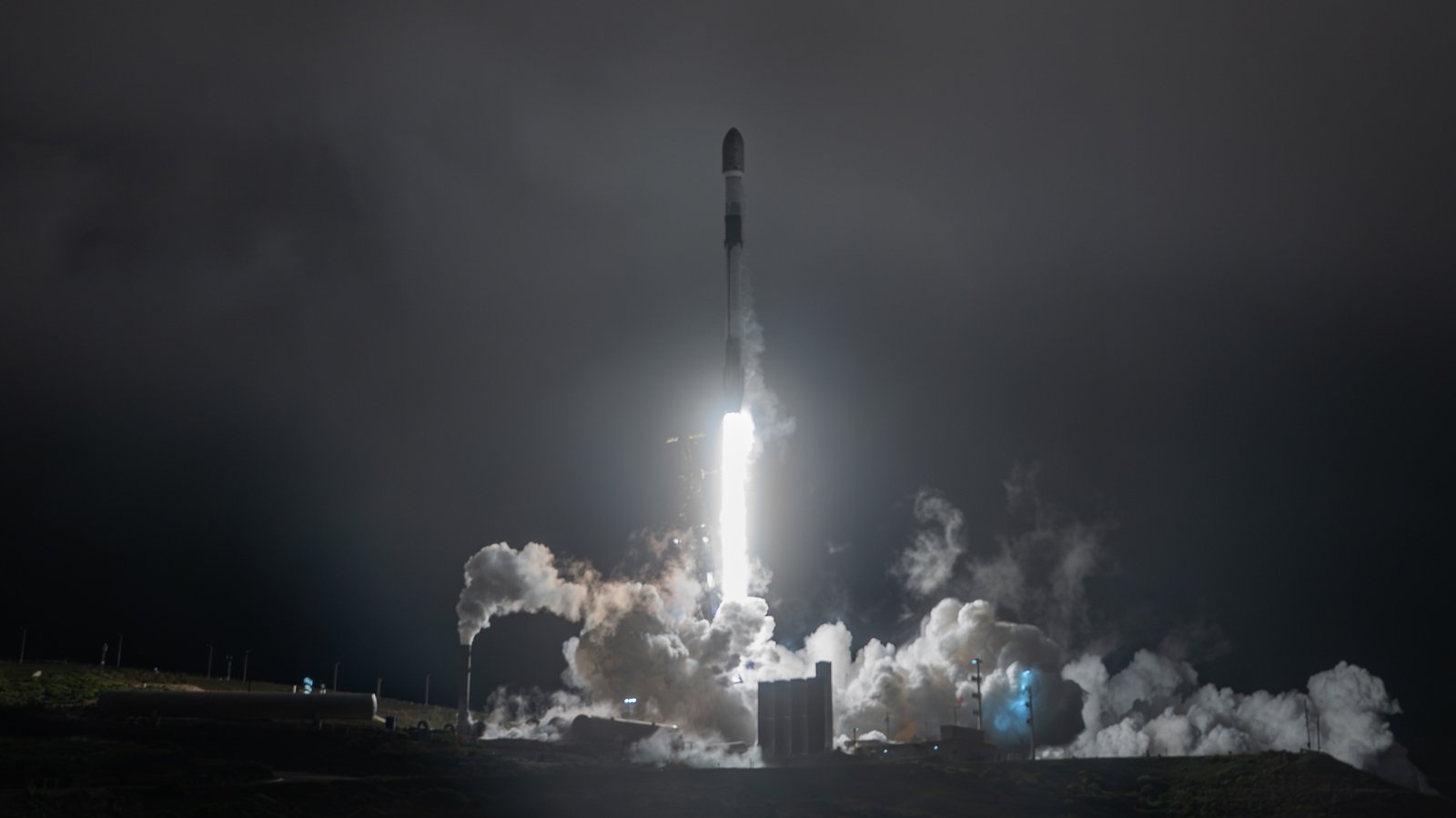
TOKYO — SpaceX launched the latest in a series of collaborative Transporter missions on July 7 as industry concerns about the program’s future reached what one rival executive called panic.
Falcon 9 lifted off from Vandenberg Space Force Base in California at 3:12 a.m. ET as part of the Transporter 17 mission to sun-synchronous orbit. The mission carried 81 payloads, including hosted payloads as well as spacecraft on orbital vehicles that will be deployed later, according to SpaceX.
The mission was launched anchored by CAS500-4, a South Korean 514 kg imaging satellite that will be used in agriculture and forestry. In May, another Falcon 9 launched a similar spacecraft, CAS500-2, as part of a joint mission.
Like other Transporter missions, this launch has attracted both new and returning customers, including those creating or updating constellations. Iceye had four radar imaging satellites on its mission, while Spire had 10 Lemur satellites at launch. Axelspace, a Japanese Earth observation company, launched seven of its GRUS-3 medium-resolution imaging spacecraft on the mission.
These and other companies have relied heavily on SpaceX missions for low-cost, regular access to space. However, there is growing concern in the industry that SpaceX is winding down the program, at least using its production Falcon 9 rocket.
In recent weeks, several partners and customers of these ride-sharing missions have said that SpaceX is not taking orders for transporters after late 2028 or early 2029. They added that the missions in the manifest are almost full up to this point. This has prompted companies such as Exolaunch and SEOPS, which organized launches on Transporter missions, to purchase their own Falcon 9 launches for shared use.
SpaceX has not commented on the claims, and its webcast announcing the Transporter 17 launch did not discuss any changes to the ride-sharing program. “Shared use missions like today significantly expand access to space for small satellite operators around the world, and we are excited to be able to offer these launch capabilities to SpaceX customers,” said one of the webcast hosts.
However, an executive at a rival launch provider has heard similar concerns about the availability of SpaceX’s joint launches.
“There was a lot of concern about Transporter missions and whether they would continue to be delivered,” said Adam Spies, Rocket Lab’s chief financial officer, during a fireside chat at the Spacetide conference on July 7.
That extends, he added, to the availability of the Falcon 9 itself. SpaceX officials said they were close to peak Falcon 9 launch activity last year and expect the number of launches to begin to decline as the company ramps up the capacity of Starship, its fully reusable heavy lift vehicle.
“In the last three to six months, what I would use to describe conversations with customers about access to the Falcon 9 is that there seems to be panic setting in,” Spies said. “There’s not that much confidence that the Falcon 9 will be available on the commercial market beyond what they put in the manifest.”
He said he expects SpaceX to focus its Falcon 9 efforts more on its domestic customers, including Starlink and its future orbital data center system. “When you look at SpaceX’s ambitious plans, their internal consumption is probably their most attractive opportunity. They would rather put another Starlink satellite or data center into orbit than put someone else’s material into orbit.”
That’s factored into planning for Rocket Lab’s Neutron medium-lift rocket, he said, including clients seeking “long-term” deals and launch procurement lock-ins to ensure access to space.
“Even though the environment has been constrained over the last few years, which has led to opportunities for Neutron, I think it’s becoming more difficult, not easier, for people to secure a launch,” Spies said. “We’ve probably only seen the tip of the iceberg.”