


image source, NurPhoto via Getty Images
image caption, Iran’s Supreme Leader Ali Khamenei was killed in an American-Israeli airstrike in February.….IN
Donald Trump’s recent statements regarding Iran and the possibility of an agreement are being taken seriously. After all, he is the president of America, and his statements can influence world politics.
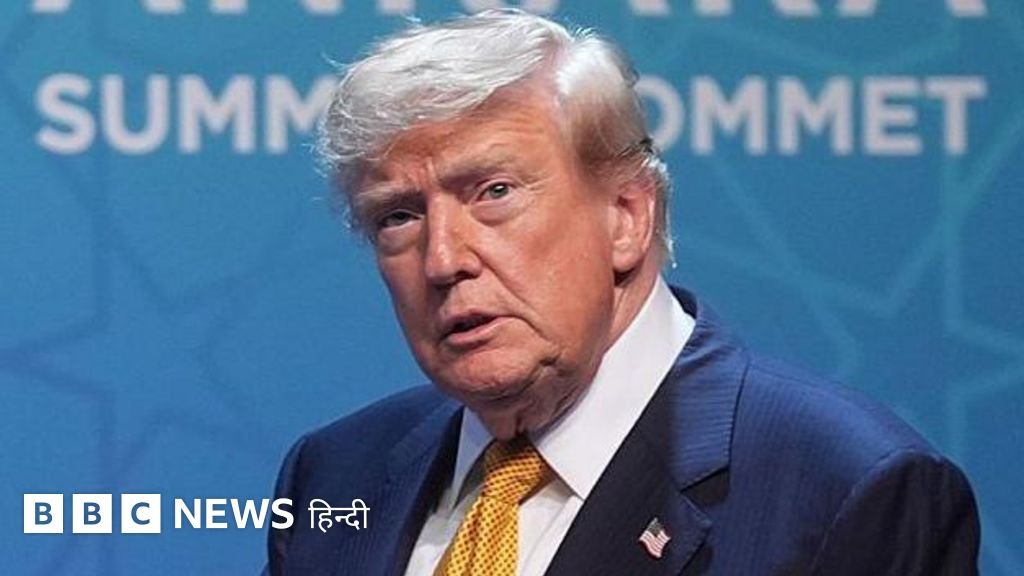
During the NATO summit in Turkey, Trump said: “Now I don’t want to negotiate with them (Iran). They are cheap people. Do you know what cheap means?
He said, “These are useless people. They are sick people. They are run by sick people. These are cruel and violent people.”
Trump said: “If they have nuclear weapons, they will use them. In my opinion, this issue is now closed.”
Continue reading
But is this the last of Trump’s thoughts on the matter? Probably not. He has constantly made statements regarding Iran, the war and the proposed agreement (MoU) between the two countries.
Sometimes he declared his victory. Sometimes he threatened to completely destroy Iran, and sometimes he supported negotiations and agreements.
Trump later escalated his threat, saying the US would “likely launch a larger attack on Iran again tonight.”
He said: “I have already warned them gently. Now we will start a strong attack again tonight.”
There is no doubt that America has the military capacity to inflict enormous damage on Iran, but so far it has failed to force the Iranian government to back down from its basic demands.
Foremost among these demands is maintaining our influence and control over maritime traffic through the Strait of Hormuz.
The path to dialogue is not closed

image source, Reuters
image caption, Trump made this statement during a meeting with NATO head Mark Rutte.
However, against the backdrop of Trump’s harsh statements, one thing became clear: the path to dialogue is not yet completely closed.
He noted that negotiations between the two sides could continue further.
Those talks are currently stalled as Iran is busy with funerals and mourning programs for its former Supreme Leader Ayatollah Ali Khamenei.
Khamenei was killed in an Israeli-American attack on February 28, the first day of the war.
Trump was asked whether negotiations were fully concluded following the attacks between America and Iran and the intervention of some of America’s Arab allies in the Persian Gulf region.
Speaking about his chief negotiators Steve Witkoff and Jared Kushner, Trump said: “I don’t care. They want to talk, let’s talk, but I think they’re wasting their time.”
Addressing the Iranian government, Trump said: “This is a group of people who are lying.”
Trump’s statement is also seen as an indication that, despite all the tough statements, he has no better option than negotiations.
America, together with Israel, tried to overthrow the Iranian government, but it failed to achieve its goal.
However, the negotiation process is still at a very delicate stage. A source involved in the mediation called the recent events a “major blow.” According to the source, the atmosphere between the two sides is currently very tense.
In diplomatic parlance, this means that the events of the past few days have made negotiations difficult.
The trust between the two countries is almost over. Both do not believe that after an agreement the other side will keep their word.
Iran’s position

The main reason for the recent military confrontation between America and Iran is Iran’s position that it does not want to return to the previous situation.
That is, Iran is no longer ready to put up with the situation that existed before the attack by America and Israel on February 28.
The Iranian government wants to maintain control of the Strait of Hormuz and is not ready to take a step back from this. This sea route is very important for the world.
About 20 percent of the world’s oil and gas is supplied along this route. If Iran stops shipping on this route, it could impact the entire global economy and energy supply.
For Iran, control of the Strait of Hormuz is considered a more effective weapon than the ability to develop nuclear weapons, since by influencing this route it can immediately put pressure on the world.
Iran is not ready to give up control of the Strait of Hormuz. It is for this reason that it seems willing to put the proposed agreement (MoU) on the line, even though it stands to gain many economic and political benefits from the agreement.
Iran says it will not back down now. He is also willing to take the risk of continuing the war if necessary to protect his strategic rights.
America and Israel were unable to overthrow the Iranian government. This further increased the confidence of the Iranian government.
The large number of people attending the funeral of the supreme leader, who died in the war, also showed that the government still has strong public support.
Although domestic opposition to the government has not yet completely died down, the government cracked down on protesters in January, reportedly killing thousands.
Since then, protesters have avoided public action.
If rising tensions between the two countries stop, mediators believe an agreement with Iran is possible.
According to this agreement, the movement of ships through the Strait of Hormuz can become normal. In exchange, Iran’s assets stuck abroad could be freed and it could be allowed to sell oil. In addition, Iran’s rights to the Strait of Hormuz may be recognized in one form or another.
In return, Iran will also have to accept some conditions. He will have to set limits on uranium enrichment and allow repeated inspections by UN nuclear inspectors.
In addition, Iran will have to fully account for its enriched uranium, which Trump calls “nuclear dust.” That is, uranium enriched to a level close to making it possible to make nuclear weapons.
However, events over the past 24 hours show that reaching such an agreement will not be easy. Mistrust and tension between the two countries remain very deep.
Published by the BBC News Team.