

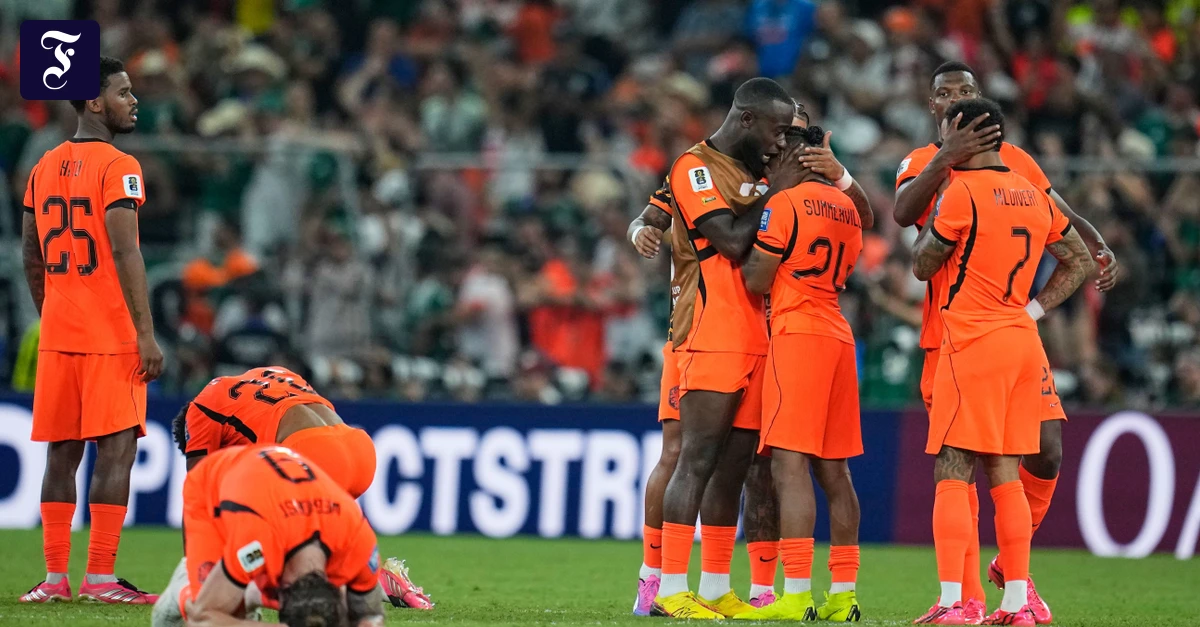
Dutch, German, Swiss, French: at this World Cup, players are also subjected to racial abuse, insults and threats on social media. For example, Jonathan Ta, who missed the decisive penalty for the German national team in the 1/8 finals against Paraguay. A similar fate befell Dutch national team players Quinten Timber, Justin Kluivert and Crisencio Summerville. They missed three penalties in the round of 16 against Morocco. The Dutch Football Association has filed reports in several cases.
Former Dutch international and four-time Champions League winner Clarence Seedorf has spoken out in response to numerous incidents last week. The nearly nine-minute video he posted on Instagram was shared many times more than his other posts, with more than 5,000 users commenting on it. We document Seedorf’s words in excerpts.
Seedorf places responsibility primarily on white people
“I will speak English, even if the issue concerns the Dutch national team, “l’arancia meccanica.” We saw a few years ago when England played Italy in the European Championship final (2021; ed.) and three black players missed a penalty, that there was a lot of backlash and racist hostility online, which is of course absurd.
The same thing happened immediately after the Netherlands’ game with Morocco, where Timber, Kluivert and Summerville failed to score in the penalty shootout. Now we can start destroying each other. I decided not to do this. But I definitely want to start by supporting these incredible players who had the courage to take on the responsibility of taking these penalties.
 Include external content
I also went through a similar situation. During my career with the Dutch national team, I myself missed several penalties. There was no social media back then, but I felt a reaction. This had a great influence on my career, including in the national team. (…) It is always easier to criticize those who take responsibility than those who do not take responsibility.
We live in a world full of hatred, full of attempts to divide people and take out our frustrations on others. And I don’t want to be a part of it. I want to call for solidarity, justice and the courage to stand up for what is right.
I will definitely keep an eye on those who remain silent because those who remain silent are actually part of the problem. This applies to everyone: players, teams, coaches, associations (…), FIFA (international football association; editor’s note), institutions, politicians in the Netherlands. (…) It is time to take serious measures to punish those who behave in this way.
Racism should have no place in our society. We know that not everyone is racist and not everyone discriminates. But the big problem I’ve encountered over the years is that people who have good hearts but don’t speak out against this behavior are also part of the problem.
I believe it is time for Dutch society and beyond, be it Belgium, France, Germany, especially European countries (…), to stand up for what is right, to take a stand on who they want to be, to take a stand on what values they want to represent. (…) This is just a reminder that some things still haven’t changed. (…)
“It was as if there was no shame”
Unless we do something to change the direction society is heading, nothing will change. And I also think that white people should feel responsible for how they present themselves, right. If black people and people of other ethnic backgrounds are being discriminated against and attacked on racial grounds, then they will come before the public and talk about it. (…)
Especially when we talk about sports, you can win or lose. Unfortunately, we’ve seen too many bad winners act like there’s no shame in it. But I am ashamed that in 2026 we are still facing the same things that I and many before me had to face when we represented the country, proudly represented the country in which we grew up. (…)
I leave you with the question: what can you do to make a difference? What can you do to make society a better place? What can you do to make the world a better place? Every little bit helps.
It had been a long day, but I wanted to put it out of my mind. Of course, that’s not all I have to say. But this is the most important thing for me to say.”