
Gergely Gulyas, the leader of the Fidesz faction, said in parliament on Monday: Fidesz is organizing a demonstration because of the 17th Amendment to the Basic Law, in particular because of its clause removing the President of the Republic, Tamás Sulik, from office. Demonstration #StopVoluntarily promoted under the name Viktor Orbán also participates in the coverage of this event. János Ader, the former President of the Republic, who spoke with Peter Magyar in recent days, will give a speech at Sándor Palace.
Demonstrations have been regularly used as a political tool by the Fidesz-KDPP opposition for the past sixteen years, but after April 12 the situation changed: Fidesz, forced into opposition, took to the streets. Three aspects are worth examining when attempting to interpret the functioning and consequences of the demonstrations:
1. Structure of political opportunities
Daniel Mikec is a political scientist and researcher who has studied in depth the demonstrations of recent years, e.g. Nothing about us without us – Demonstrations, political activism during the Orbán regime in the book – he was engaged in defining the structure of political possibility in several volumes. New parties, changing movements in his study, he wrote about this concept: “According to the political process model of resource mobilization theory, the emergence of social movements depends on variables such as the level of movement organization, the nature of movement organizations, belief in political action, and systems of alliances between individual actors. Movement studies call their combination the political opportunity structure.”
By the way, the concept of political opportunity structure is associated with Peter Eisinger, who in a 1973 study concluded that political protests are most likely in semi-open and semi-closed systems for two reasons, to quote the book:
- “In fully open systems, institutionalized means of advocacy are available.
- however, in completely closed systems the likelihood of official repression is too high, so the individual costs of protest will be too high for participants.”
2. Measure of success
At the end of May, we spoke with Andrea Virag, strategic director of the Republic Institute, about the measure of success, looking at the 2010-2026 demonstrations. The political scientist named two units of measurement:
- If the measure of success is the influence on political events, then, according to Andrea Virag, the demonstrations “against the slave law” had the greatest impact, since they caused fundamental changes in the relations between opposition parties. These demonstrations paved the way for Jobbik’s cooperation with left-wing, liberal and green opposition parties.
- If policy effectiveness is a measure of success, then the demonstration of anti-clean taxes is an adequate example. The question is whether the decision makers decided against introducing a net tax as a result of the demonstrations, or whether other considerations or public opinion polls pointed to it, but in the end it was not introduced, which is what the demonstration was organized against.
According to Andrea Virag, Fidesz often realistically understood that certain demonstrations did not pose a real threat to its power, but the number of people at last year’s Pride, which they tried to make impossible to organize, was already “one of the outstanding milestones of the weakening of the system.”
3. Opposition political tools and government party control of the narrative
As we mentioned at the beginning of our article, Fidesz is organizing a demonstration at Sándor Palace on Thursday regarding the proposed 17th Amendment to the Basic Law. Viktor Orbán, Gergely Gulyás and other Fidesz politicians argue that Tisza’s party is building an autocracy.
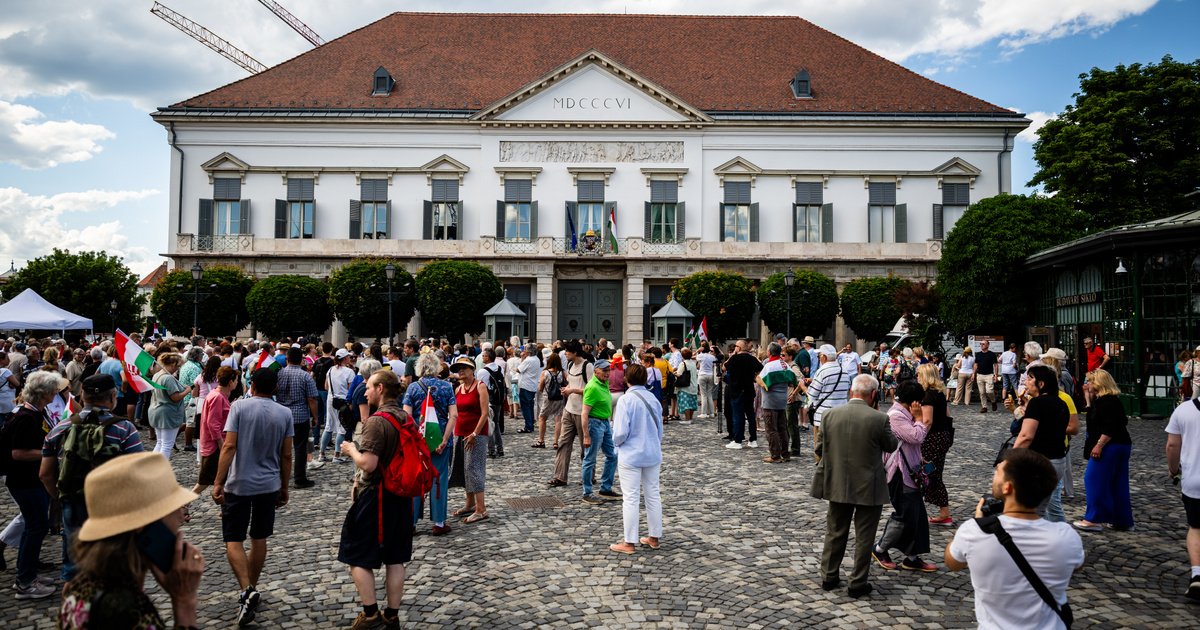
Almost exactly a month ago, at the beginning of June, a demonstration of sympathy for Tamas Sulek took place at the Sándor Palace, the official organizer of which was not yet Fidesz, but Viktor Orbán called for participation, and Gergely Gulyás appeared on the stage. Senior political leaders did not speak at the demonstration, but opinion leaders, journalists and political commentators played a major role. This week’s event takes that to a new level: the demonstration speaker will be former head of state Janos Ader, a former Fidesz strongman.
At the beginning of June, a demonstration against the migration pact also took place in Budapest, not organized by Fidesz, but attended by party member of parliament Balázs Németh, as well as László Toroczkay, president of Mi Hazank Mozgalom.
Peter Magyar never let go of the reins of the story. With his appearance on the balcony and then a video comparing the facial expressions of some demonstrators, he tried to present the movement against the migration pact in a way that suited his interests. After the demonstration in front of the Sandor Palace, the parties fought a war of numbers.
When evaluating demonstrations, it is traditional for counter-stakeholders to underestimate the number of people greater than the number of organizers and participants. At that time, several thousand people saw the actors who criticized the government, four hundred people saw Peter Magyar.
Thursday’s new demonstration shows that the genre could become an integral part of the already opposition Fidesz’s political toolkit in the coming years. The question is what movements can achieve in terms of influencing the political events identified in the second point or the effectiveness of policies.
(Cover image: Demonstration of sympathy next to Tamás Sulök and heads of state institutions at Sándor Palace June 7, 2026 Photo: Peter Papajczyk / Index)

Follow the Index on Facebook too!
I follow you!