
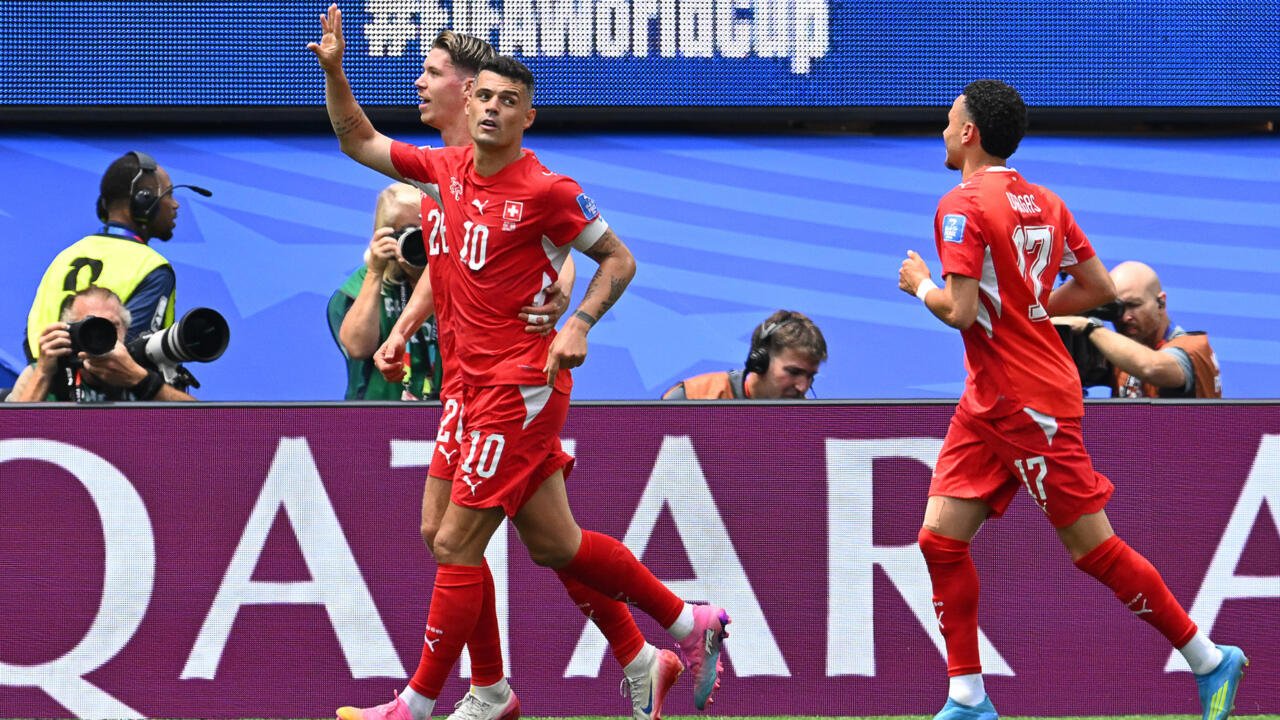
Paris (France) (AFP) – Switzerland’s World Cup captain Granit Xhaka says leadership is a role he learned at age four, when he was handed the keys to the house as his Albanian parents worked long hours to make ends meet in their adopted country.
Released: 05/07/2026 – 03:52
3 min. Reading time
The 33-year-old midfielder has a chance to prove that hard experience has paid off by leading the Swiss to the World Cup quarter-finals for the first time since 1954 if they beat Colombia on Tuesday.
But those early years, when he and his brother Taulant, a year older, were left to fend for themselves, left their mark on a player who at times allowed his emotions to get the better of him on the field.
“I think I learned about leadership when I was four,” he told Stan Sport Football earlier this year.
“My parents worked during the day, extra work just to give us what we wanted, and that’s why we are where we are today.
“I was four years old and given the keys to the house, so I already had responsibility,” he added.
Xhaka, who like Taulant was born in Switzerland, said he and his brother would spend 18 hours at home together.
“My two oldest daughters are six and four years old and I can’t imagine my kids being left alone for 18 hours today,” he said.
“But we had it, my brother and I. My mother (Elmaze) would start work at four in the morning, prepare lunch before leaving, return at three and prepare dinner before going to her second job.
“My father (Ragip) was the same,” he added with tears in his eyes.
“There were beatings”
Xhaka’s parents met and married in Kosovo, then an autonomous province of Yugoslavia and later Serbia, with a predominantly ethnic Albanian population.
Ragip opposed the regime of Serbian leader Slobodan Milosevic and was sentenced to six years in prison for participating in an anti-government demonstration.
“Nobody knew whether he was still alive or not,” Xhaka told The Times in May.
“So even with those ten minutes (of daily exercise), sometimes he wouldn’t talk to his family members for months.
His father told his sons about the beatings he suffered in prison. “He starts telling you something, but then he feels like he needs to stop,” Xhaka said.
His father emerged from this hellish existence after three years, and the family packed up their things and fled by bus to Switzerland. “My mom (was) legal, my dad illegal,” he recalls.
Xhaka and Taulant rewarded their parents for their courage and sacrifice by becoming successful footballers.
Both played for Swiss club Basel, but while Xhaka chose to represent Switzerland (he has 150 appearances to his name), Taulant chose Albania.
Xhaka showed the resilience he has acquired since childhood, picking up the ball in difficult times.
The lowest point was perhaps when he was stripped of the Arsenal captaincy after being replaced by then-manager Unai Emery in October 2019.

Granit Xhaka (centre) showed his mettle by regaining his place in the Arsenal team despite being stripped of the captain’s armband © Daniel LEAL / AFP
Xhaka had a love-hate relationship with the Arsenal fans and when they cheered his removal, he told them in vivid terms where to go.
“The darkness (after the replacement) was only when I was alone, but it was a nice darkness because I learned a lot from it,” he told The Times.
He stayed and re-established himself in the Arsenal squad when Mikel Arteta took over and won a second FA Cup before heading to Germany.
There he played a key role in Bayer Leverkusen’s league and cup double in 2024, going undefeated throughout the domestic season.
With a successful return to England with Sunderland’s surprise Premier League package and now the opportunity to play in a World Cup quarter-final for the first time in over 70 years for Switzerland, life certainly couldn’t be any sweeter.
However, he has his feet firmly on the ground.
“We never forget where we come from.”
© 2026 AFP