

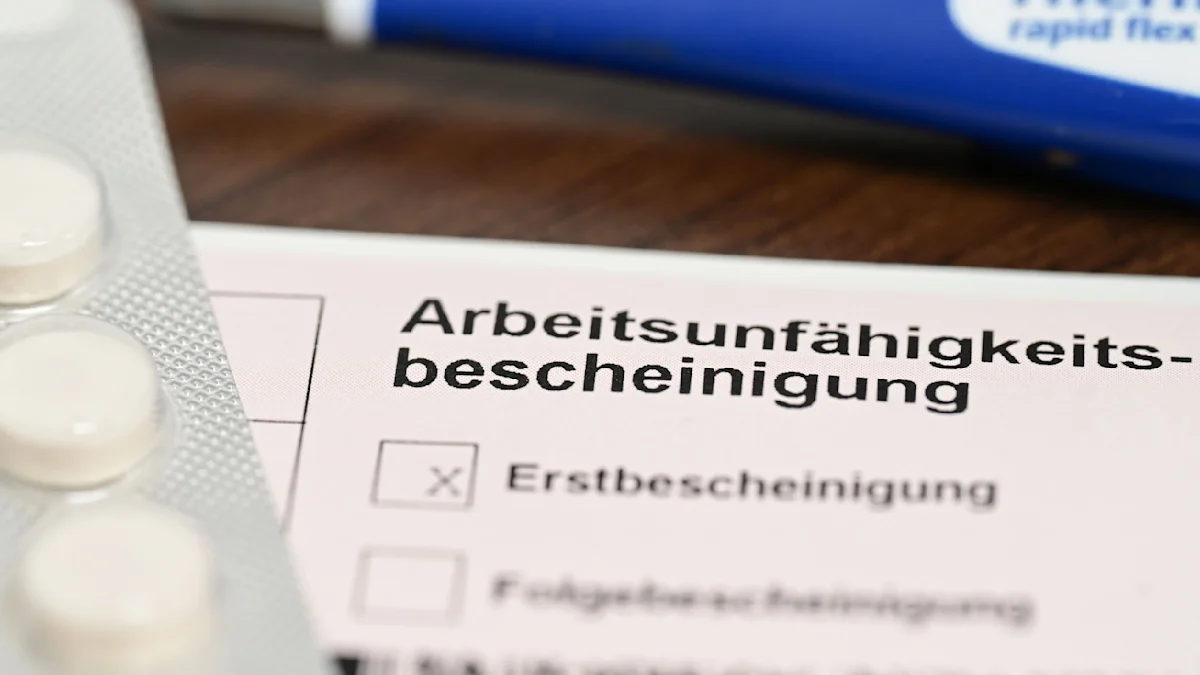
The tightening of sick leave plans planned by Black and Red continues to face widespread criticism, including from the Association of GPs. A YouGov poll shows majority rejection among Germans. The economist does not believe in a noticeable effect.
Economist Daniel Graeber from the German Institute for Economic Research (DIW) does not expect that the stricter sick leave plans planned by the Union and the SPD will significantly reduce the incidence rate in Germany. Instead, requiring a certificate from the first day of illness may result in more clinic visits and increase the risk of infection in waiting rooms. “If this leads to people going to work despite mild infections, infections at work could end up leading to more days of absence than if those employees simply stayed home,” warns Graeber.
Graeber does not see a cause-and-effect relationship between the high incidence rate in recent years and the ability to take sick leave by telephone from the end of 2023. Analyzes based on data from health insurer Barmer show no increase in disability due to telephone or video sick leave. According to him, the share of sick leave by telephone or video is only about 0.8-1.2 percent of all sick leave.
More important are other factors, such as more complete recording of sick leave, strong waves of infection and longer illnesses since the introduction of the electronic sick leave certificate (ESC). In 2024, long-term illnesses lasting more than six weeks would account for about 40 percent of all days absent, although they accounted for only a small proportion of illness reports. This is often associated with diseases of the musculoskeletal system and mental illness. Health prevention could help more here, says Graeber.
Poll: Most Germans reject the requirement to have a certificate
The coalition’s plans are also generally rejected by the public, according to a YouGov poll. Accordingly, 59 percent of respondents are against the mandatory presentation of a certificate of incapacity for work from the first day of illness, while 31 percent welcome it. 58 percent reject the planned abolition of telephone sick leave for minor illnesses, while 33 percent support it. The representative survey surveyed 6,200 adults in Germany.
The GPs’ Association has called for stricter measures to be taken against providers of video consultations instead of eliminating telephone sick leave. The association’s federal president, Nicola Bülinger-Gepfarth, told the Rheinische Post that the planned changes were a “purely symbolic policy” and would neither reduce incidence nor prevent abuse.
If it was really about fighting fraud, the “explosive growth” of video consultation providers, some of which aggressively advertise their services in the form of short hospital notes, would have to be curbed. “If there’s a big potential for abuse anywhere, it’s on anonymous platforms that profit from it and don’t even know their customers. The door is open to fraud there, not in our practice!” says Bulinger-Gopfarth. On the other hand, telephone sick leave has no greater potential for abuse than visiting a practice because it involves the practice knowing the patients.
The association’s federal chairman, Markus Blumenthal-Bayer, told Funke newspapers about Schwarz-Rot’s plans: “This is a disaster for our practice.” If in the future employees required sick leave on the first day of illness, the practice would have to “expect millions of additional patients.” Severely and chronically ill people will be particularly affected because there will be less time to treat them.
DGB: Plans lead to ‘overload of entire medical practice’
Criticism also comes from the German Trade Union Federation (DGB). DGB board member Anja Peel warned in the newspapers of the Funke media group that the obligation to work from the first day could contribute to presenteeism, that is, working despite illness. This has negative consequences such as decreased productivity and increased incidence of chronic diseases. The combination of mandatory medical certificates from day one and the elimination of telephone sick leave also “leads directly to the overload of all medical practices in the country,” Peel said.
The patient representative of the federal government, Stefan Schwarze (SPD), also expresses criticism. “For many diseases, going to the doctor is an unnecessary burden for everyone and increases the risk of infection,” he told the newspapers of the Funke media group (Saturday editions).
Given the planned rules, the concern is that “in the future, even more employees will drag themselves to work sick, not recover and end up taking more sick days due to long-term illnesses,” Schwarze said. He called on policymakers to further expand digital and telemedicine offerings.
The union and the SPD agreed in the coalition committee to require employees to provide a certificate of incapacity for work from the first day of illness. In this case, sick leave by telephone will again be canceled. Both projects still need to work their way through the legislative process. Chancellor Friedrich Merz (CDU) justified the tightening by saying that the number of sick leave in Germany is too high. You cannot take “exorbitant” sick leave.
DPA/AFP/luvi