

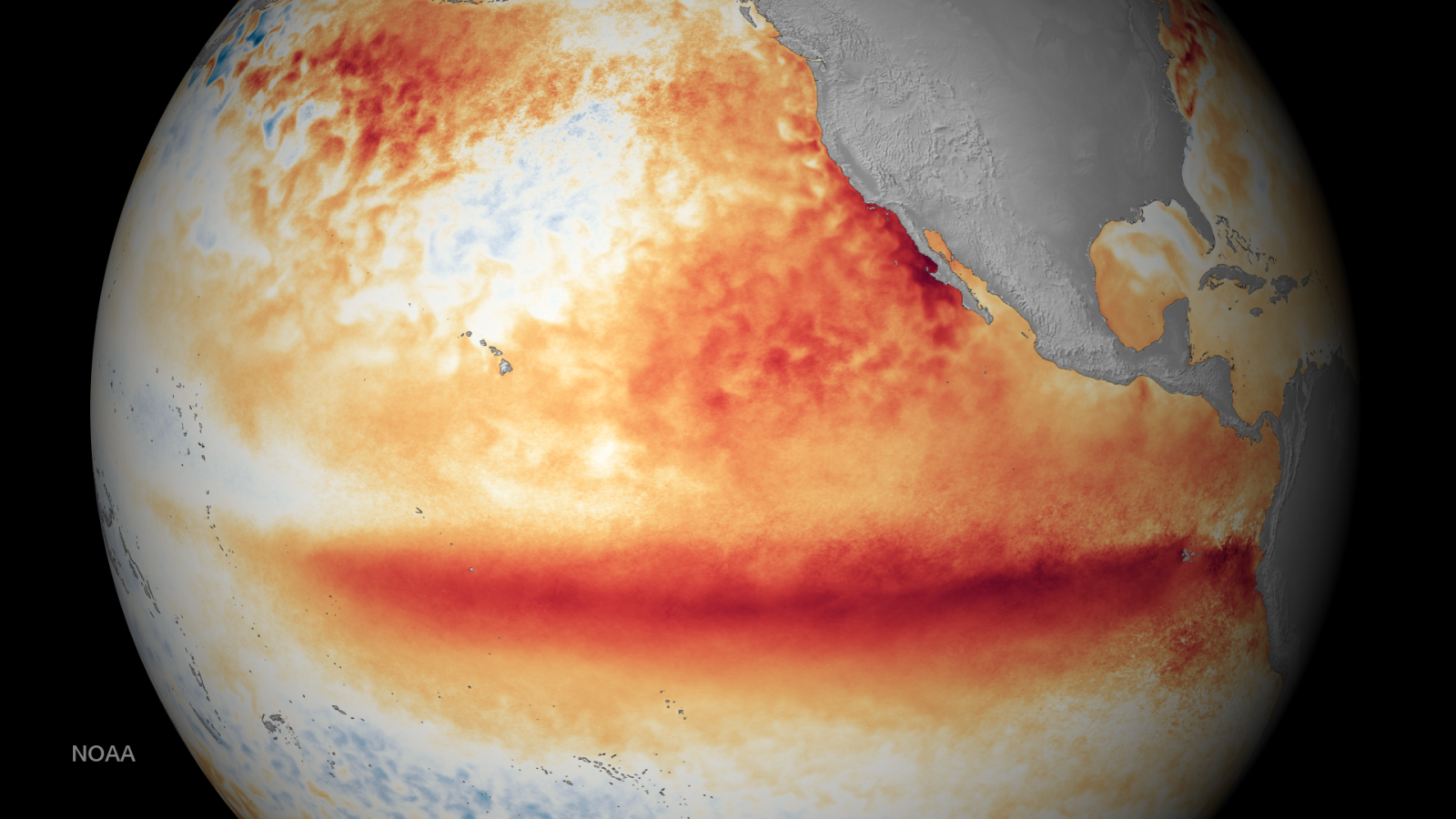
A rise of water called a Kelvin wave is currently moving across the Pacific Ocean along the equator. This signal indicates an intensification of the El Niño phenomenon. Satellite images show a swath of above-normal water stretching hundreds of kilometers as a result of warming waters typical of this climate phenomenon.
This Kelvin wave occurs when the Pacific westerly winds weaken and temporarily change direction, blowing from west to east instead of east to west. This change allows warm water to gradually accumulate to the east, deepening the warm water layer and preventing cold water from rising from the depths. The Sentinel-6 Michael Freilich satellite detected the wave on June 8, revealing sea level anomalies that were sometimes more than 15 centimeters above normal.
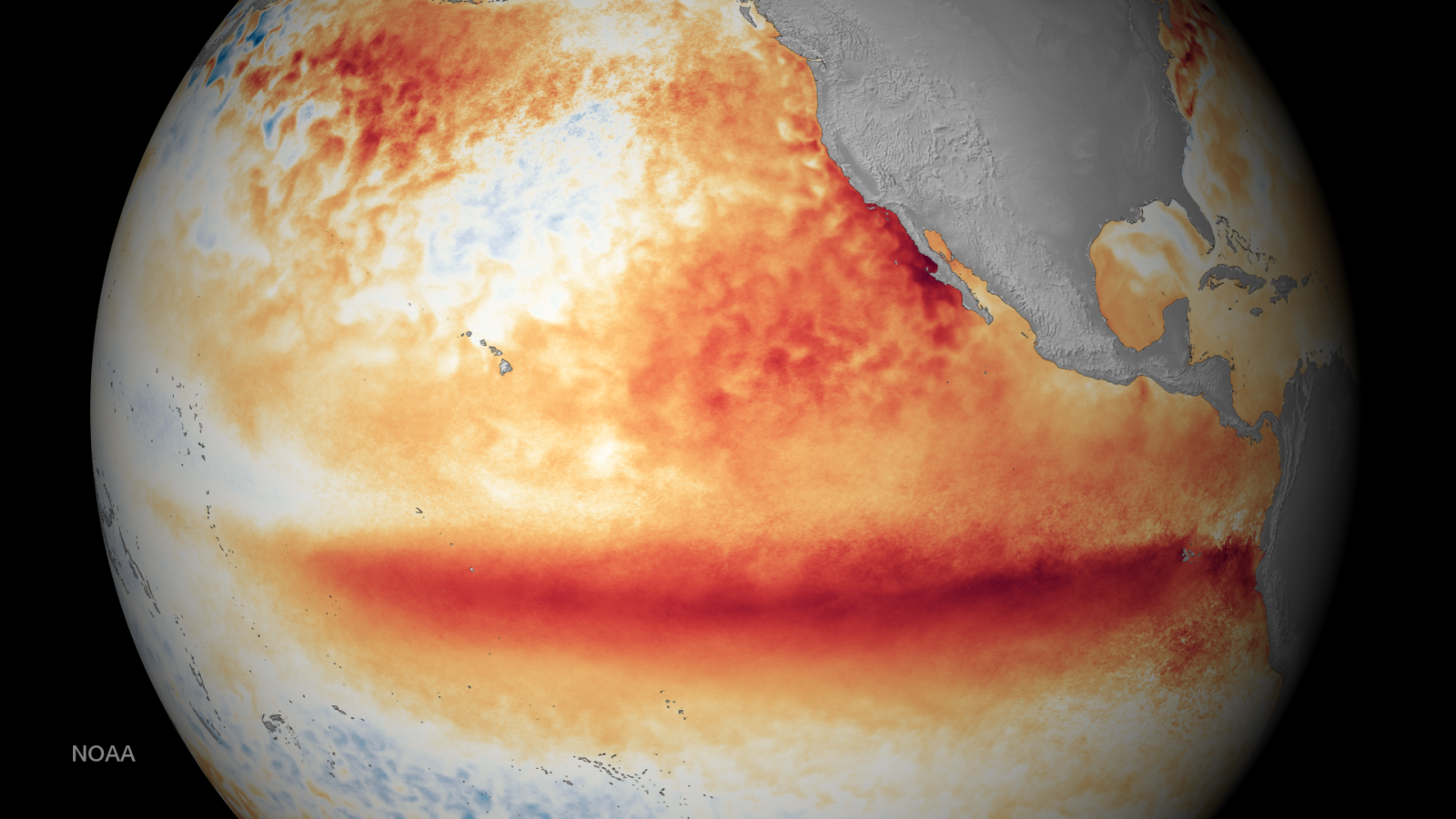
El Niño in 2015.
This image illustrates the difference in satellite-measured sea surface temperatures in October 2015. Orange-red areas corresponding to above-normal temperatures are characteristic of El Niño.
Image by NOAA.
The satellite, developed by NASA and the European Space Agency, measures changes in sea height to within a few millimeters every ten days. The data complements surface temperature observations that already indicate record warming in the Pacific Ocean in recent months. On June 11, authorities officially announced the beginning of a new El Niño, confirming the scale of the anomalies.
Previously, scientists had already observed other Kelvin waves earlier in the year, heralding the arrival of El Niño. A wave in January near Micronesia dissipated in February, and another in March raised sea levels off Peru in May. This latest wave has already reached the west coast of South America.
These changes in temperature and sea height alter atmospheric contours and influence climate. El Niño typically increases precipitation in the southwestern United States, Colombia, Peru, and Ecuador, while decreasing precipitation in the western Pacific Ocean. The previous El Niño, which lasted from 2023 to 2024, contributed to 2024 becoming the warmest year on record, exceeding the 1.5°C warming limit set by the Paris Agreement.
The current configuration in the Western Pacific is reminiscent of 1997, a particularly strong El Niño year. Although the number of Kelvin waves observed in 2026 is less than in 1997, the episode is still in an intensifying phase. Current data suggests this will be a large event, but more observations are needed to confirm its magnitude.
What is an oceanic Kelvin wave?
A Kelvin wave is a large amplitude ocean wave that propagates along the equator or coastline due to the Earth’s rotation. In the equatorial Pacific Ocean, these waves move from west to east, under the influence of underwater terrain and the Coriolis force. They are manifested by rising sea levels and the accumulation of warm water on the surface. These waves play a key role in the occurrence of El Niño. When the trade winds weaken, a Kelvin wave is created, which carries warm water that normally accumulates in the western Pacific Ocean eastward. Once it reaches the American coast, this hot water prevents the rise of cold water, which warms the atmosphere and changes precipitation on a planetary scale.
Kelvin waves are usually the precursors to El Niño. Its satellite detection warns climate scientists that warming is imminent. Several waves were observed in 2026 before El Niño was officially declared, confirming its usefulness for seasonal forecasting.