

Listen to this article
Approximately 2 minutes
The audio version of this article was created using artificial intelligence technology. Pronunciation errors may occur. We work with our partners to continually analyze and improve results.
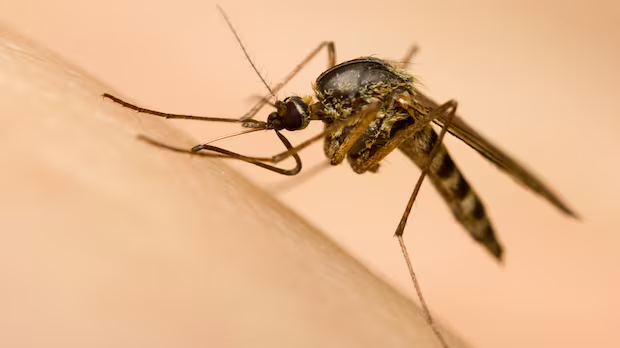
A batch of mosquitoes in Toronto tested positive for West Nile virus, just days after mosquitoes in York and Halton regions also tested positive, according to Toronto Public Health.
The batch is the first in Toronto to test positive for the virus this year, the public health unit said in a news release Friday. The virus is transmitted to people through the bite of an infected mosquito.
Toronto Public Health conducts mosquito surveillance every year from mid-June to mid-September.
Once a week, 22 mosquito traps are placed throughout the city. The mosquitoes are then sent to a laboratory for identification and testing.
The news comes as public health officials in York and Halton Regions confirmed some mosquitoes in their areas have tested positive for the virus. The findings marked the first positive cases in both regions this summer.
York Region confirmed the positive test on Thursday, and Halton Region confirmed the positive test on July 2.
In York Region, positive tests were found at two mosquito traps in Markham.
According to the Region of Halton, mosquitoes with the virus are more common in urban areas.
The region said in a news release that most infected people do not have any symptoms, but some may develop fever, headache, body aches, nausea and rash.
While most people make a “full recovery,” the region says some continue to develop severe illness affecting the central nervous system. People over 50 or with weakened immune systems are at greater risk of severe illness.
Toronto, York Region and Halton Region recommend people take the following precautions:
- Wear long, light-colored clothes.
- Cover between dawn and dusk, when mosquitoes are most active.
- Use insect repellent with DEET or icaridin.
- Eliminate water accumulations on your property, such as in flower pots, pool covers and trash containers.
- Make sure window and door screens fit snugly.