

Only on Monday, Western Ukrainian allies in the so-called “Coalition of the Willing” agreed at a meeting in Paris that wanted to conduct the first exercises of multinational Ukrainian forces. It is being created to support Ukraine in the event of a ceasefire with Russia. The first maneuvers are planned to be held in Poland, one of Ukraine’s neighboring countries.
On Wednesday, Moscow said it would consider any multinational force stationed in Ukraine unacceptable, a threat and a legitimate military target. Russian Foreign Ministry spokeswoman Maria Zakharova told reporters: “In this context, we would like to emphasize once again that sending any military contingents from the countries of the so-called “Coalition of the Willing” to Ukraine unacceptable for our country.“
She added: “De facto, this will mean foreign interference and an escalation of threats to Russia’s security. We consider such units to be legitimate military targets.“
Multinational forces of Ukraine: what is planned?
Germany now wants to take part in the exercise
On Monday, a coalition of about 35 Ukrainian allies announced the first exercises of multinational Ukrainian forces on Polish soil. The goal is to prepare for “concrete security guarantees for Ukraine as well as for the region,” Polish Prime Minister Donald Tusk said, according to the PAP news agency. Tusk named France and the UK as the next participating states. Germany was initially cautious.
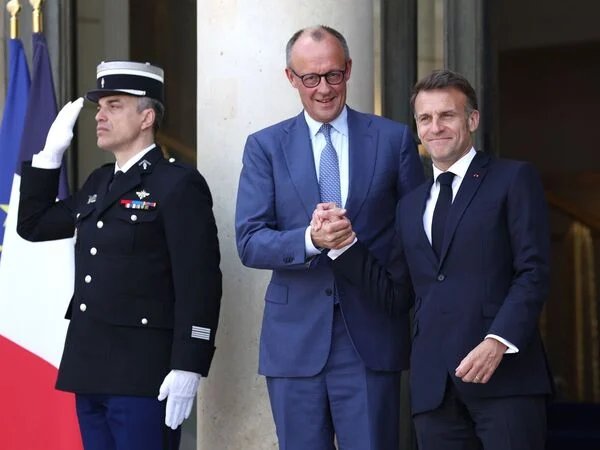 Friedrich Merz and Emmanuel Macron (right) at a meeting of the “Coalition of the Willing” in Paris.
© dpa/PA Wire/Pool Getty Images Europe/Tom Nicholson
According to the German Press Agency (dpa), government spokesman Stefan Cornelius announced the change of course on Wednesday: Cornelius said they wanted to discuss it at a scheduled meeting of the Franco-German Security and Defense Council. “Germany will take part in this maneuver. The federal government is studying what that participation would look like.” On Tuesday, government circles said Germany would not take part.
The Franco-German Security and Defense Council will meet at Nörvenich airbase on Friday, just ahead of a meeting of both countries’ ministerial councils in Brühl near Cologne. in which numerous ministers take part along with Merz and Macron.
Initially, this is just a small exercise in “coalition of the willing.”
According to Tusk be less of an exercisewhich tests leadership structures and decision-making processes for the first time. The main purpose of such general staff exercises is to practice decision making and coordination or redeployment of troops – usually without moving military equipment or soldiers into the area.
The formation of a European-led multinational force to secure an eventual ceasefire was The decision was made at the Ukrainian summit in Berlin in December. French President Emmanuel Macron said on Monday that troops were ready to go.
Merz initially said only that a “coalition of the willing” was ready to provide security guarantees to Ukraine after the ceasefire play an “important role” in close cooperation with the US. “The Federal Government and the German Bundestag will also decide on the type and size of Germany’s contribution,” the chancellor said.
Bulgaria does not participate in the “Coalition of the Willing”
EU and NATO member country Bulgaria on Tuesday refused to participate in the “coalition of the willing” to support Ukraine. “Bulgaria’s place is not there”This was stated by the new Prime Minister of Bulgaria Rumen Radev in Paris, reports the Bulgarian national television BNT.
Bulgaria does not participate in the coalition, which insists on continuing financial and military assistance to Ukraine, the politician explained. Regarding the Ukrainian war, former fighter pilot and commander of the Bulgarian Air Force Radev said: “The solution to this conflict is not to prolong it by military means, but to prolong it by military means. but in a strong diplomatic mission that will end the escalation.”
Also read:
“No prospects for resumption” At present, Moscow sees no chance of new peace negotiations on Ukraine “We must be prepared for this” Putin may soon begin forced mobilization – Zelensky is concerned
Former Bulgarian President Radev has led the government of the country of about 6.4 million people since May 2026. Unlike previous governments in Sofia, as head of state, he advocated a diplomatic solution to the war in Ukraine. (dpa, Reuters, check it out)
Note. Parts of this text have been translated using artificial intelligence.