

Naval blockade of Iranian portsTrump wants to seize the Strait of Hormuz and have the money to do it
July 14, 2026, 8:56 am
Listen to the article(04:51 min)
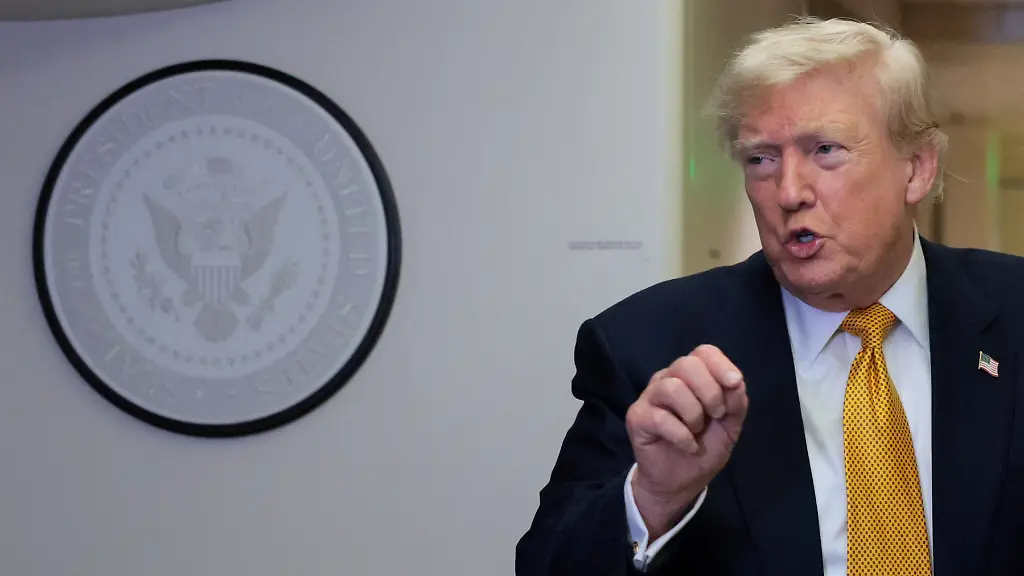 Trump has always rejected Iranian tariffs, but now he is demanding payment for security in the Strait of Hormuz. (Photo: REUTERS)SplitFollow along:

“We will be guardians of the strait,” says US President Trump. Tehran immediately rejected the proposal: the United States “will not be allowed under any circumstances” to intervene in the Strait of Hormuz. Meanwhile, Iranian ports are once again being blocked.
In the conflict over the Strait of Hormuz, US President Donald Trump announced the resumption of a naval blockade of ships heading to or leaving Iranian ports. All other countries should be able to have “fair and open” access to the strait, he said on his Truth Social platform. In the evening, the US military announced that it would impose a naval blockade on Tuesday at 22:00. Central European Time (CEST). This measure applies to all maritime traffic regardless of flag and applies to the entire Iranian coastline, including all ports and oil terminals. The passage of neutral ships through the Strait of Hormuz to destinations outside Iran will not be impeded. The delivery of humanitarian aid is still allowed after preliminary verification.
According to Trump, the United States wants to “take over” the Strait of Hormuz and receive payment for military security. “We are taking control of the strait,” Trump said on Fox News. “We will be guardians of the strait,” Trump continued. Then the United States could call itself the “guardian angel” of the Strait of Hormuz. “We will be paid to protect them.”
In June, the president already threatened something like a tariff on the Strait of Hormuz if negotiations with Iran failed. On Truth Social, Trump clarified that the US wants to be reimbursed for all necessary security costs “in this very troubled part of the world” in the amount of 20 percent on all cargo shipped. This is a matter of “fairness”. Implementation of this must begin immediately. Further details remain open, such as who exactly should pay for the fee.
A spokesman for the Iranian military command said in a video message that Tehran “under no circumstances will allow” US intervention in the strategically important strait. Any cooperation between the Gulf countries and Washington is also considered an “act of war.”
The UN shipping organization IMO criticized Trump’s plans. The organization stated that there is no legal basis for charging transportation fees. Payments for passage through international straits will be categorically rejected. Shipping industry representatives have expressed concern and said they believe such a move would violate international law.
Oman puts forward free transit proposal
Tensions between the US and Iran have previously escalated significantly again. Overnight, the US military said it had fired at dozens of targets in Iran. The Revolutionary Guards, in turn, attacked US military installations in Jordan, Kuwait, Bahrain and Oman. In mid-June, the United States and Iran signed a framework agreement that was supposed to lead to a peace agreement within 60 days. About half the time passed, and no rapprochement occurred.
According to media reports, the US has actually demanded that Iran ensure free and safe navigation in the Strait of Hormuz and has given Tehran a deadline of Saturday to do so, as reported by some US media. The Iranian leadership must publicly assure that the strait is open and that Iran will refrain from attacks on commercial ships, write Axios and the Wall Street Journal, including with reference to US government officials. Obviously nothing came of it.
As a result of the recent attacks, shipping through the Strait of Hormuz has fallen sharply again in recent days. Just 14 ships passed through the strait on Sunday, the lowest number this month, according to data provider Kpler. Before the war began, an average of more than 100 ships passed through the Strait of Hormuz every day.
Trump recently threatened Tehran, but at the same time seemed open to negotiations. According to media reports, Oman has also submitted a proposal for free passage through the Strait of Hormuz. Accordingly, navigation along the southern route should be free, as before the war, CNN reports, citing an unnamed source. Axios correspondent Barak Ravid confirmed the proposal.
Rubio came out strongly against tolls in late June
Representatives of Iran and Oman agreed to regulate shipping in the Omani capital Muscat. On the Omani side, the negotiations were led by Foreign Minister Badr al-Busaidi, and on the Iranian side by Foreign Minister Abbas Araghchi. Oman’s Foreign Ministry said negotiations were continuing at the technical and political level. Oman has not provided any information on this proposal. According to reporter Ravid, a commitment from Iran is still awaited.
The US-Iran framework agreement stipulates that Tehran must negotiate with Oman on the future management of the strait in coordination with neighboring states. US President Trump has repeatedly called the losses unacceptable. In late June, his Foreign Minister Marco Rubio also stressed that no country has the right to demand money for the use of international waters. Such a requirement will never be part of an acceptable agreement. “You can call it a fee or a fee,” Rubio said.
The Strait of Hormuz is international waters and does not belong to any state. This is a fundamental principle of international order. Rubio further argued that if states agreed that states would charge for the use of international waters simply because they were close to their territory, such an assertion could spread throughout the world.