
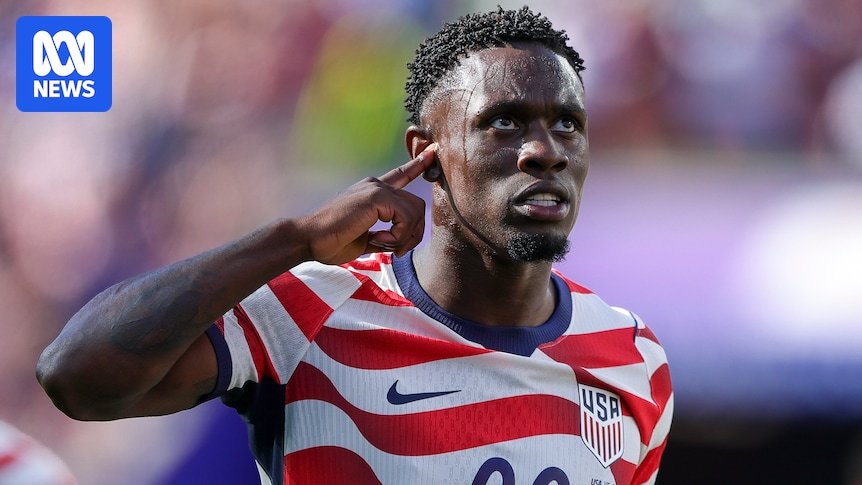
Folarin Balogun’s one-game suspension was unexpectedly suspended by FIFA, allowing the American striker to play in the World Cup round of 16 team match against Belgium.
This decision was highly praised by US President Donald Trump, but caused outrage from the Red Devils.
Balogun, who has scored three goals in the US campaign so far, was red carded for clumsily stepping on the right ankle of Bosnia-Herzegovina’s Tarik Muharemovic in the 2-0 win.
Trump praised FIFA’s decision. FIFA President Gianni Infantino has repeatedly tried to build a close relationship with Trump, even presenting him with the FIFA World Prize at the World Cup draw.
According to several reports, Trump called Infantino this week and asked him to reconsider Balogun’s red card.
“Thank you FIFA for doing the right thing and changing a huge injustice!” Trump announced this in his post on the social network.
A red card results in an automatic one-game ban, but American players learned of Balogun’s availability when social media posts began popping up during Sunday’s 10-minute bus ride from their hotel to training.

Folarin Balogun received a red card for marking Tarik Muharemovich after a VAR check. (Getty Images: Michael Steele)
“I think a lot of us thought it was artificial intelligence at first,” defenseman Chris Richards said. “We weren’t sure if it was true or not.”
Belgium coach Rudi Garcia ridiculed FIFA’s actions.
“I didn’t know that at the FIFA office, July 5 was April 1 in Europe,” Garcia said through a translator, comparing it to April Fool’s Day.
“The Belgian federation does not protect itself, it does not protect the national team. She defends football in general, she defends her integrity, her ethics.”
The Royal Belgian Football Association (RBFA) said it was “surprised”.
“This decision is in direct conflict with the 2026 FIFA World Cup Competition Regulations,” the statement said.
“To protect the legal rights of all participating teams and uphold the fundamental principles of fair play in our sport, both at this World Cup and future tournaments, the RBFA is exploring all potential options.”
Stay up to date with the latest news, analysis and coverage of the 2026 FIFA World Cup. Here.
The red card and disqualification of Balogun for the 1/8 final match became one of the most controversial and important decisions of the World Cup.
“If you look at that foul, there was no intention at all,” American star Christian Pulisic said.
“I felt there were much worse things happening at this tournament.”
Read more about the 2026 FIFA World Cup.
The US Soccer Federation learned of the decision through a message sent by FIFA to its portal at 10:31 a.m. ET.
“The match suspension is suspended for a probationary period of one year,” FIFA said.
“If Folarin Balogun commits another violation of a similar nature and gravity during the probationary period, the suspension will be revoked and the sanction will be imposed without prejudice to any additional sanctions imposed for the new violation.”
Folarin Balogun was the best player for the United States at the World Cup. (Getty Images: ISI Photos/Robin Alam)
The USSF said it would not give Balogun the opportunity to comment on Sunday, but Balogun posted on social media a photo of himself in front of American fans, set to music from Michael Jackson’s pop single “Bad.”
FIFA said its decision was based on Article 27 of the disciplinary committee rules.
“The judicial authority may decide to fully or partially suspend the execution of the disciplinary measure. Having suspended the execution of the sanction, the judicial authority subjects the person subject to punishment to a probationary period of one to four years,” the rule says.
For the first time since the cards were introduced at the 1970 FIFA World Cup, a player received a red card and was able to play in the next game.
In November, FIFA postponed the final two games due to Portugal’s Cristiano Ronaldo’s three-match ban for his red card against Ireland in a World Cup qualifier, allowing him to play at the start of the World Cup.
The Brazilian Garrincha was excluded from the 1962 semi-finals, but under political pressure he was allowed to play in the final against Chile.
ABC/AP