
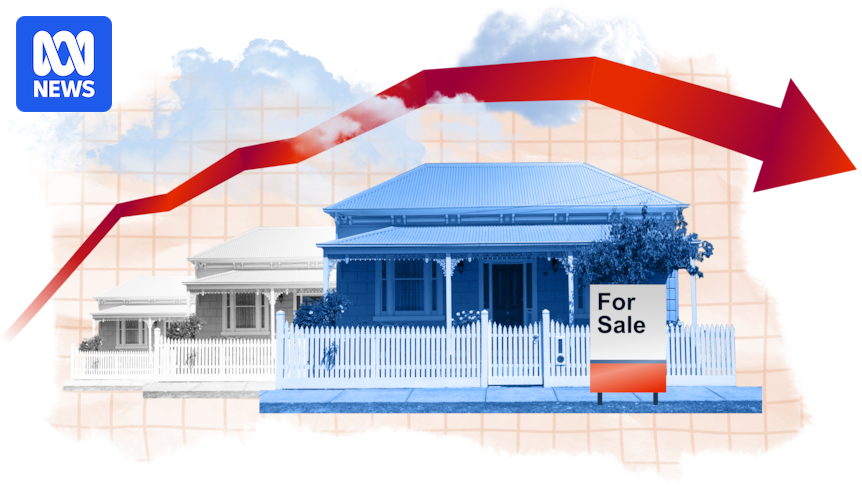
After decades of rising house prices in Australia are slowing. This is what a fall might look like.
Property prices are under more scrutiny than ever before.
Following the shake-up towards negative gearing and capital gains tax (CGT) rebates, the housing market has stalled and auction rates have fallen.
Investors and home owners are feeling some concern about declining property values, and their concerns are being supported by the big banks.
NAB predicted a 2 percent fall in major capitals, while the Commonwealth Bank revised its growth estimate to 3 percent from 5 percent.
Prices are already falling, with Sydney alone reporting a 1.2% decline last month.
Investment bank Morgan Stanley predicted that home prices could fall 5 to 10 percent, which it called “one of the largest price corrections in the last 40 years.”
So what would a 10% fall in house prices mean for Australians?
First, we need to look at how home prices have risen over the decades.
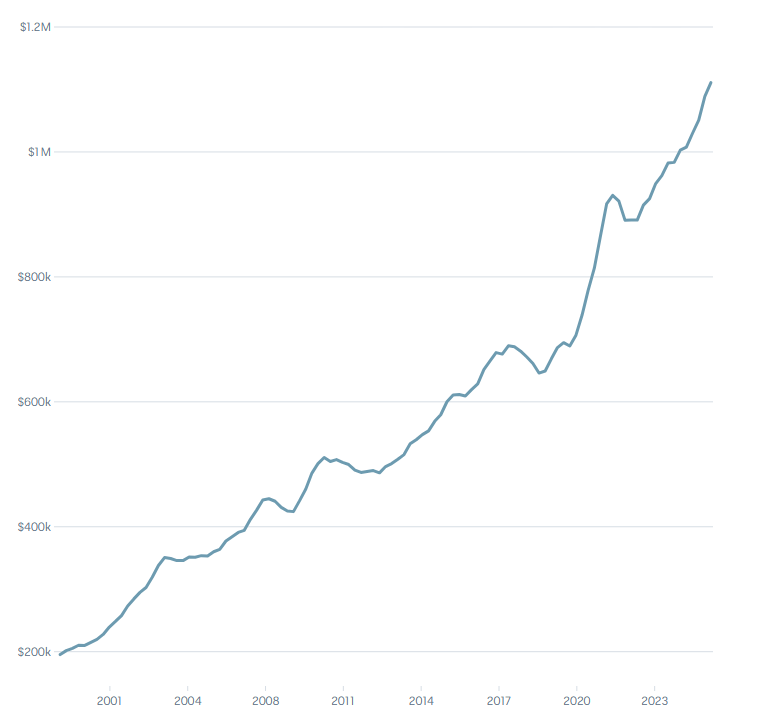
This chart, based on Australian Bureau of Statistics data, shows average house prices in Australia since 1999.
Average home prices have risen more than 400 percent since 2000, increasing at about 8 percent per year.
Clearly prices have risen, but let’s zoom in to better understand the market’s path to this point.
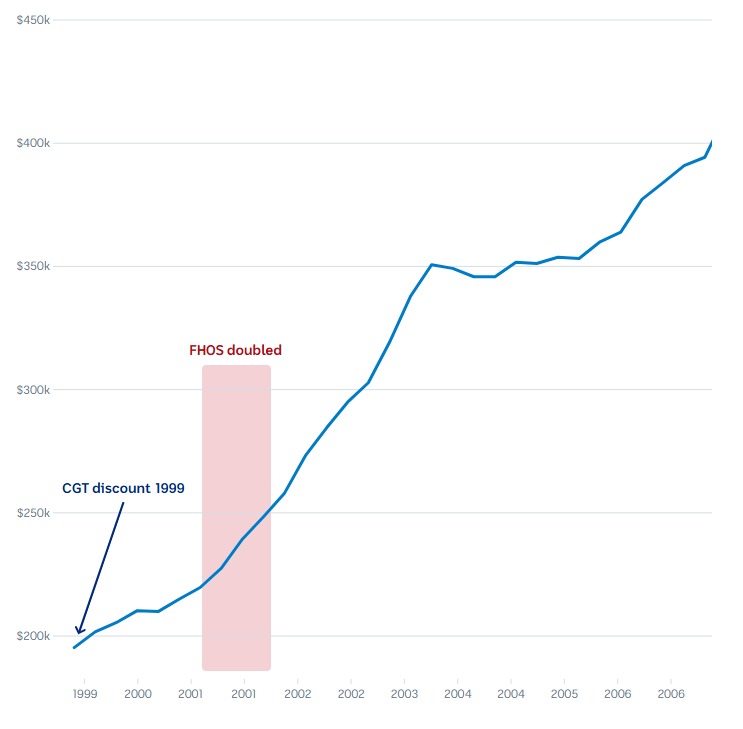
We’ll start in 1999, when then Prime Minister John Howard introduced Capital gains tax (CGT) relief.
The 50 percent discount allowed taxpayers to cut their taxable capital gains in half rather than having to adjust for inflation.
Note that in 2000, the average cost of a house in Australia ranged from $205,000 to $215,000.
In early 2001, with house prices gradually rising, the Howard government doubled the rate. First home owner scheme from $7,000 to $14,000 by the end of the year.
The market continued to rise steadily throughout the mid-2000s, with home prices averaging between $364,000 and $391,000.
Here we’ll zoom out our diagram a little.
Because in the mid-2000s the market changed a lot.
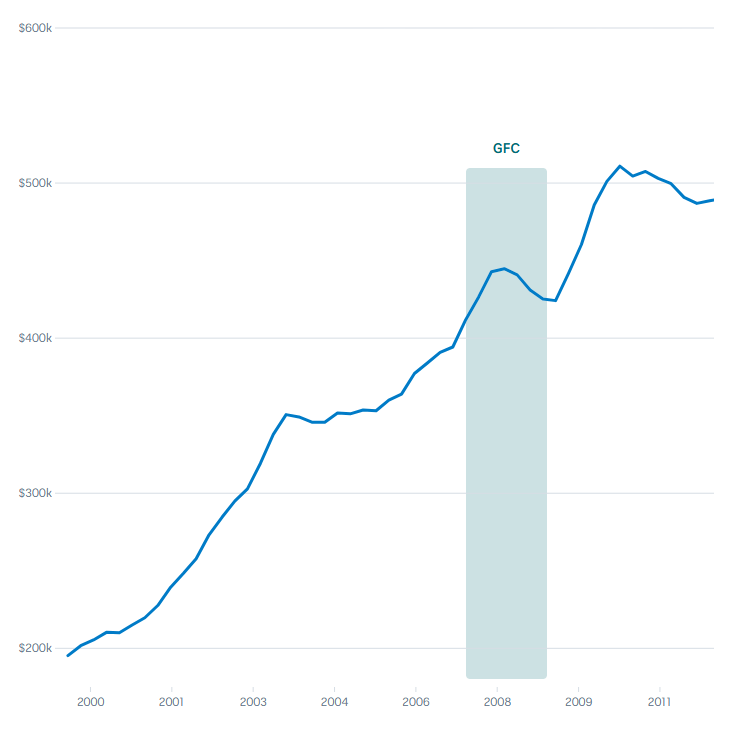
In 2008 global financial crisis (GFC) hit.
In an attempt to prevent an economic downturn, one of the measures taken by the Rudd government during this period included tripling the benefit for first homeowners to US$21,000 to stimulate the housing market.
Unsurprisingly, the GFC is where we see the first significant market decline on our chart.
By 2010, the market was booming and the average home price topped half a million dollars.
The Australian housing market boomed during this time, thanks to a mixture of negative gearing, high population growth due to migration, low interest rates and tight housing supply conditions.
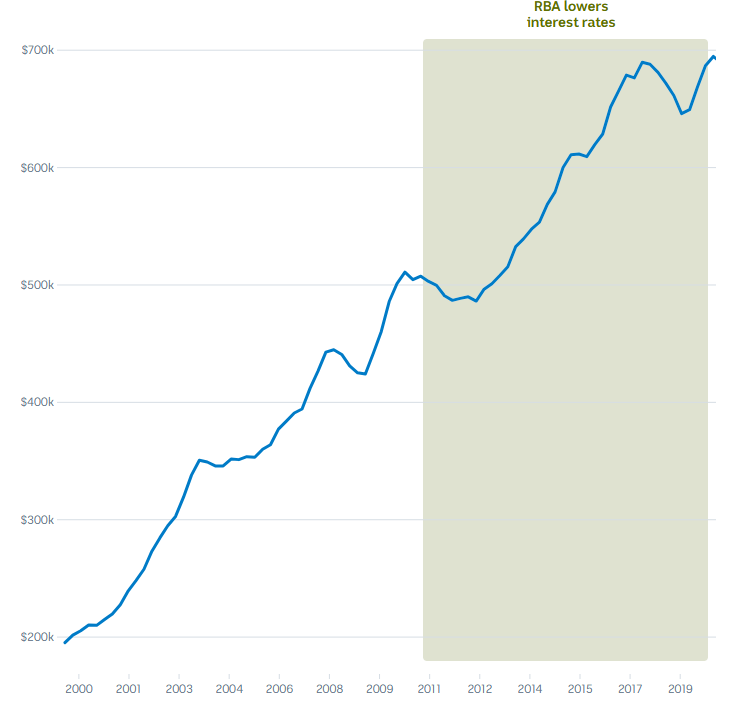
Over the next 10 years Reserve Bank of Australia (RBA) gradually lowered the cash rate target from 4.75 percent at the end of 2010 to just 0.25 percent in March 2020.
By early 2020, home prices averaged between $694,700 and $738,900.
Let’s zoom out again because things are about to change dramatically.
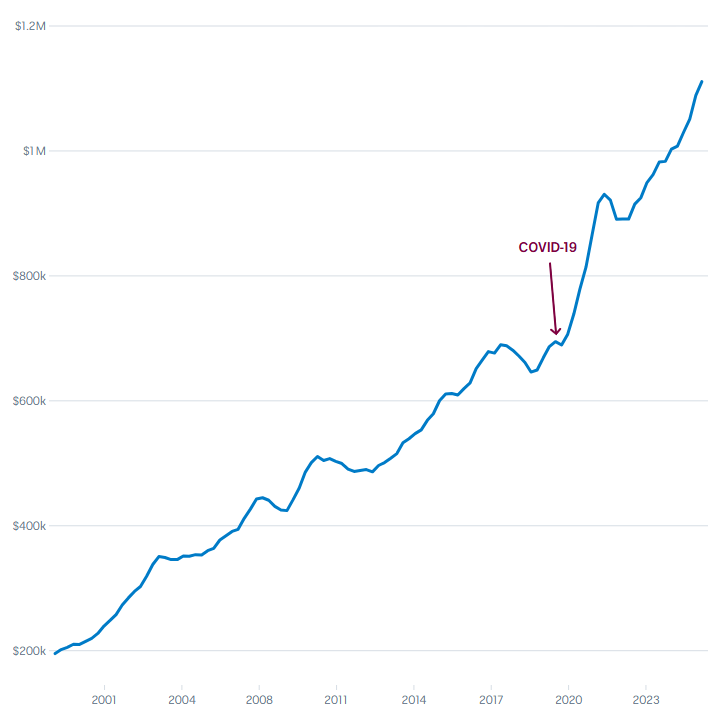
When COVID-19 When the pandemic hit, it dramatically changed the Australian housing market.
A number of factors, including record low interest rates and economic stimulus, have contributed to rising home prices.
It’s also worth noting here that property prices have soared during the pandemic, when immigration was at historic lows.
The Morrison government introduced HomeBuilder The scheme is a time-limited grant of $25,000 towards the construction of a new home or significant renovation of an existing home.
By the end of 2024, the average house price in Australia had surpassed the $1 million mark.
In October 2025, the Albana government expanded 5 percent deposit schemeleading to a sharp increase in the number of first home buyers entering the market.
We have now reached 2026, when the Federal Budget has revealed that the 50% CGT rebate will be replaced by an inflation-based rebate.
So, if house prices fell by 10 percent in Australia, what would that look like?
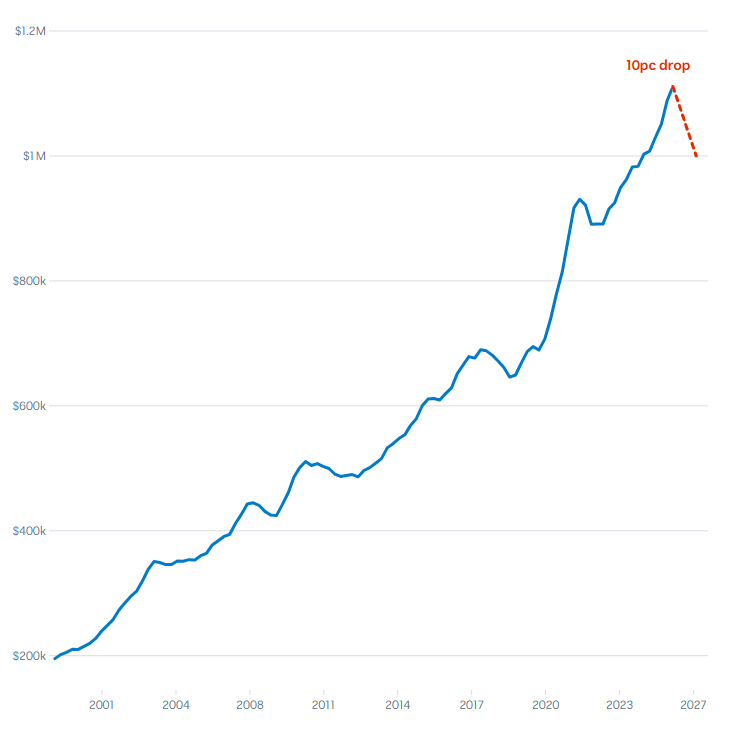
This means prices will return to where they were at the end of 2024.
Economist James Graham from the University of Sydney says property prices are still high even as property values have fallen.
“House prices have been rising rapidly year on year for at least four or five years,” Dr Graham says.
“10 percent seems like a lot, and for some it is, but it’s not that much in the grand scheme of the continued rise in house prices that we’re seeing.”
Independent economist Nicky Hutley says Australia is “one of the least affordable places in the world” when it comes to house prices in terms of price to income.
According to Cotality, the average home price is now 8.9 times the average income.
“The idea behind the tax changes is to force fewer investors to compete, especially with first home buyers, so that house prices come down and make them more affordable.”
To understand who would be most affected by the changes, we spoke to a potential buyer, a new home owner and someone hoping to sell.
First up is our potential buyer: Zakariah Northcott.
Mr Northcott lives in Brisbane, one of the fastest growing housing markets in the country.
He calls the fall in prices a “market correction.”
The 25-year-old works as a customer service manager and says he felt hopeless at times while collecting a deposit on a house with his partner.
House prices in Brisbane have more than doubled over the past six years.
“It feels like the game is rigged against us,” he says.
 Zakaria Northcott and his partner Zoe Mildwaters are looking to buy their first home.()
“Houses have to fall down to make buying a home smart for everyone.
“If house prices continue to rise at this rate, it won’t matter if we save until we’re 45, we’ll never have a big enough deposit.”
Mr Northcott says all he can currently afford is a one-bedroom apartment.
“We need more than one bedroom so we can have a family and have space,” he says.
“If house prices don’t fall, it may mean we simply won’t be able to have children.
“This is the purpose of our life. We always wanted a family, a home, the same thing that our parents and grandparents had.”
On the other side of the country, in Perth, we have a new home owner – Daniel Jones.
Mr Jones says “distorted” house prices should fall, even though his home could end up worth less.
The 27-year-old bought the two-bedroom apartment with his wife last September for about $725,000.
Daniel Jones says ‘distorted’ house prices must change.()
The property was smaller than the couple would have liked as young parents, but they decided to hit the market to stay close to family in Perth’s inner western suburbs.
He says price increases over the past two decades are unsustainable and are preventing young people from owning a home.
“It’s becoming an investment casino rather than what it should be, a place for people to live,” he says.
Ms Hutley says for most people who have bought a home in the last few years, even a 5 per cent drop in house prices would leave the value of their home the same as when they bought it.
Since the COVID-19 pandemic, house prices in Australia have risen by more than 50 per cent.
Ms Hutley says negative equity – where a home is worth less than what it owes to the bank – poses a higher risk when house prices fall.
“There is a risk for younger new home buyers with higher levels of debt: if they lose their job and have to sell and the price of the home falls, then that becomes a big problem,” she says.
“Not so much for the banks, because they have mortgage lender insurance, but for a person to walk away with less than they started with is problematic.
“We’re talking about a very small percentage of the population, but still, for those who have faced this risk, it’s a concern.”
Daniel Jones bought his two-bedroom apartment with his wife in September last year. ()
Mr Jones says he is not afraid of the risks of falling house prices for first-time buyers, such as negative equity.
He says his properties have already increased in value by at least 10 percent.
“It’s not good for people who end up with negative equity. But in order to reverse this discount, unfortunately, some people have to lose out,” he says.
“I have very strong views on this issue. I think this is long overdue.”
And there are those who want to sell. Larissa Ferguson was hoping house prices wouldn’t fall after she spent the last three years building a three-bedroom home in Victoria Point, in Brisbane’s south-east.
The single mother of three says she had planned to sell her home next year to buy a bigger home for her family, but those plans have now fallen by the wayside.
Ms. Ferguson says the total cost of her home was about $830,000.
“With house prices possibly falling, I may not be able to get what I was hoping for, and that will affect me getting something big enough for us,” she says.
Larissa Ferguson says falling home prices and rising interest rates have heightened her concerns about negative equity.()
Dr. Graham says falling home prices affect the entire market, not just the home a person is trying to sell.
“If all the houses are down 10 percent, your house is down 10 percent, but so is the house you want to buy.
“So for this person the situation is no worse than it was a month or two ago.
“People sometimes forget about this. They feel like they’ve lost wealth, but as long as what you want to do with that wealth is just buy another house, that’s a form of laundering.”
But Ms Ferguson says a combination of falling house prices and higher interest rates has heightened her concerns about negative equity.
She already spends about half her income on biweekly mortgage payments.
“If (house prices) fall, then the money I made on my last property over the last 10 years will unfortunately be wasted,” she says.
“It will have serious consequences for me financially and for the children if the amount falls below what I invested in it.”
Ms Hutley advises being careful with house price forecasts because they can be difficult to justify.
She says there are many factors contributing to the contraction of the market right now.
“Rising interest rates, changes in the tax treatment of investment properties, increasing the cost of a home to the level of people’s earnings,” she says.
“All of these factors put downward pressure on home prices.”
The Prime Minister acknowledged the consternation among investors and homeowners but said the changes were aimed at “making the system fairer”.
“In this debate, everyone has accepted that the housing system is broken,” Anthony Albanese said at 7.30 on Monday night.
“So we had to do something about it.”