

Listen to this article
Approximately 3 minutes
The audio version of this article was created using artificial intelligence technology. Pronunciation errors may occur. We work with our partners to continually analyze and improve results.
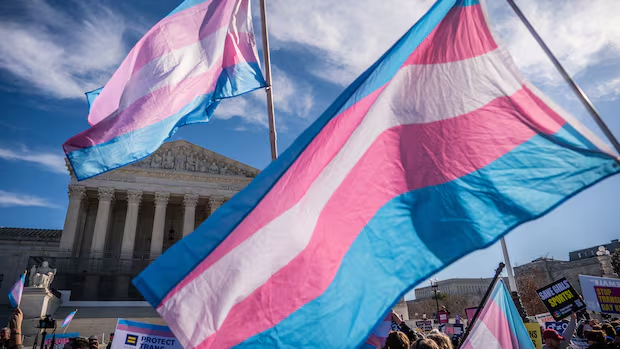
The U.S. Supreme Court on Tuesday allowed states to impose restrictions on transgender student-athletes, upholding laws in Idaho and West Virginia that bar them from participating in women’s sports teams, a controversial issue woven into the nation’s culture wars.
The justices overturned lower court decisions that sided with transgender students who challenged bans in two states as violations of the U.S. Constitution and federal anti-discrimination law.
Laws in Idaho and West Virginia define sports teams in public schools, including universities, according to the “biological sex” assigned at birth and prohibit “male students” from participating in girls’ teams. Twenty-five other states have similar laws.
Republican President Donald Trump’s administration, which has tightened transgender rights, supported the states in the lawsuit.
Idaho and West Virginia say the laws preserve fair and safe competition for women and girls, while critics see the measures as part of a broader attack on the rights of transgender Americans.
Students challenging the measures said they discriminate based on a person’s sex or transgender status—in violation of the 14th Amendment to the Constitution, which guarantees equal protection under the law, as well as Title IX of the Civil Rights Act, which prohibits discrimination in education “on the basis of sex.”
Last year, the Supreme Court handed down another major ruling on transgender rights, ruling that states can ban medical treatments such as puberty blockers and hormones for people under 18 who suffer from gender dysphoria. This term refers to the clinical diagnosis of significant distress that may result from a discrepancy between a person’s gender identity and sex at birth.
The Supreme Court, which has a 6-3 conservative majority, has upheld other transgender restrictions, allowing Trump to ban transgender people from serving in the military and prohibit passport applicants from choosing the gender that reflects their gender identity on the document.
And yet, in 2020, the court issued a landmark ruling protecting transgender people from workplace discrimination under a federal law called Title VII of the Civil Rights Act of 1964, which contains language similar to Title IX.
Trump policy
The issue of transgender athletes playing on women’s sports teams has become part of the US culture wars.
Trump has taken a strong stance on transgender rights since returning to office in January 2025. He has called transgender people’s gender identity a lie and issued decrees restricting their rights, including rights related to participation in sports.
The West Virginia law was challenged by Becky Pepper-Jackson and her mother, Heather Jackson. Pepper-Jackson is a high school junior in Bridgeport, West Virginia, who competes in shot put and discus.
The Idaho challenge was proposed by Lindsay Hecox, a transgender student who previously participated in Boise State University’s soccer and cross-country clubs.
Hecox decided to quit the sport and tried to drop the case in part due to fears of persecution and growing intolerance towards transgender people. Hecox’s lawyers argued that this development rendered the challenge moot.
The Supreme Court heard arguments in January. Its conservative judges expressed concern about imposing uniform rules across the country amid controversy and uncertainty over whether drugs such as puberty blockers or gender-affirming hormones eliminate male physiological advantages in sports.