
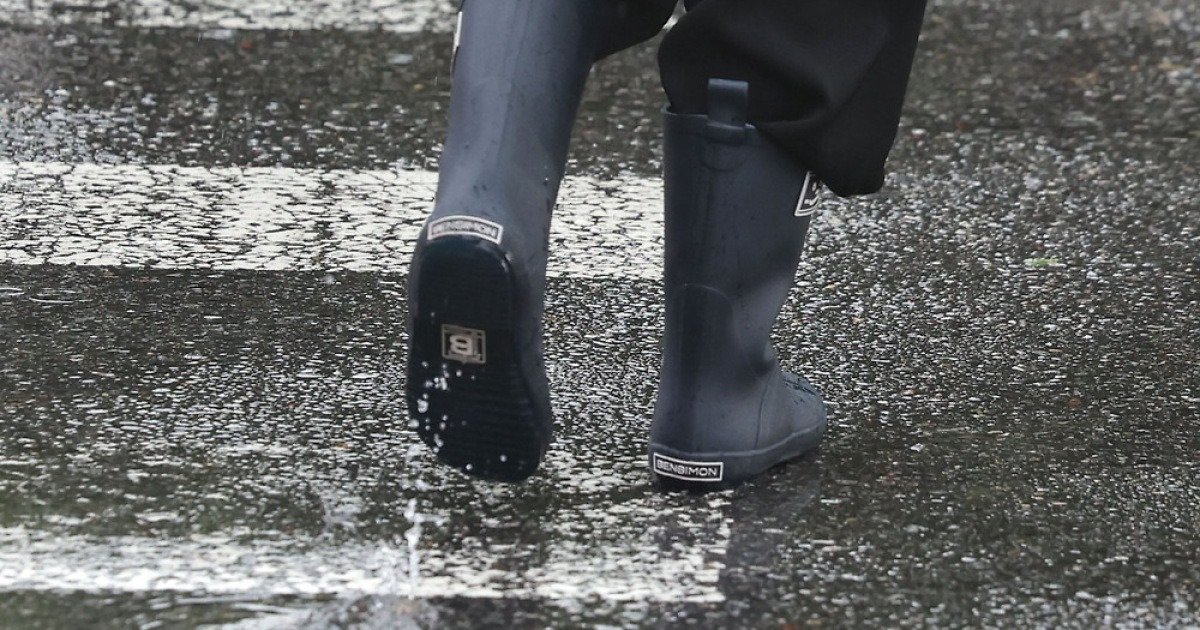
Citizens wearing boots move through Gwanghwamun Square in Jong-gu, Seoul, on the 20th after rain. /News 1
This summer’s rainy season is expected to end across the country no later than early next week. As high pressure in the North Pacific Ocean completely covers the sky over Korea, a full-blown heat wave is expected in midsummer.
According to the Korea Meteorological Administration on the 23rd, the stagnant front (monsoon front) is currently mainly in the central region and is moving north and south in the central and southern regions. Jeju Island is already occupied by high pressure in the North Pacific Ocean.
The rainy season begins when the hot high pressure of the North Pacific Ocean and the cold high pressure of the Sea of Okhotsk collide over our country. During this collision, a stagnant front forms, and as high pressure in the North Pacific Ocean expands, the front rises from Jeju to the southern and central regions. When high pressure in the North Pacific no longer moves south and dominates the skies, the region’s monsoon season will end.
In the case of Jeju, the rainy season practically ended on the 19th. After the 19th, it began to rain in Jeju, but the rain was not caused by a stagnant front. According to the mid-term forecast of the Korea Meteorological Administration, the southern and central regions are expected to declare the end of the rainy season on the 26th and 27th.
On the 23rd, 20 to 60 mm of rain is forecast for the city center and Gyeongbuk. On the 24th, rain of 20 to 60 mm is forecast in the metropolitan area and Gangwon-do, and on the 25th, rain of 5 to 40 mm is forecast in the metropolitan area and Gangwon-do. Although forecast rainfall amounts have not yet been released, there is news of rainfall in the central region, Gyeongbuk and Jeonbuk on the 26th and 27th. From the 28th until the end of this month, the entire country will be on the edge of a North Pacific high pressure area with cloudy skies and no rain expected.
Just because the rainy season is over doesn’t mean it won’t rain again. This is because localized heavy rain can occur at any time. After 2022, the rainy season ended and there was a lot of rainfall in August. “Extremely heavy rain” of 141.5 mm per hour in Dongjak-gu, Seoul also occurred in August 2022.
The heat wave, currently concentrated in the south, is expected to spread into the central region. The “night heat” is already intensifying: from the night of the 22nd to the morning of the 23rd, a tropical night begins in Seoul (the minimum night temperature is above 25 degrees). The Korea Meteorological Administration forecasts the highest temperature on the 24th to be 38 degrees, and the highest temperature on the 25th to be 37 degrees.
Copyright © Joseon Ilbo. Reproduction and distribution is prohibited.