

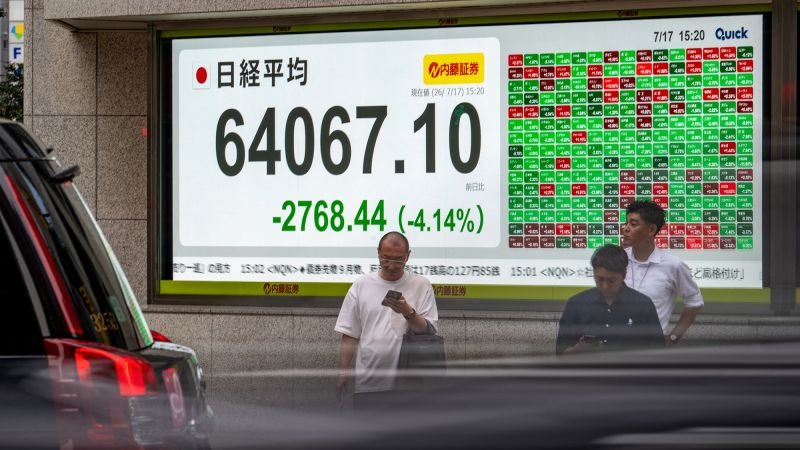
Stocks in Asia and the US fell on Friday after tech Advances announced by a Chinese company in artificial intelligence have fueled concerns that the surge in AI spending that has fueled this year’s market rally could be at risk.
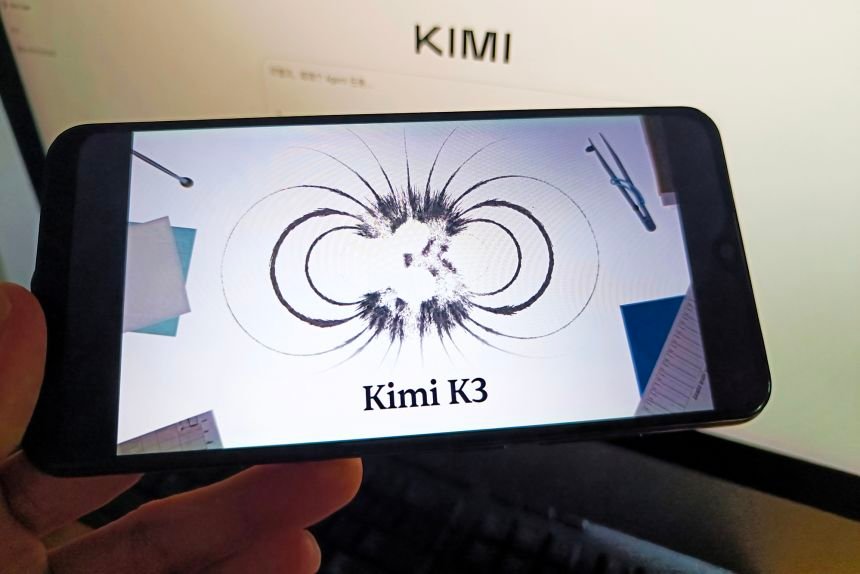
Chinese startup Moonshot AI has unveiled Kimi K3, a new open-source model that the company says largely closes the gap with models like OpenAI’s ChatGPT and Anthropic’s Claude.
On Friday, the Nasdaq fell 1.4% and the S&P 500 fell 1%. The Dow closed down 407 points, or 0.77%.
On the news, Taiwan’s benchmark stock index closed down more than 6%, while Japanese markets closed down 4%. South Korean markets were closed on Friday for a national holiday.
Moonshot said the Kimi K3 is approaching the performance of cutting-edge models such as Anthropic’s Claude Fable 5, again raising concerns about competition from Chinese companies.
According to Moonshot, the Kimi K3 is the world’s largest open source model. Open-source models could pose problems for US artificial intelligence companies that are trying to charge subscription fees for access to their closed-source models. It could also hurt chipmakers who are betting on continued growth in AI spending.
A popular index tracking shares of semiconductor chip makers fell 1.6% on Friday, down 20% since hitting a record high in late June – and entering a technical bear market. The index fell 10% this week, its worst week in more than a year, although it is still up 65% this year.
After a surge in artificial intelligence enthusiasm in recent months, the number of chip makers is falling sharply. Shares of chipmaker Micron (MU) have fallen about 30% since hitting a record high in late June, but they are still up nearly 200% this year.
Competition from alternative open-source models could worsen growth forecasts for artificial intelligence companies and complicate plans for massive infrastructure spending, which could hurt earnings forecasts for chipmakers and companies betting on the artificial intelligence boom.
Breakthroughs by Chinese artificial intelligence companies have rocked American markets in the past, such as in January 2025, when Chinese artificial intelligence company DeepSeek unveiled a model that challenged assumptions of U.S. dominance in the tech sector.
While the Kimi K3 roiled markets on Friday, some investors said it would be necessary to see how effective it would be. US stocks quickly recovered from the DeepSeek scare in January 2025, and tech companies continued to spend on building artificial intelligence infrastructure.
Shares of Google parent Alphabet (GOOG), which fell 4% on Thursday following reports of a delay in the launch of its flagship artificial intelligence model, fell another 2% on Friday.
Shares of Nvidia (NVDA) fell more than 2% on Friday. The company’s market value briefly fell to $4.85 trillion, falling below Apple’s value and returning Apple to its status as the world’s most valuable company. Apple (AAPL) shares rose 0.1% and are up 15% this month.
It’s been six weeks since the S&P 500 and Nasdaq hit record highs. Since then, the S&P is down about 2% and the Nasdaq is down about 6%. Nervous about whether investors are overpaying for AI and tech stocks has already surfaced in recent weeks, and the announcement of a new AI model that could compete with leading US models is adding to the worry.
“We’ve been concerned over the past few weeks that technology, particularly semi-finished products, has gone too far, too fast,” Samir Samana, head of global equities and real assets at Wells Fargo Investment Institute, said in an email. “The markets were really just looking for any excuse to sell.”
But Samana said he remains confident in the long-term trajectory of U.S. artificial intelligence companies’ earnings and expenses. “Chinese competition is not new, and we believe the overall pie will grow enough to support US tech companies,” he added.
Overall, the S&P 500 is still near all-time highs. Investors have also moved into other sectors, such as financials, while moving away from technology stocks. An exchange-traded fund that tracks technology stocks is down more than 7% this month, while a fund that tracks financial performance is up 5%.
Another headwind for stocks was the continued rise in oil futures due to overnight US attacks in Iran, raising fears that the flow of oil from the Persian Gulf would be cut off again. Rising oil prices could raise fresh inflation concerns, which have subsided as oil has fallen since early June on hopes of an end to the war.
Annual inflation was 3.5% in June, down from 4.2% in May, according to consumer price index data released Tuesday by the Bureau of Labor Statistics. This comes after gas prices fell sharply as tensions in the Middle East eased.
But oil futures rose in Friday trading, with the average price of a gallon of regular gasoline in the U.S. approaching $4 for the first time in a month, reaching $3.98 in the latest AAA data.
Brent crude rose about 4.6% on Friday to settle at $88.10 a barrel, its highest level since June 11. US benchmark WTI rose about 4.5% to settle at $82.49 a barrel, its highest level since June 12.
The price of WTI crude oil rose 15.5% this week, the biggest weekly increase since the first week of the war with Iran in early March. The price of Brent crude jumped nearly 16%, its biggest weekly jump since late April.
“This combination of concerns about technology and inflation is really undermining the more buoyant story following the weak US CPI report earlier this week,” Deutsche Bank Research said in a note to investors on Friday.