

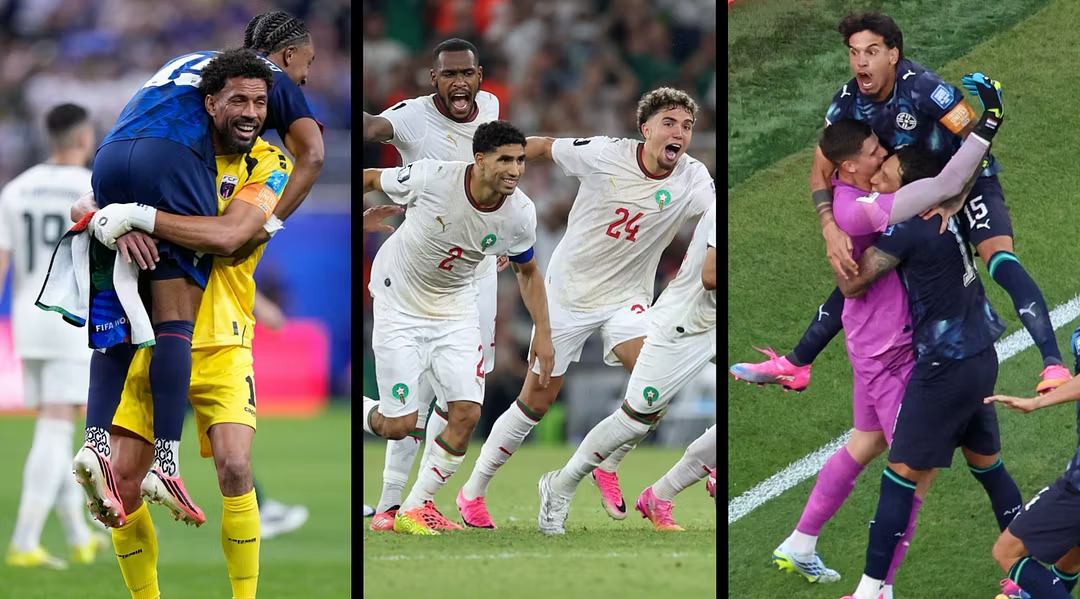
Cape Verde, Morocco and Paraguay have shown that being an underdog can be an advantage. Photo: Ashley Landis/AP/TT, Sophia Yacker/AP/TT, Mark Stockwell/AP/TTShow more
Being someone who has everything to gain and nothing to lose can be a huge psychological advantage. Especially when the difference in results is as small as at this year’s World Cup, say sports psychology researchers.

In principle, no one expects Sweden to win today’s World Cup match against France.
And that can be quite good.
 Show more
– From experience we know that then there will be less pressure. “You can relax your shoulders a little and dare to attack, even if you are up against such a good team,” says Henrik Gustafsson, professor of sports science at Karlstad University and consultant in performance psychology.
He cites some historical examples where the focus was on opponents just about to win. For example, when IFK Göteborg, essentially a group of amateurs, defeated a big German team to win the UEFA Cup in 1982.
Or, of course, the few World Cup matches this year that were full of shocks: Cape Verde’s 0-0 draw against Spain and the last 16 when Paraguay knocked out Germany.
Press about France
Also, Göran Kentta, a lecturer and researcher in sports psychology at the University of Gymnastics and Sports, believes that Sweden’s situation before the match with France has psychological advantages. Because the pressure and expectations are actually mostly on the opponent.
 Show more
“On the contrary, they have something to lose and nothing to gain, which is a much more difficult situation morally.” A loss or a draw after regulation time would be a complete fiasco for them. “From a Swedish point of view, overcoming a disadvantage is a positive thing, you can play more relaxed,” he says.
Unleash your full potential
But perhaps a friend of the order would argue, France is still by all accounts the better team. Of course, but during a match it’s not about being better than you are, it’s about getting as close to your performance ceiling as possible, says Henrik Gustafsson.
– It is important to give yourself a chance by optimizing your own performance. If we can stick to our game plan, there is a good chance that we will perform very well and thus have a chance to beat France. “Even if it’s a fantastic team, you’re not part of it,” he says.
Physical ability, tactics and technique are of course the deciding factors in football. But when teams are as evenly matched as they are today, psychology can be what prevails, says Henrik Gustafsson and shows that Sweden played on equal terms against Japan, which in turn played on equal terms against the football giant. Brazil.
– This shows how small the difference is in world football now. So we don’t need to think that we are the best. We need to believe that our game idea works and implement it to the fullest.
 Paraguay’s Gustavo Gomez celebrates victory over Germany and may be an inspiration to Sweden’s players. Photo: Charles Krupa/AP/TTShow more
Confidence is largely based on one’s own previous performances, and here Sweden can build on the match against Japan, which showed potential. But according to conventional “self-efficacy” theory, seeing other calculating teams win over and over again can affect us positively, which roughly translates to situation-specific self-confidence.
– If miracles never happen, it’s hard to believe in miracles. But if you can compare with other underdog teams who manage to win, it increases the feeling that it really is possible, says Göran Kentta.
Psychological flexibility
But when you meet a team like the French, full of international stars, can’t you perform worse out of sheer nervousness?
In modern sports psychology we talk about psychological flexibility.
“It’s not about not being nervous or being fearless. And about courage, despite feelings of doubt or even anxiety. “Not to get rid of nervousness, but to carry it with you and perform despite it,” says Henrik Gustafsson.
Despite optimistic reports that it’s not over yet, how likely do researchers think Sweden will actually win?
– If you look at the statistics, the teams with the best rating most often win. But the success of an underdog team is not unusual. “Nobody thought Mjällby would win Allsvenskan last year,” says Göran Kentta.