

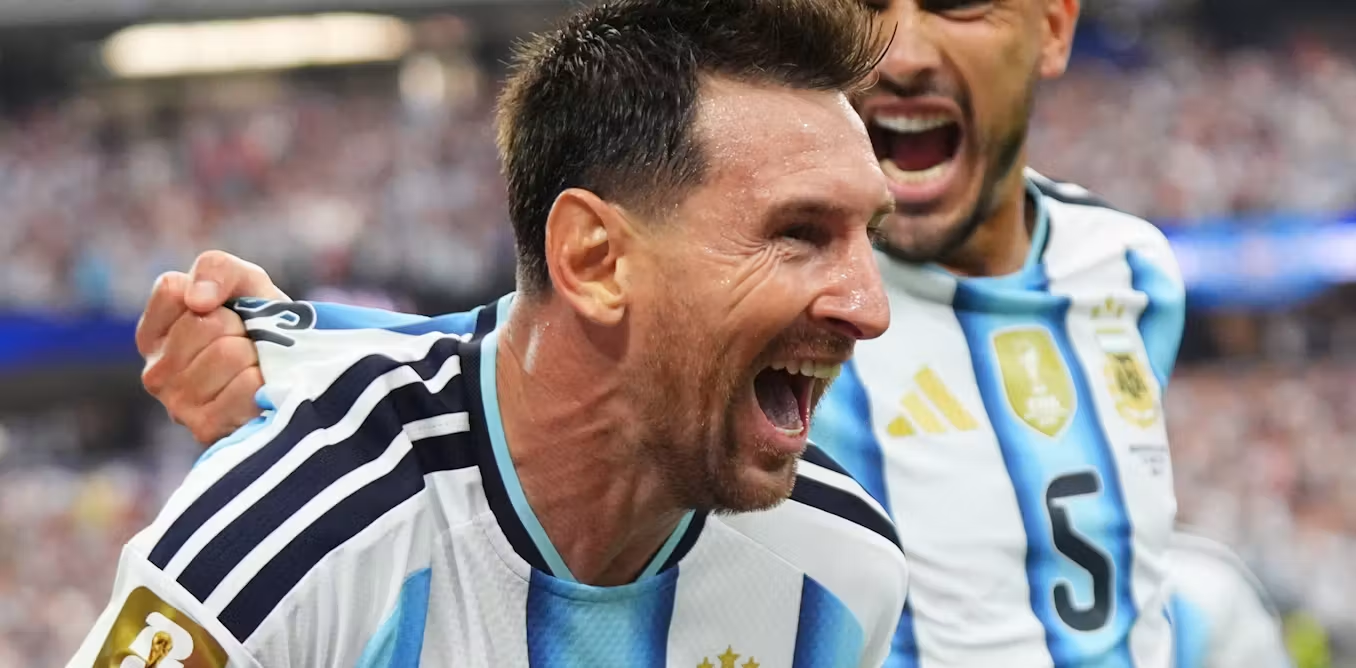
Lionel Messi is 39 years old. At 1.70m, he is shorter than almost any defender he plays against. He had never been amazingly fast, but now he was slower.
And yet, watching this World Cup, you’d be hard-pressed to name a player who has done more damage: he’s tied with France’s Kylian Mbappe on the number of goals so far (six).
How can a man who has so little of what we might call athleticism (at least compared to his peers) still be the best player on the field?
Does athleticism really matter?
Perhaps the riddle is not put together correctly. Many people are surprised by Messi only because we have been told the story of what makes an athlete great, and that story is mainly about the body: speed, height, strength, fitness.
Compared to this story, Messi seems like an exception.
But what if the problem is in the story itself? What if football was never a competition of physicality?
Johan Cruyff, the great Dutch player, coach, commentator and football philosopher, saw this clearly half a century ago. He said:
What is speed? The sports press often confuses speed with insight. If I start running a little earlier than someone else, I seem faster.
This remark sounds like a riddle, but the fast player is often not the one with the faster feet. Often they are the ones who leave earlier and arrive first. What looks like speed is very often an advantage bought by perception.
Cruyff understood this. What we’ve been able to do more recently is measure this.
Importance of scanning
Think about what happens in the seconds before Messi receives the pass. Watch him for 30 seconds when the ball is not near him: his head rarely stays still. One look over the left shoulder, another to the right, then back to the ball carrier.
None of this seems remarkable until you realize that he has already collected information that others have not yet found, or at least are less adept at finding.
By the time the ball gets to him, he already knows where the defenders and teammates are and where the gaps will open. Control, turn, pass that splits the defense: all this is the easy part. The hard part happens before he even touches the ball.
This is something we can measure.
For more than a decade, we have been studying how soccer players gather information before receiving the ball. Working with athletes from youth academies to senior professionals, we installed small motion sensors on the back of their heads and recorded how often and how widely they turned to look around during a match.
We measured what we call visual exploration – or, more simply put, scanning.
We asked a simple question: how much do players look around before the ball gets to them, and does it matter?
The conclusion was consistent and clear. Players who scanned the ball more often in the seconds before receiving the ball were quicker to complete their next pass, more likely to turn with the ball rather than playing it safely back, and more likely to play a forward pass that actually threatened an opponent.
The information they gathered before the ball arrived determined what they could do after that. Scanning is how the player obtains this information in the first place.
Our work separates two scanning objectives. The first is orientation: Look around to see what the entire area has to offer, what options exist, where the dangers lie, and what might become available.
Second specification: A more subtle, late-looking, directing pass execution.
Orientation comes first and is something we tend to neglect in both research and coaching because it happens away from the ball when nothing dramatic happens. And yet this is the basis. You can’t make a pass you’ve never seen before. Cruyff put it this way:
There is only one moment in which you can catch it. If you’re not there, you’re either too early or too late.
This is where Messi stops being an anomaly and becomes the ultimate example of what the sport rewards. He never defeated opponents primarily with his body. He defeats them over time and wins by seeing earlier.
If he’s slower, it doesn’t matter because he’s not racing anyone – thanks to earlier and better perception, he’s wired in such a way that there will never be a need for that. The shorter, slower and aging body is not a disadvantage that he overcomes with genius. This is a sign that the body was never the main event.
A skill you can develop
Of course, scanning is not everything. Technique, experience and team tactics all matter. But without timely information, these qualities rarely have the opportunity to manifest themselves.
There is a lesson in this: perception is something we can consciously develop in players who will never be the fastest or the tallest.
Coaches already sense this when they yell “check your shoulder” at a player who is about to get into trouble or lose sight of an opposing player.
Our data shows that the habit of scanning the field before the ball arrives can be instilled from an early age.
Where greatness truly lives
We’ve spent a century creating athletes in the gym, but much less time creating what Messi does in abundance.
So the next time someone wonders how a 39-year-old man standing just 1.70 meters tall is still dominating the World Cup, watch his head, not his feet.
Greatness has never been hidden in the body. It was always in search.