

Alphabet performed well, but the stock still fell significantly. That’s what makes it interesting. The market reacted not to a weak operating business, but to a surge in AI investment and negative free cash flow for the first time. The risk-reward profile has now changed for stocks.
• Alphabet is growing rapidly operationally.
• Google Cloud is accelerating significantly.
• The market is wary of high investments in AI.
• Reported earnings are distorted by investment earnings.
The key question for investors is not whether Alphabet is weak. The question is, is the massive expansion of AI infrastructure a cost issue or the basis for the next phase of growth?
Alphabet: sales continue to grow
From US$29.3 billion (2010) to US$402.8 billion (2025), the growth trajectory remains unchanged.
Alphabet (GOOGL): sales development 2010-2025.
Growth compared to previous year
Actual, time period and estimates
Highlights: Growth in 2021 +41.2% | Sales in 2025 +15.1% | LTM by June 30, 2026: US$445.9 billion.
Source: Bloomberg, annual data in billions of US dollars; As of July 24, 2026. LTM = Last 12 Months, e = Estimate.
Failed to load chart library.
Operationally strong, balance distorted
Sales rose 24 percent to $119.8 billion in the second quarter. Google Cloud even grew 82 percent to $24.8 billion. Operating income increased 30 percent to $40.8 billion. These are not crisis numbers. This is a solid operating basis.
However, the reported earnings per share are confusing. GAAP earnings per share jumped to $9.11, but were heavily impacted by gains in the value of holdings such as SpaceX and Anthropic. Operating earnings per share were $2.85, slightly below expectations.
That’s why it’s worth taking another look. The headline “Profits Explode” is not true. But the headline “Alphabet Disappointed” is just as wrong. The truth lies in the middle: the core business is doing well, cash flow is under pressure due to investments in artificial intelligence.
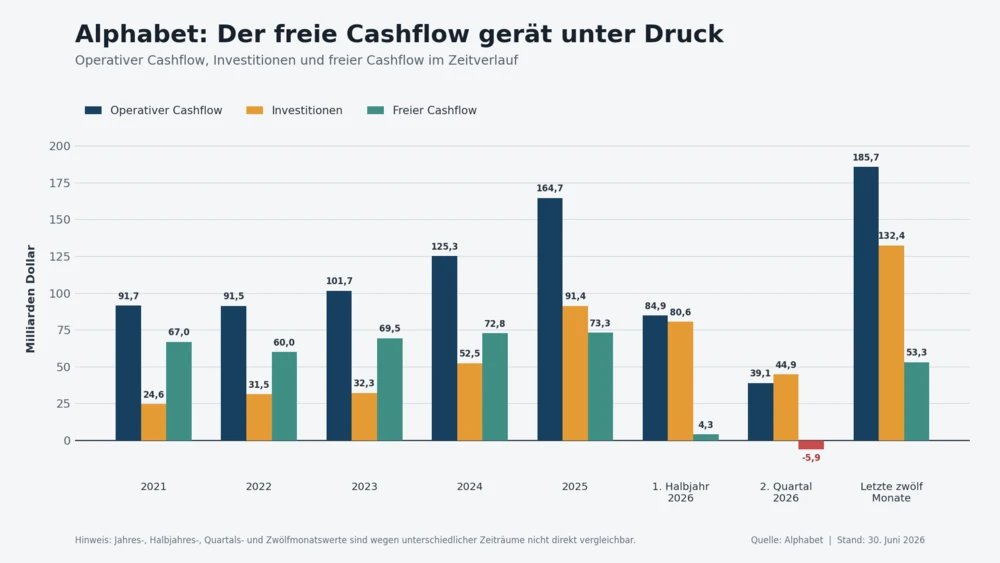
Cash flow development in the alphabet
The real shock is called capex
The market was particularly concerned about capital expenditures. Alphabet spent $44.9 billion on infrastructure during the quarter. As a result, free cash flow fell to minus $5.9 billion. For the full year, the group raised its capital expenditure forecast to $195–205 billion. Alphabet plans to increase its investment plan for 2026 by another $15 billion.
This is the central debate: Alphabet makes a lot of money, but invests even faster. The market wants to know when this spending will produce visible AI benefits.
In the short term, this skepticism is understandable. However, in the long term it is not automatically negative. Anyone serious about AI, the cloud, and native TPU hardware today must build data centers, chips, networks, and capacity.
Megatrend follower
Alphabet (A)
(WKN: A14Y6F)
The cloud shows why people invest
The cloudy numbers serve as a counterbalance to concerns about capital expenditures. Google Cloud grew 82 percent to $24.8 billion in revenue. Expectations were clearly exceeded. The development was driven by artificial intelligence workloads.
This is where the strategic core lies. Alphabet doesn’t invest in abstract promises of the future. The group is building capacity because there is demand. As cloud, AI models, TPU hardware and Gemini applications continue to scale, today’s workloads could become the foundation of the next level of revenue.
Thus, the stock’s decline demonstrates less operational weakness than a conflict of trust: investors believe in AI, but want to see the investment pay off faster.
Alphabet: profits continue to grow steadily
From $8.5 billion (2010) to $132.2 billion (2025), profitability has increased significantly.
Alphabet (GOOGL): Earnings 2010–2025
Growth compared to previous year
Actual, time period and estimates
Highlights: Profit in 2018 increased by 142.7% | For the first time in 2024 more than 100 billion US dollars | Net profit in 2025: $132.2 billion.
Source: Bloomberg, annual data in billions of US dollars; As of July 24, 2026. LTM = Last 12 Months, e = Estimate.
Failed to load chart library.
The big picture matters
The most important classification is simple: Alphabet reported no drop in demand. The company is growing, the cloud is accelerating, the operating result is growing. At the same time, the group is paying for this growth spurt with heavy investment.
This makes the stock vulnerable in the short term. Further fluctuations are possible, especially if the market measures large tech companies more in terms of free cash flow. But for long-term investors, Alphabet remains a key platform asset in the digital economy: Google, YouTube, Android, Maps, Cloud, Gemini and its own artificial intelligence chips.
Not a perfect quarter – but a strong signal
Alphabet didn’t have a perfect quarter. Earnings per share are skewed by capital gains, free cash flow is negative and the capex outlook is constrained.
But the operating picture is significantly better than the price cuts suggest. Alphabet is growing rapidly, Google Cloud is working, and high investments show that the company wants to control the artificial intelligence infrastructure itself. The mini-crash has further improved the risk-reward ratio, opening up entry opportunities for long-term investors. It’s these kinds of failures among global market leaders that the stock market newsletter Megatrend Folger is interested in. In the current issue, readers will be able to find out which strategic orientation and which order offers the best setup based on the numbers.
Click here to view megatrending stocks
What: BMAG
Conflict of Interest Note
The author has direct positions in the following financial instruments or related derivatives mentioned in the publication, which may benefit from any price changes as a result of the publication: Alphabet.