

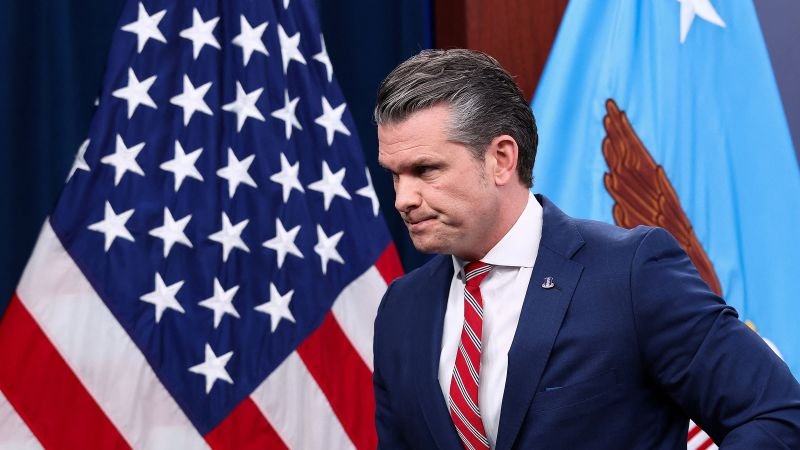
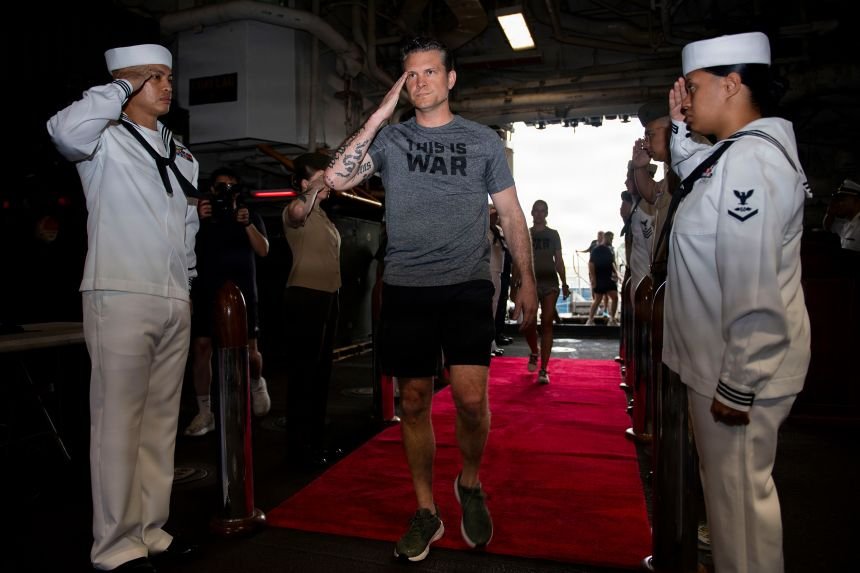
With the U.S.-Iran war at risk of resuming in recent weeks, Defense Secretary Pete Hegseth boarded a Navy ship for what was supposed to be a routine visit to sailors.
The trip was marred by facial hair: Hegseth spotted several sailors with beards, appearing to violate a stricter policy limiting beards in most cases that he issued last year, according to a Defense Department spokesman and emails reviewed by CNN, citing requests for action from the defense secretary.
Hegseth jumped ship wondering whether the rank and file at the Pentagon had paid attention to his beard policy and other policy changes he had made regarding the workforce.
Shortly after the June visit, Pentagon officials held a series of meetings in which they told subordinates that Hegseth was closely monitoring the agency’s progress on beard policies and other workplace changes, and that there was pressure from political appointees to speed up implementation of the directives.
“I would like to point out that SecWar is paying close attention to the progress of EEO (Equal Employment Opportunity) reforms,” a Pentagon official involved in civilian personnel policy wrote in an email to colleagues in June. “Really, our goal is to move faster … some of our schedules need to be reconsidered.”
The episode shows Hegseth paying close attention to personnel policies, including ones that have culture war overtones, even as the U.S. military conducts operations from Iran to the Caribbean. The 46-year-old Iraq War veteran also led Christian prayer services at the Pentagon and threatened to sever ties with Scouts of America over its “woke” policies.
CNN was unable to determine which ship visit prompted Hegseth’s crackdown. He visited the USS Carl Vinson in San Diego in June and the USS Boxer in Singapore in May, according to the Pentagon.
Asked for comment, Pentagon spokesman Sean Parnell said in a statement: Hegseth “maintains the highest expectations of our military personnel to maintain the professional standards of appearance, fitness and discipline that define our fighting force, and he continues to emphasize consistent adherence to hair, weight and grooming standards across all ranks.”
Commanders “will be held accountable for achieving results as the department works to restore a culture of excellence and readiness,” Parnell said.
Hegseth’s changes to the Pentagon’s EEO policy include requirements that workplace complaints be addressed in a timely manner and that the subject of the complaint be presumed innocent unless the evidence proves otherwise. A survey sent recently to Pentagon employees asked them how many workplace complaints were dismissed.
These EEO reforms are a welcome attempt to improve a process that has long been plagued by delays, according to Katherine Kuzminski, a scholar at the Center for a New American Security think tank.
“For those who make a valid complaint, lengthy time frames delay appropriate intervention; Those against whom a frivolous lawsuit is filed have a cloud of suspicion hanging over them until the process is completed,” Kuzminsky told CNN.
Facial hair became a more visible indicator of how Hegseth was changing the army.
In September, he issued a memorandum that tightened restrictions on beards and provided medical benefits for growing them, reversing decades of policy. “No more beards,” Hegseth told hundreds of senior Army officers. “The era of rampant and ridiculous shaving profiles is over.”
In recent years, the military has gradually become more lenient on beards, granting thousands of medical and religious exemptions. But Hegseth’s memo argues that beards pose a national security concern because they can prevent military personnel from safely donning protective gear in response to a chemical or biological threat. (The Army has conducted extensive research into the effects of beards on gas masks and has approved exceptions in the past.)
Critics of the policy say it fails to adequately explain the painful situation. a health condition that disproportionately affects black men. Pseudofolliculitis barbae, or PFP, occurs when shaved hair curls back into the skin. Under the new policy, commanders can remove troops who need to stop shaving after a year of treatment for PFB.
The policy “allows for a climate of hostility toward our Black service members in uniform, in part because it opens them up to greater harassment from older service members,” said Richard Brookshire, co-founder of the nonprofit Black Veterans Project. “This opens them up to the possibility of… disciplinary action for a treatable disease that the military has adequately treated for over a decade.”
“You’re talking about getting rid of highly trained, patriotic and lethal soldiers at a time when our country is promoting new and complex wars by spending literally millions of dollars training these men and women,” Brookshire told CNN.
Hegseth’s changes to care and personnel standards coincided with a speech he gave in September to hundreds of the nation’s senior officers and enlisted leaders he summoned to a military installation in Quantico, Virginia. Hegseth stressed the need for changes on issues such as physical fitness and stricter grooming standards, issues that typically fall to more junior executives to enforce. The issue of threats to the homeland and containing China, he said then, was “another speech for another day.”
The day before the United States and Israel went to war with Iran in February, Hegseth posted a video on social media about Scouts America (formerly the Boy Scouts of America) and his “deep concerns” about the organization’s diversity, equity and inclusion efforts. That same day, he signed a memorandum to end officers’ participation in select fellowships and elite universities such as Yale, Harvard and MIT, accusing the schools of promoting “left-wing ideology.”
CNN’s Haley Britzky contributed reporting.