

CNN —
When it comes to the U.S. Supreme Court, President Donald Trump appears to believe in second chances, however unlikely.
In the days since the high court concluded last week’s session with the release of several high-profile decisions, the president and his legal team have raised the possibility of resorting to an unusual mechanism: asking judges to reconsider decisions they have just made, a procedure that has in some cases failed to succeed in more than half a century.
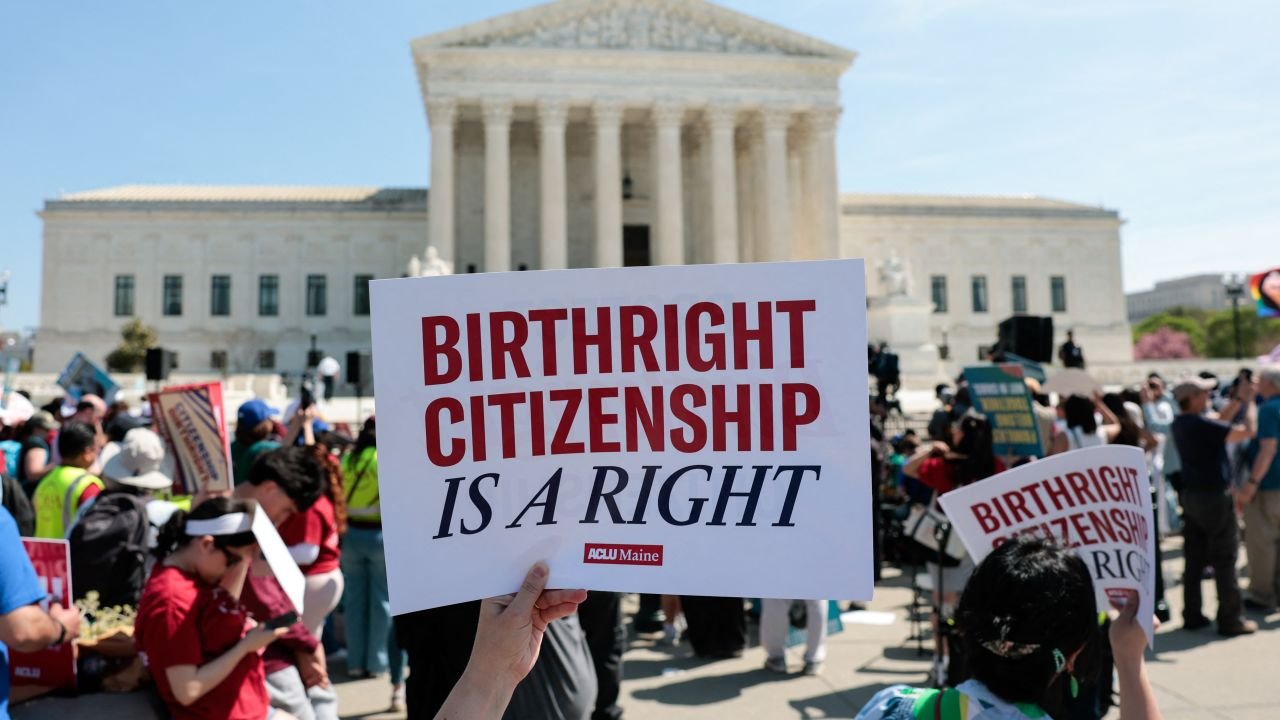
Trump’s lawyers have already asked for a new review of the Supreme Court’s decision to reject his appeal of a ruling that ordered him to pay $5 million after finding that he sexually assaulted and defamed former magazine columnist E. Jean Carroll. In addition, this Wednesday, Trump promised to ask the court to reconsider the decision to block the decree by which he tried to abolish birthright citizenship.
“The Supreme Court decision is wrong,” Trump wrote on social media. “I will immediately seek a new review from the United States Supreme Court. This miscarriage of justice will destroy America unless they reverse this absolutely absurd decision.”
Why was the US Supreme Court’s birthright citizenship decision a blow to Trump?
Why was the US Supreme Court’s birthright citizenship decision a blow to Trump?
01:44
Supreme Court rules allow parties to request a rehearing within 25 days of the decision. However, in practice, the court usually grants such requests only when a relevant fact arises after the decision is made, and not simply because the losing party does not agree with the result.
On June 30, the Supreme Court ruled by a six-to-three vote to invalidate Trump’s attempt to end automatic birthright citizenship through an executive order. Five justices found that the measure violated the citizenship clause of the Fourteenth Amendment. The sixth justice, Brett Kavanaugh, ruled that the order was constitutional but was still blocked by federal immigration law.
The last time the Supreme Court agreed to review a decision after hearing arguments was in 1965. The case, Maryland v. United States, arose from a 1958 air collision between a commercial airliner and a Maryland Air National Guard training aircraft. The issue was whether the plaintiffs could seek compensation from the United States government. In 1965, the court concluded that the pilot was an employee of the State of Maryland, not the federal government.
However, the plaintiffs argued that lower courts only considered the liability of pilots, not federal air traffic controllers. In a brief resolution, the Supreme Court allowed this particular case to continue to be heard in the lower courts.
Nearly a decade ago, the Court agreed to review another case involving the court-martial of two common-law wives accused of killing their military husbands while they were overseas, one in England and the other in Japan. Having considered the case again, the court came to the conclusion that women could not be tried in a military court. To date, this is the only time the Supreme Court has reviewed an already decided case and overturned its own decision.
“It’s extremely rare for a court to grant a retrial,” said Michael Dorf, a constitutional law professor at Cornell Law School.
“When he does this, it’s usually because critical information comes to light that wasn’t available when he initially solved the case,” Dorf told CNN. “Attempts to re-discuss an already settled issue almost always fail.”
The Justice Department did not respond to questions about Trump’s promise to ask for a new review.
Judging by the court’s historical jurisprudence, Trump’s chances in the Carroll case might have been slightly better, although they remain very slim.
This week, the president’s lawyers asked the Supreme Court to reconsider its decision to reject his appeal of a ruling requiring him to pay Carroll $5 million. They also later asked lower courts to withhold the payment while judges reviewed the request.

Trump has signaled he will soon appeal another case involving Carroll and argues the Supreme Court should review both cases together. However, his lawyers already made this argument in a letter sent to the court last month. Despite this, the court rejected the appeal last week, with no judge dissenting.
Carroll’s lawyers declined to comment for this story.
Reviews of decisions to dismiss an appeal are somewhat more common than reviews of a final decision, although they are almost always in response to a significant change in circumstances after the court’s decision. The last time the Supreme Court granted such a request was just over a year ago in a case involving federal anti-doping laws for the horse racing industry. In that case, the court remanded the case to a federal appeals court for a new trial after another appeals court reached a different conclusion about the constitutionality of the law.
In asking a lower federal court to stop Carroll’s payment, Trump’s lawyers cited about a dozen cases, some dating back to 1940, in which the Supreme Court reversed its decision to reject the appeal.
“Reconsideration is not legally impossible,” Trump’s lawyers said this week. “The court should not ignore the serious and irreparable consequences of transferring funds that can never be returned.”
The federal judge presiding over the case rejected that argument this Wednesday and ordered the funds to go to Carroll.
Trump immediately appealed the decision. Later that same Wednesday, a federal appeals court declined to grant an immediate stay while it considers the president’s request to further delay the payment.
This story has been updated with additional information.