
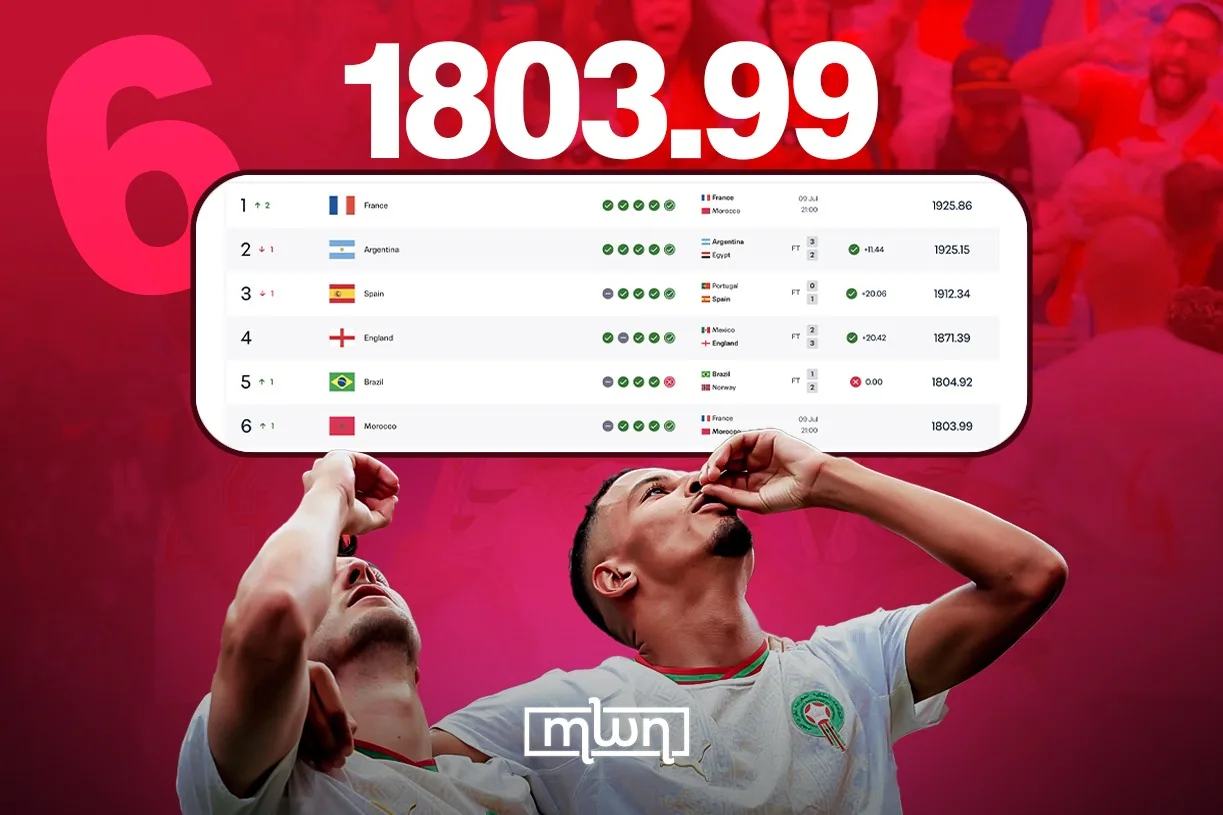
Marrakesh – Morocco beat Canada 3–0 in the round of 16. Brazil lost 2–1 to Norway in the same round and were sent home. However, Brazil remains 5th in the FIFA rankings and Morocco 6th. The gap between them is less than one point – 1804.92 versus 1803.99. The situation upset many Moroccan fans who expected the Atlas Lions to be ranked among the top five in the world.
The explanation lies in a certain rule built into the FIFA ranking formula.
The FIFA Men’s World Rankings were first introduced in 1992 to rank national teams around the world. In August 2018, FIFA adopted a new calculation method called SUM, approved by the FIFA Council.
The system is based on the Elo rating model originally developed for chess. It works by adding or subtracting points from a team’s total after each match, rather than averaging scores over a fixed period as was done in the old system.
The basic formula is simple: P = Pbefore + I × (W − We). A team’s new point total (P) is equal to its previous total (Pbefore), plus the match importance factor (I) multiplied by the difference between the actual result (W) and the expected result (We).
The actual result is simple: 1 for a win, 0.5 for a draw, 0 for a loss. The expected result is calculated based on the ranking gap between the two teams before the start of the match. The larger the gap, the higher the expectations from a stronger team.
This is why no team ever gets a full score on the importance factor. The multiplier is always reduced by the expected result. For example, when Morocco beat Canada, Morocco had a big advantage due to the ranking gap. The expected result was high.
The actual score was 1. So the calculation gave approximately 50 × (1 – 0.70) = approximately 15 points. This corresponds to the figure of 15.13 obtained by Morocco. A lower-ranked team that upsets a higher-ranked opponent receives more because the gap between the actual result and the expected result is larger.
Not all matches are weighted equally. Friendly matches outside official windows are worth only 5 points. In World Cup qualifiers the number is 25. World Cup matches from the group stage to the round of 16 are weighted at 50. From the quarter-finals onwards this figure rises to 60 – the highest in international football.
Why the Moroccan quarterfinal is a chance for ranking without risk
But the most important rule in Morocco’s case concerns defeats in the knockout stages. According to FIFA ranking rules, teams that score negative points in the knockout stages of the final competition do not lose any points. The rule was introduced to protect teams deep in the tournament from being penalized for losing at later stages.
Brazil lost to Norway, currently ranked 19th. Under normal circumstances, a loss to a lower ranked team would cost points. But because the match was a knockout game at the World Cup, Brazil’s total remained unchanged at 1804.92. Norway, meanwhile, gained 33.61 points from the win.
Morocco scored an estimated 15.13 points after beating Canada, bringing their total to 1,803.99. Thanks to arithmetic, Brazil was ahead of its opponent by 0.93 points.
The same rule applies in penalty shootouts. If a knockout match ends in penalties, the losing team is considered a draw and the winner is credited with half the victory. Morocco experienced this first hand with their Round of 16 shootout win over the Netherlands, scoring 12.46 points while the Orange scored just 0.04.
This ranking picture now has a direct bearing on what comes next. Morocco will face France in the World Cup quarterfinals on Thursday at Gillette Stadium in Foxboro, Boston. This is a rematch of the 2022 World Cup semi-final, which France won 2-0.
This time the match falls into the highest importance category in the ranking formula – a weight of 60 points. A win over France, who currently top the real FIFA rankings, would give Morocco a significant points boost. A defeat won’t cost them anything in the rankings.
The system is designed to reward teams for winning major matches without penalizing them for losing in subsequent rounds. For Morocco, this means that the game against France represents an opportunity to improve their rankings without the risk of worsening the situation. A strong showing at Gillette Stadium could finally propel the Atlas Lions into the top five, a position not occupied by any African team since Nigeria reached 5th place in April 1994.
The rating is not just symbolic. It determines place in the World Cup by directly determining a team’s path through the group stage and knockout rounds. At the 2026 World Cup, the top nine ranked teams were placed in Pot 1, along with the three hosts.
FIFA also used the rankings to split the top four teams – Spain, Argentina, France and England – into different sides of the knockout stages, ensuring they could not meet until the semi-finals. A higher ranking means more favorable draws, weaker opponents in the group stage and a clearer path to subsequent rounds.
In addition to the technical benefits, a position in the top five brings national pride, greater media attention, increased commercial appeal and stronger support from fans and sponsors. For Morocco, further ascension will strengthen the team’s seeding position in future tournaments.
Read also: Morocco vs France: history, forecasts and ongoing refereeing concerns