

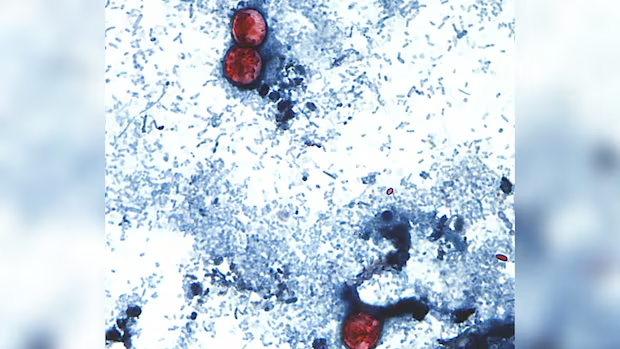
The parasite, which causes diarrhea, has led to a growing outbreak in the United States that has sickened more than 1,000 people and sent dozens to hospitals.
As of Wednesday, cyclospora infections, which can cause watery diarrhea, bloating, fever and nausea, had been reported in many states.
Although cases are common in the spring and summer, the current outbreak has resulted in an unusually high number of cases, making it one of the largest in the country’s history. No deaths were reported.
Despite the outbreak’s rapid growth, a spokesperson for the Public Health Agency of Canada (PHAC) said the agency is not investigating any outbreaks in Canada and that the parasite is “not typically found in food or drinking water in Canada.”
What is Cyclospora?
Cyclospora is a microscopic, spherical parasite that typically causes watery diarrhea “with frequent and sometimes explosive bowel movements,” according to the U.S. Centers for Disease Control and Prevention.
The disease, called cyclosporiasis, is usually not life-threatening and can be treated with antibiotics.
The heat-loving parasite infects the intestines and spreads through feces. In the past, people became infected by eating fruits or vegetables that had been exposed to irrigation water contaminated with feces.
“This disease is commonly transmitted through fresh fruits and vegetables, especially those that have nooks and crannies like raspberries and blueberries and lettuce,” said Lawrence Goodridge, professor of food safety at the University of Guelph..
 The berries have folds among the fruits where the parasite can hide, so washing the fruits with water does not remove it, experts say. (Sue Ogrocki/Associated Press)
While it remains unclear what is behind the outbreak, Goodridge expects it to be linked to products imported from South and Central America, the Caribbean, Southeast Asia or Africa.
Symptoms can begin two weeks after infection and last up to two months, Goodridge said.
Cyclospora is less common than some other foodborne illnesses, including salmonella and E. coli. For many years, only a few outbreaks of cyclospora were reported each year in the United States. But that number began to rise about a decade ago, with particularly notable spikes in 2018 and 2019. Experts attribute the increase to climate change and improved detection.
Where’s the flash?
Michigan reported 1,251 cases Thursday, a significant increase from when officials first announced the outbreak last week. Most cases are concentrated in the southeastern part of the state. As of Monday, public health officials said 36 people were hospitalized with the disease.
Michigan typically sees about 50 cases per year.
Just across the state line in Lucas County, Ohio, there were 306 cases reported as of Wednesday. There have been more than 400 cases in northwest Ohio.
Another 28 states, including Illinois and New York, have reported cases and are investigating.
The source of the outbreak has not been identified and experts say it is often difficult to trace.
“Any foodborne illness outbreak involving fresh fruits and vegetables is always challenging because these products have a short shelf life,” Goodridge said.
 Lawrence Goodridge is a professor of food safety at the University of Guelph. (Melanie Glanz/CBC)
Despite the sharp increase, the outbreak is not considered a national health emergency.
There is no evidence that the parasite has evolved to become more infectious, said Dianna Blau, acting director of the Centers for Disease Control and Prevention’s (CDC) Division of Parasitic Diseases.
There are thousands of cases of cyclospora in the U.S. every year, and it’s unclear how unusual this year will be, she added.
Michigan appears to have the largest concentration of cases, but the state’s aggressive reporting may be “one of the reasons why this looks like a Michigan problem,” said Dr. Natasha Bagdasarian, Michigan’s chief medical officer.
Previous large outbreaks included one in 1997 linked to Guatemalan raspberries that sickened more than 1,000 people in the U.S. and Canada, and a 2019 outbreak linked to Mexican basil that sickened more than 2,400 people.
Will Canada be affected?
While Canada is not affected by the current outbreak, the federal government says an average of 238 cases of cyclosporiasis were reported annually between 2004 and 2019.
“I don’t think Canadians should be concerned about this outbreak coming into Canada,” Goodridge said.
Anyone who suspects they have the disease should seek medical attention and get tested, Goodridge said.
Canadians traveling to the U.S. should avoid fruits and vegetables or only eat cooked foods and fruits that can be peeled or have a smooth surface, such as grapes, Goodridge said.
According to him, washing food will not protect against the parasite.
He also recommended purchasing whole heads of lettuce so that the outer leaves can be removed. Freezing fruit may reduce the number of parasites, but there is no guarantee it will kill them, he said.