

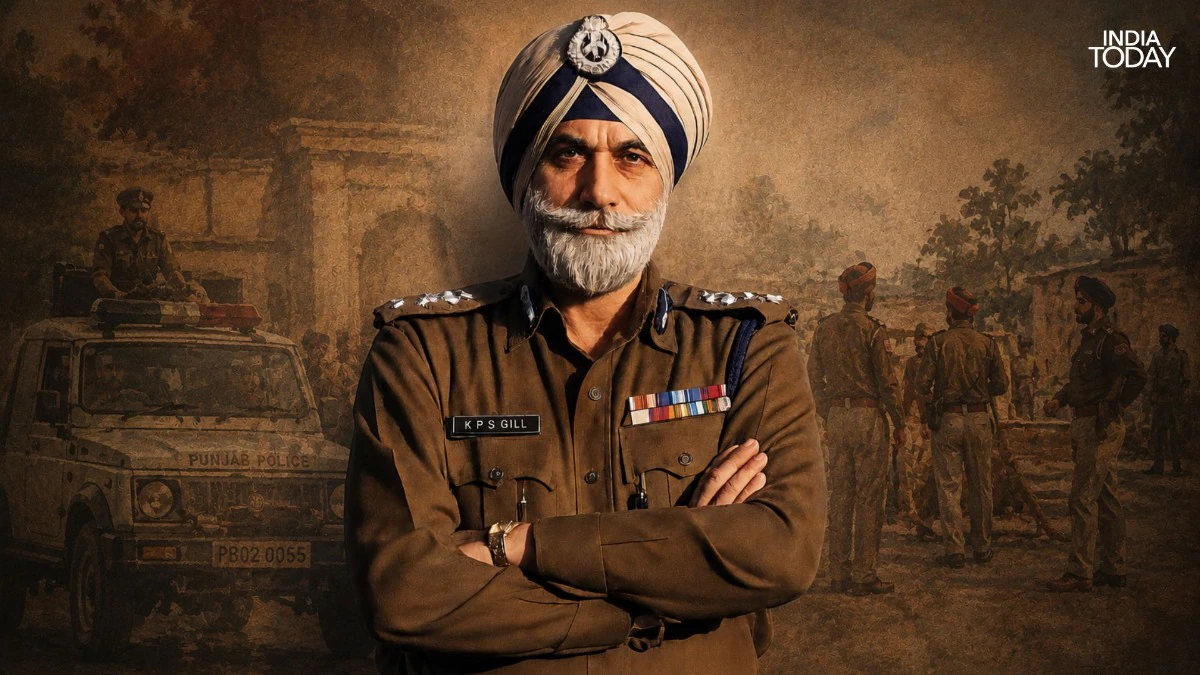
“There was never a Khalistan movement. Even (Jarnail Singh) Bhindranwale rarely spoke so clearly. He made a statement (in favor of Khalistan), then denied it, and then denied the denial. Bhindranwale and his ideologues used the two-nation theory, the same verbiage,” IPS officer Kanwar Pal Singh (KPS) Gill said about the Khalistan movement in an interview with India Today Magazine. 1993.
This KPS Gill’s remark was a reflection of his confidence. Gill was a controversial policeman whose supporters praised him for crushing the Khalistani insurgency through an aggressive counter-insurgency campaign that transformed Punjab’s security landscape in the early 1990s.
To his fans, Gill was the “Super Cop” who restored peace to Punjab, a state ravaged by militants. To his critics, he symbolized an era marked by allegations of serious human rights abuses.
More than three decades later, Gill, who died in 2017, is back in public debate, this time over actor and singer Diljit Dosanjh, starring Satluj. The film, based on the life of human rights activist Jaswant Singh Khalra, depicts disappearance and presumed murder of Khalra in 1995 after he exposed alleged secret cremations carried out during the anti-insurgency years in Punjab.
Although Gill was never convicted of Khalra’s murder and has consistently denied any involvement, he has been accused by eyewitnesses and human rights groups of masterminding the entire plot. Khalra was kidnapped in 1995 and never found. A CBI investigation revealed that he was murdered, but his body was never recovered.
Controversy surrounding Diljit’s film due to lengthy censorship failure to secure theatrical releaseand subsequent removal from the OTT platform has reignited the debate about Gill’s legacy and the controversial methods adopted in Punjab during the fight against militancy and Khalistani terrorism.
Veteran actor Kanwaljeet Singh plays KPS Gill in Satluj, which was earlier titled Punjab ’95. “95th” is a reference to 1995, when Khalra was kidnapped and killed.
KPS GILL WAS BORN IN PUNJAB AND STARTED HIS CAREER IN ASSAM.
Gill was born in Ludhiana, Punjab on December 29, 1934. Although he was born in Punjab, he grew up in Simla (now Shimla) in the foothills of the Himalayas after India’s independence in 1947. His father, Rakhpal Singh Gill, was a senior government engineer, and his mother, Amrit Kaur, died when he was still a schoolboy. His father later remarried.
According to an obituary published in The Guardian, Gill’s childhood friend, the writer Reginald Massey, described him as an above-average student but an introverted child, perhaps shaped by the grief of losing his mother at an early age.
Gill earned a degree in English from Punjab University and was then commissioned into the Indian Police Service (IPS) in 1958. He joined the Assam-Meghalaya cadre, where he spent the formative years of his police career.
Gill started his stint as an IPS officer in Assam and his stint there remains among the most controversial chapters of his post-Punjab career.
Gill served as Deputy Inspector General of Police (DIG) during height of Assam agitation (1979–1985), a mass movement led by the Assam Students’ Union (AASU) against illegal immigration. His reputation as a tough officer was seriously damaged after the death of Hargeshwar Talukdar, a 22-year-old AASU leader who was revered as the first of the 855 martyrs of the agitation.
KPS Gill PROPOSES TO ORDER VIOLENT LATHI ATTACK AGAINST ASSAM STUDENTS
Talukdar died on December 10, 1979 after Assam police crack down on protesters is trying to stop Begum Abida Ahmed, wife of former President Fakhruddin Ali Ahmed, from filing her nomination papers in Barpeta.
Protesters accused Gill, who led the police operation, of ordering the brutal attack that left Talukdar fatally wounded.
The agitation in Assam led to attacks on several Bengali-speaking residents, many of whom were considered illegal immigrants or outsiders by some sections of the movement.
Years later, Gill returned to Gill returned to Assam as Security Advisor government of the Asom Gana Parishad (AGP) and continued to speak out on issues ranging from the Nellie massacre in 1983 to the implementation of the Assam Accord. However, for many in the state, his legacy remains overshadowed by the Talukdar episode.
Gill’s stay in Punjab and return to normal life
The defining years of Gill’s life were in Punjab, his home state, where he was called to fight the Khalistani insurgency that had escalated after Operation Blue Star in 1984 and the assassination of the former prime minister Indira Gandhi later that year.
Gill first took over as Director General of Police (DGP) in 1988 as militancy swept across large parts of Punjab. One of his biggest successes came in Operation Black Bolt II in May 1988when security forces removed armed militants from the Golden Temple complex through a lengthy siege, negotiations and precision operations, avoiding the large-scale destruction seen during Operation Blue Star.
Gill completed his first stint as Director General of Punjab in December 1990 and then served as Director General of the Central Reserve Police Force (CRPF) for some time. He returned as DGP of Punjab in late 1991. with the support of the then Chief Minister Beant Singhand began an even more aggressive campaign against the rebels.
Gill’s strategy relied heavily on intelligence-led operations, strengthening local police, rewarding officers involved in counter-insurgency operations, and maintaining unrelenting pressure on militant groups.
Over the next few years, the level of violence in Punjab dropped sharply, and by the mid-1990s, the Khalistani insurgency was largely suppressed. Many of his contemporaries hailed him as the officer who restored normal life to Punjab.
ANNOUNCEMENTS ABOUT KPS GILL’S INVOLVEMENT IN THE MURDER OF JASWANT SINHA KHALRA
Gill’s reputation as a supercop remains controversial. Human rights groups have accused the Punjab Police under his leadership of fake encounters, enforced disappearances and killings during the counter-insurgency campaign.
Gill has consistently defended the force’s actions, arguing that extraordinary circumstances require extraordinary measures.
One of the longest-running disputes concerns the kidnapping and murder of human rights activist Jaswant Singh Khalra.
Khalra documented the alleged secret cremation of thousands of unidentified persons by the Punjab Police before he was abducted near his Amritsar residence on September 6, 1995.
A subsequent CBI investigation revealed that Khalra had been illegally detained before the murder.
Six Punjab Police officials were eventually found guilty of kidnapping and murder. Gill was never convicted in the case and has repeatedly denied any involvement in Khalra’s murder.
The controversy surrounding Gill continued even after his retirement.
After all the years of service that was hated by some and revered as a hero by many, Gill retired from the Punjab Police on December 31, 1995. His retirement age was extended beyond the normal age due to the security situation in Punjab. “I’ve been through three extensions, I can’t be in Punjab forever” Gill told India Today magazine in 1996.
His departure occurred a few months after assassination of Chief Minister Beant Singh in 1995 and amid criticism over security failures. Beant Singh was killed by Khalistani organization Babbar Khalsa International in a car bombing in Chandigarh.
After his retirement, Gill founded the Institute of Conflict Management in New Delhi and wrote extensively on terrorism and internal security.
However, in 1996, Gill found himself at the center of another serious scandal when he was found guilty of sexual harassment of senior IAS officer Rupan Deol Bajaj at an official party. The verdict significantly damaged his public image.
Gill later served as president of the Hockey Federation of India and remained an influential voice on national security matters. In 2012, activists in the United Kingdom successfully campaigned to stop him from attending the London Olympics, arguing that he was responsible for massive human rights abuses during Punjab’s militancy years.
KPS Gill passed away in 2017leaving behind one of the most controversial legacies in modern Indian policing.
Militancy in Punjab had largely ceased by 1993, but we are talking about 1995 when Khalra was kidnapped and killed. Although he was never found guilty in the case, the accusations hung around Gill like a ghost.
To many, KPS Gill was the officer who defeated one of the most brutal uprisings in India. For others, it remains inseparable from accusations of excesses committed in the name of restoring law and order.
– Ends
Published:
Avinash Kateel
Published:
July 8, 2026 08:00 EST