

This article is part of a series in which we reach out to people who—because of a unique job, location, or experience—share ideas they’d like others to know about.
What’s the one thing people need to know? A peaceful and supported end-of-life experience that focuses on family, end-of-life, and the environment can transform the dying process and the way loved ones grieve.
For 61-year-old Katie Hollis, the journey to palliative care began two decades ago when her father decided to die at his London home after a long battle with colon cancer.
At the time, Hollis was working as a nurse at Bradford Royal Infirmary, a large teaching hospital in the north of England, and she traveled to the capital to help care for him in his final weeks.
Surrounded by loved ones, her father, a dedicated police detective, said he wished he could be more present in the lives of his three daughters and not let work take up so much of his time.
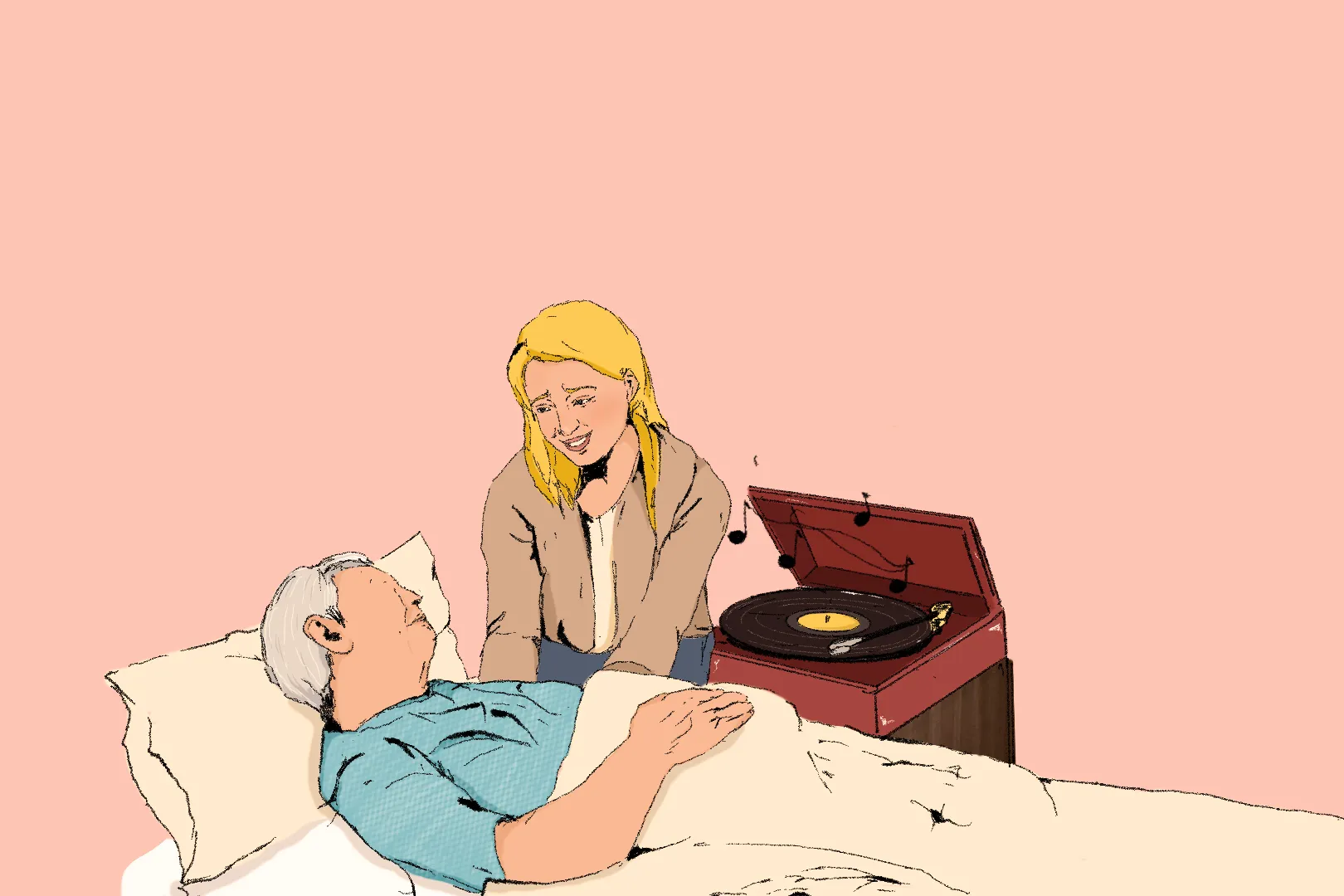
A week before his death, his family decided he would spend his last days at home, where those closest to him gathered at his bedside and filled the room with his favorite music, from the soft voice of Frank Sinatra to the upbeat symphonic rock of the Electric Light Orchestra.
Hollis recently took time off from work due to a miscarriage, one of several she has suffered in recent years. The latest loss upset her father because he wanted Hollis and her husband to experience the joys of parenthood.
In his final days, he even told her he was dying so they could have a child – “like a circle of life” – which she said brought him great peace.
At the time, Hollis’ two sisters already had children, and she often found it difficult to be around them. Fertility problems made it difficult for her to spend time with their growing families, especially when her father was dying and her older sister became pregnant again. However, in the days before his death, she began to find comfort in the presence of her sisters.
“The morning before he died, when he was settled peacefully but could no longer communicate, we spent time together discussing my sister’s baby and laughing out loud at some of the possible outlandish names she and her partner could name their child. We were all confident that dad could hear us and enjoy the sound of laughter,” she said.
As he died, the comforting words of James Taylor singing “You’ve Got a Friend” echoed throughout the room, a song that would forever cement her memories of her father.
As she watched him die, she was struck by how different it was from the deaths she had seen on her unit.
We were all sure that dad could hear us and enjoy the sound of laughter.
Away from the constant noise of hospital machines and a sterile environment full of strangers, he was able to spend his final hours in what she considered a much more natural environment.
At home the focus shifted. Instead of urgent medical attention in hospital, where every effort was made to prolong his life, the priority became ensuring that his final moments passed as peacefully as possible.
In the vascular unit, Hollis encountered frequent end-of-life care, but it was largely clinical, focused on the formalities of the patient’s final hours. Watching her father die so calmly changed her perspective on what that care could look like.
So, in 2003, Hollis decided to join Marie Curie, one of the UK’s largest aged care charities, which provides hospice care that focuses less on curative treatment and more on the comfort, quality of life and emotional well-being of patients and their loved ones.
“They have already received a diagnosis. They know that their life is limited, but the important thing is that they can have the right environment and people,” she explained.
Music, she says, plays a central role in end-of-life care because it “can take you to places you’re not physically in… to a different place and hopefully to happier times.”
They have already received their diagnosis. They know that their life is limited, but what is important is that they can have the right environment and people.
While hospital nurses may play music and tend to patients’ physical needs, Hollis says the deepest comfort comes when a person is surrounded by family, when differences are put aside, conversations are open, decisions are made together and a sense of peace is achieved together.
She explained that this does not eliminate all difficult feelings, but for families who are able to spend this time in peace, there is less room for guilt, misunderstanding or conflict during the grieving process.
There are still times when there is no relief or comfort, especially when caring for young patients or when someone dies from pain or suffering, she said.
Younger patients “just aren’t ready to die, and they fight it tooth and nail,” she said, adding that this struggle to stay alive can add to the suffering of everyone involved.
Still, she said, most patients eventually reach a state of comfort and calm before leaving. She recalled one patient, a woman who had two daughters: one lived with her and took care of her, but she had no contact with the other.
When the mother was admitted to hospice care, the estranged daughter was informed and arrived, attempting to take the lead care role. This caused great concern to her sister and in turn to their mother. But with the support of medical staff and patient and family support groups, tensions gradually subsided. Both daughters began to better understand each other’s point of view, which allowed their mother to spend her final days in a more peaceful and settled environment.
Sometimes you can even laugh in hospice, Hollis said.
“There are a lot of memories that come, even when the patient can no longer respond—you can still have a lot of… joy, memories, and it can be a time of real togetherness,” she said.
In the last 24 to 48 hours of their lives, patients are usually unresponsive and unable to speak, but nurses still encourage loved ones to continue talking to them as it is widely believed that hearing is the last sense to fade.
Hollis’ work has also made her acutely aware of what she says may seem like a cliché – the need to live now rather than procrastinate.
“I really love traveling and living in the moment…as much as I love my job, I get to go on vacation and see my kids…I have friends all over the place and I try to spend my vacations with all of them,” she said firmly.
Ultimately, Hollis hopes her clients will see that the arguments, silences and stubborn opposition that seem so overwhelming in life will fall away at the bedside.
This reconciliation, she says, is the real consolation – the one that allows a person to die peacefully, and those who love him to live on without regret.
For Hollis, her father’s view that his death made way for her to have a child turned out to be true.
“When I got pregnant again,” she said, “my baby was due exactly one year after my father died. She turns 25 this summer.”