

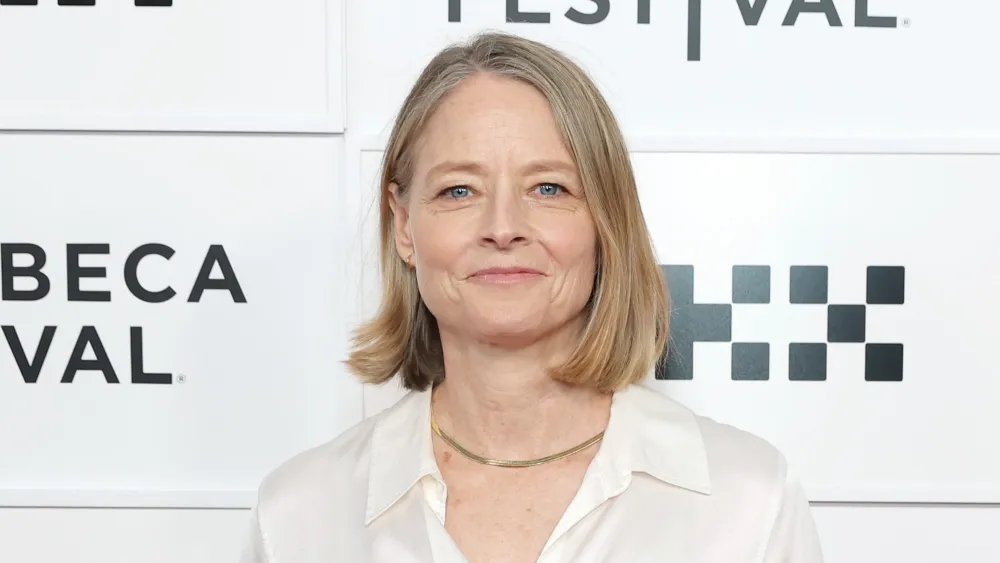
Jodie Foster discussed great films and how Hollywood has changed in her talk this week, and cited Apple’s Formula 1 as an example of how machines can change creativity. During a conversation Tuesday on “Who Owns the Future of Hollywood” with former Sony Pictures CEO Michael Lynton at the Aspen Ideas Festival, Foster smiled and suggested that Brad Pitt’s racing movie looked like it could have been made by artificial intelligence.
“I don’t say this disparagingly – how could I? That movie made millions of dollars. But I look at a movie like Formula 1 and I think, Formula 1 was made by artificial intelligence,” she said with a laugh at an event in Colorado. “Isn’t it? I mean, the structure was exactly the kind of structure you would learn in school. The actors say the lines exactly as they would have been written if a computer had written exactly what would have been correct for the time. And they were able to dominate the technology to create something big and beautiful, and potentially where a lot of information comes from other places.”
Formula 1 grossed $634 million worldwide and was nominated for four Oscars, including Best Picture and Best Sound.
Several panels at the annual festival discussed the emergence of artificial intelligence and its impact on society, and Linton asked Foster what she thought the implications of this technology would be.
“AI is another giant step forward in changing the industry,” Foster said, detailing the changes in the movie business brought about by computer graphics and digital technology.
“The big question is, will he replace actors and writers?” – asked Linton. “We replace people,” Foster responded, explaining how studios save money on crowd scenes by duplicating supporting actors. “We’re getting rid of a lot of jobs, and hopefully organizations like unions can come in and say, you can use my actor 20 times, but you’re going to pay him 20 times. And I think that’s fair.”
Foster said that for “small useful things” such as previs (pre-visualizing film scenes before filming), artificial intelligence tools can be useful. “What we would all like is for filmmakers to be able to dominate artificial intelligence and never lose sight of it.” In her latest film, My Private Life, she gave an example of an AI-assisted dream-like sequence that she thought was successful, although the images “didn’t make sense.”
“If we can consistently dominate artificial intelligence over time, we can create things that reflect us and we can improve things,” she said.
Diversity reached out to Foster, Apple and Formula 1 writer Ehren Kruger for comment.