

PressSplit
Follow us on Google
More and more homework assignments suddenly turn out to be flawless and error-free. Teachers see this as a warning sign for teaching.
Frankfurt – Homework was as much a part of millennials’ daily school life as lunch. During the day they tended to create a bad atmosphere. Some were racking their brains over math problems, others were writing down homework in their notebooks as quickly as possible before the first lesson. This gave an honest, imperfect impression of the students’ abilities and motivation.
One such millennial is Emily Horbach. Today, she no longer does homework, but assigns it to the class – and usually already knows what she will return: error-free texts, impeccably worded answers, almost no commas. For a school English and Geography teacher, this is not a cause for celebration, but rather a wake-up call. “In its current form, homework has become largely meaningless to me, except perhaps for younger students who don’t yet have free Internet access and whose parents look over their shoulders while they do it,” Horbach says. Frankfurter-Rundschau von Ippen.Media.
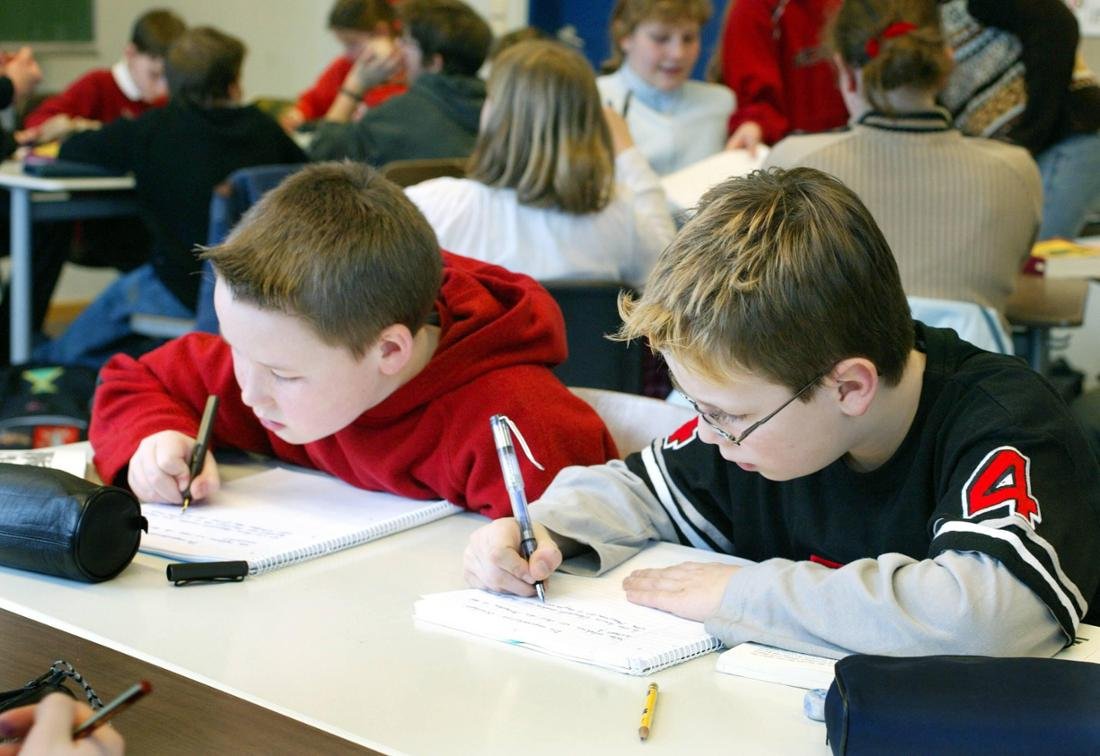 AI and tablets are now part of everyday life at school – handwriting is on the decline. (Symbolic photo) © photothek/Imago Images
What appears to be comfort at first glance has significant implications for teaching. Homework actually provides extra practice time, “exactly the kind of time that is often missing in class,” Horbach says. If this exercise is replaced by artificial intelligence tools, the actual learning outcome will be lost. The mistakes students make are critical. “Real mistakes show me as a teacher where the class really is and what I need to discuss again because it is not understood yet,” says the teacher. The error-free solution created by AI hides exactly this information. “Thus, my most valuable data is lost.”
‘Emergency Solution’: Schools have few answers to children and young people’s use of AI
Horbach is not alone in her criticism. Doris Wessels, scientific director of the Schleswig-Holstein Center for Artificial Intelligence Applications, also notes that the vast majority of children and young people use artificial intelligence tools at school: “We can assume that students have intensive contact with artificial intelligence tools in many places and that we are approaching the 100 percent line,” Wessels said. Frankfurter-Rundschau. Schools have yet to figure out how to deal with this problem: Wessels considers artificial intelligence detectors to be “unreliable black box solutions”; instead, the oral examination becomes increasingly important.
Youth researcher Simon Schnetzer knows the dilemma of teachers and, in addition to the emphasis on oral performance, names another pragmatic solution: “More and more schools, universities and training centers are again relying on handwritten exams.” Frankfurter-Rundschau He explains that handwriting is celebrating a comeback because “homework cannot currently be meaningfully checked and graded.” Wessels views the idea of handwriting only as an “emergency solution.” Instead, there is a need for mandatory rules of conduct that are relevant and practical.
Norway bans use of AI in primary schools
Horbach doesn’t blame kids who ask chatbots for homework advice: “People take the easy route, and today it is: ChatGPT does my homework,” the teacher explains. As a student, she probably wouldn’t have done anything differently, she admits. So the problem is not moral, but structural.
A look at Norway shows how radical responses to this problem can be. In the future, the country will almost completely ban generative AI such as ChatGPT or Claude from its primary schools. There is a general ban on the use of AI for grades one through seven; in the first year of secondary school its use is permitted only under strict supervision. Only in high school should young people specifically study artificial intelligence skills. The Norwegian government justifies the move on the basis of falling test scores and concerns that children may simply miss important milestones in their education.
The Horbach secondary school teacher also believes it is “undeniable” that uncontrolled use of AI among children and young people is hindering real growth in knowledge. However, she is not opposed to chatbots and is not calling for them to be banned in Germany, but rather proposes another solution: compulsory, supervised homework clubs in schools. “A quiet space where everyone gets time and support that not every child has at home,” is how she describes her idea. This will provide time for practice without children having to resort to artificial intelligence on their own, and without social backgrounds deciding who gets support at home and who doesn’t. (Source: own research, Instagram)