

LONDON (AP) — Michael Scarr has been a volunteer at Britain’s National Archives for the past 11 years, spending Thursday mornings painstakingly cataloging documents for future researchers.
One day last May, a retired insurance executive made his own discovery while looking through the letters of an 18th-century Royal Navy captain.
LOOK: A look at the founding of America from the room where independence was declared
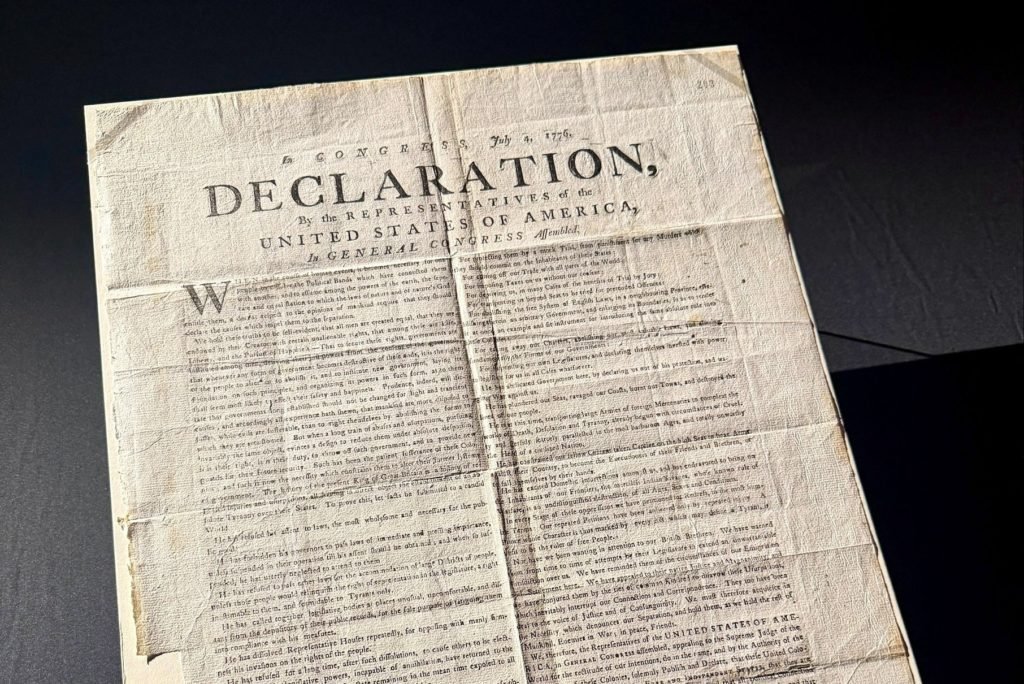
There, with the report of the capture of the American privateer Dalton on Christmas Eve 1776, was an attachment labeled “another document.” Carefully unfolding the document, Scarr paused when he saw the word “Declaration” printed at the top.
“I thought, OK, OK, this is definitely the Declaration of Independence,” he told The Associated Press. “How interesting is this?”
The document spreads the message of independence
Researchers at the National Archives have since identified the document as a rare early copy of America’s founding document, printed just days after the original was signed on July 4, 1776, to spread the news that the 13 rebellious North American colonies had severed ties with Great Britain.
It is one of just 11 original copies of the so-called Exeter Declaration Seal known to exist and the only one identified outside the United States, the National Archives said Thursday, releasing the find ahead of America’s 250th anniversary of independence this weekend. This version was printed in Exeter, New Hampshire, from July 16 to July 19, 1776.
But it’s not just the age of the document that makes it important. It’s also because it was captured from a ship under the direction of the newly formed Continental Congress, with an order signed by its president, John Hancock, said Amanda Bevan, director of the National Archives project to catalog the correspondence of Royal Navy captains during the American Revolution.
While the public had heard about the terrible conditions facing the Continental Army in places like Valley Forge, Pennsylvania, little attention was paid to the Americans who went to sea to disrupt British trade and take on the powerful Royal Navy, Bevan said.
Discovery offers insight into what was at stake
The discovery of a copy of the Declaration of Independence on board the ship also suggests how it may have been used, Bevan said. She believes that the captain of the Dalton, as was customary, would have read his orders as well as the statement itself.
“They know why they fight, but it comes out in language that makes them stronger than them,” Bevan said. “They are not fighting because they have been particularly wronged. They are fighting for an ideal. And I think just to find a declaration in a theater of war where people are committing to fight for their country across a wide ocean is really something special.”
As a privateer, the 18-gun Dalton was a private vessel fighting under the auspices of the Continental Congress to augment the new nation’s tiny fleet.
Captain Thomas Fitzherbert, commander of the 64-gun HMS Raisonnable, pursued the Dalton for seven hours on Christmas Eve 1776 before catching her off the coast of Portugal. The Dalton’s crew of 120 were imprisoned in Plymouth, England, under harsh conditions.
Charles Hebert, who was only 19 years old when he was captured, described hunger, disease and repeated punishment in the diaries he kept during more than two years of captivity before being released in a prisoner exchange.
Despite all this, many survived.
Americans share the joy of discovery
Historians in the United States are also encouraged by the opening of the National Archives.
This copy of the Declaration of Independence provides a direct link to the captain of the Dalton, who brought the news of American independence to the world, said Matthew Skeek, director of collections and exhibitions at the Museum of the American Revolution in Philadelphia.
“It’s not just a document, it’s an artifact,” he said. “It’s a tangible connection to the past, because holding that piece of paper in the hands of an archivist today is a way of transporting us back to 1776. In a sense, the baton is being passed.”
The discovery is also proof that historians still have more to uncover, Skick said.
“Even though 250 years have passed, we still don’t know everything about the American Revolution, and there are still discoveries to be made.”
A free press is the cornerstone of a healthy democracy.
Support trustworthy journalism and civil dialogue.
Donate now