

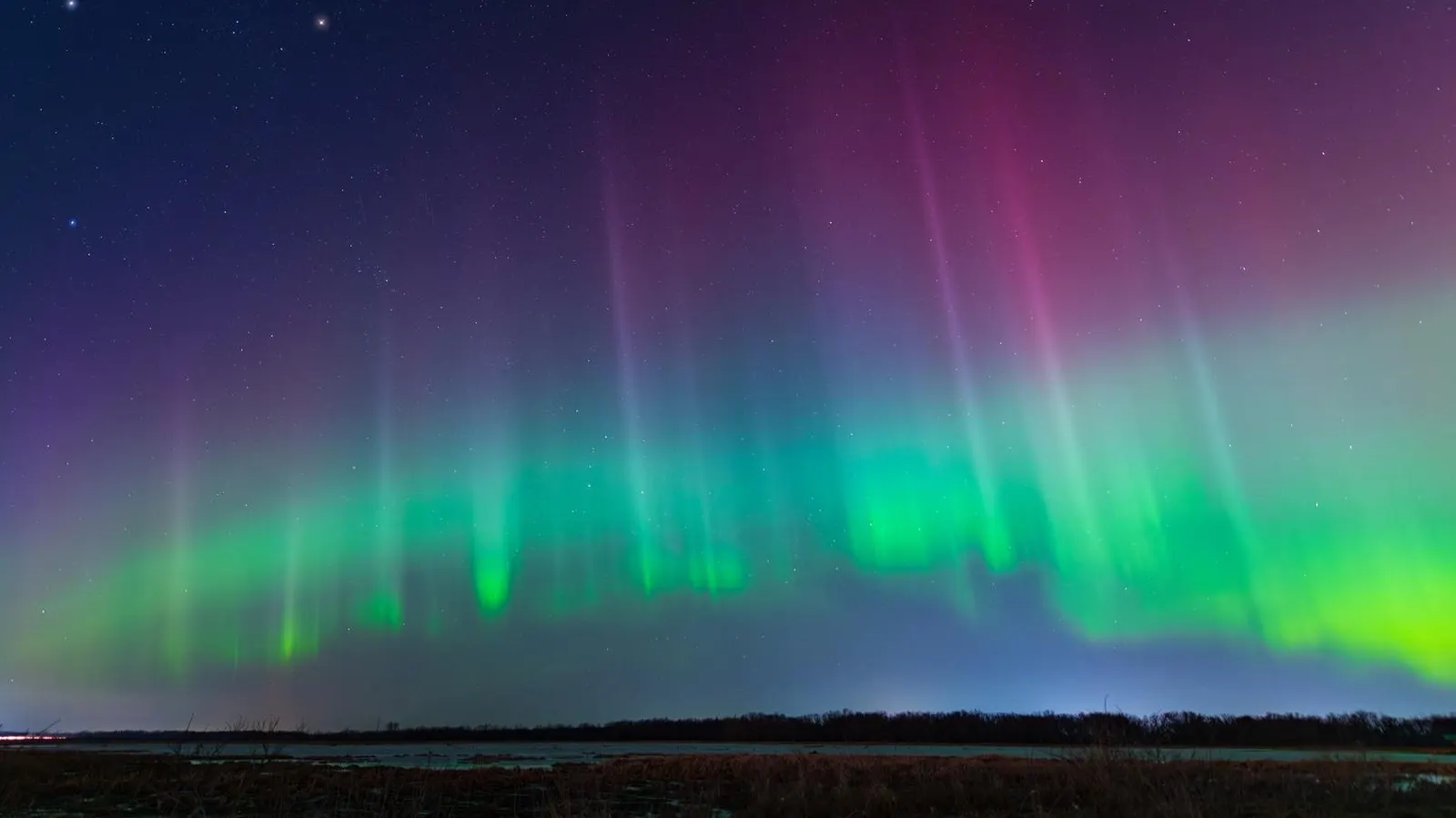
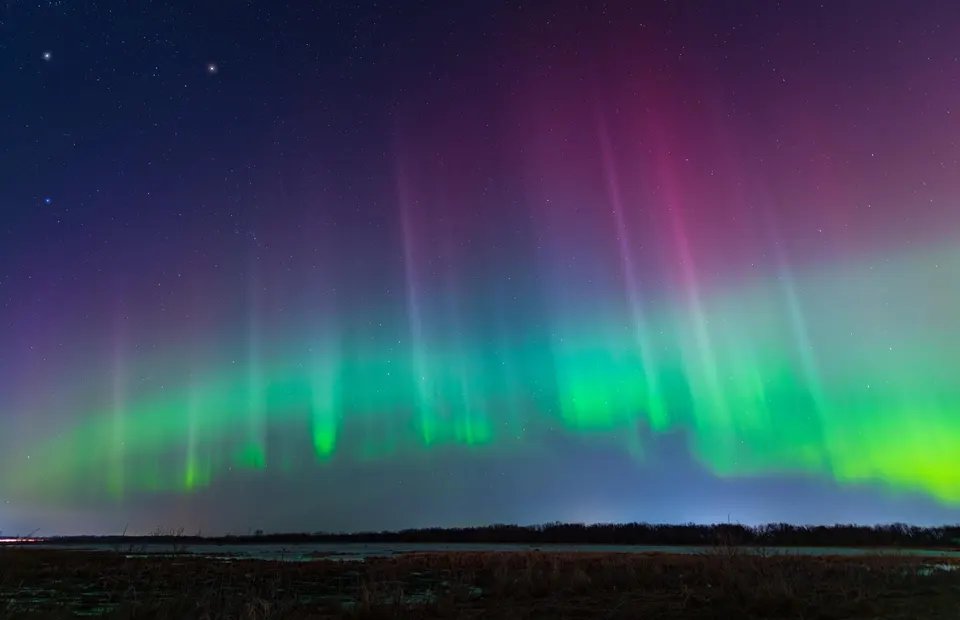
NOAA’s Space Weather Prediction Center has forecast G3 geomagnetic storm conditions for Friday, July 3 through Saturday, July 4, with the aurora likely to be on the northern horizon in U.S. states near the Canadian border.
Getty
The Northern Lights may be visible overnight in 26 states on the Fourth of July, hours before the US Independence Day holiday. It is expected to be visible overnight from Friday, July 3rd to Saturday, July 4th.
Multiple coronal mass ejections, clouds of magnetic fields, and charged particles from the Sun are heading toward Earth, shooting into space at speeds of up to 1,900 miles (3,000 kilometers) per second. The result could be a G1, G2 or even G3 geomagnetic storm that could result in aurora being visible on the northern horizon from US states close to the Canadian border – most likely through parts of Montana, North Dakota, Minnesota and northern Wisconsin – but potentially much further south into the northern and lower Midwestern states.
The waning Strawberry Moon in the southern sky after midnight, as well as the long daylight hours since last week’s solstice, may make aurora viewing difficult.
“A series of straight-line and glancing impacts that began on July 3 could produce G2 to G3 geomagnetic storms over the July 4 holiday weekend,” SpaceWeather.com reports, especially in the northern US.
NOAA view of the auroras on the night of July 3-4, 2026.
NOAA
Northern Lights on the Fourth of July?
According to the forecast from space weather experts at the National Oceanic and Atmospheric Administration, “G1-G2 conditions are likely by July 3-4 due to the expected June 30 arrival of a CME associated with the X1.1 flare.”
The UK Met Office forecast suggests a G3 geomagnetic storm is possible. “Geomagnetic activity is likely to reach active to G1/minor geomagnetic storm levels (Kp 4-5) with the likelihood of isolated intervals of a moderate G2 storm (Kp 6) and a small chance of a severe G3 storm (Kp 7) if the CME is stronger than expected,” the UK Met Office space weather forecast for 3 July UT – early morning 4 July in North America – said. It is also believed that at least three CMEs that left the Sun on July 1 may collide with Earth on Sunday, July 5.
Northern Lights tonight: what to expect
KP7 conditions could mean the northern lights will be visible as far as the lower half of the US. During a G2 geomagnetic storm, northern parts of Washington, Idaho, Montana, North Dakota, South Dakota, Minnesota, Wisconsin, Michigan and Maine. there is a chance. Also making noise are states further south, including Oregon, Wyoming, Nebraska, Iowa, Illinois, Indiana, Ohio, Pennsylvania, New York, Vermont and New Hampshire. If a G3 storm materializes, those under dark skies in Kansas, Missouri, Kentucky, West Virginia, Virginia and Maryland may also see the aurora.
If skies are clear, aurora watchers should look north around midnight, avoid bright light and use a long exposure setting on their phones or cameras. Cameras often detect faint aurora before the human eye can clearly see the color.
Aurora Alert: Latest Updates
To check real-time visibility, use NOAA’s 30-minute auroral forecast or download apps like Aurora Now, My Aurora Forecast or Glendale Aurora to get the latest alerts and real-time solar wind data.
Whether the aurora will appear depends largely on the interplanetary magnetic field, in particular its Bz component (you’ll find it in some of the above apps and on SpaceWeatherLive.com). Bz determines how easily solar energy enters the Earth’s magnetosphere. When Bz points north, the Earth’s field resists it; when Bz turns south, the two fields merge, allowing plasma to flow inward. A sustained southward Bz of -5 nT or stronger usually signals an imminent aurora event.
How easy it is to see the Northern Lights
Over the past two years, aurora sightings have become more frequent as the Sun has reached the solar maximum phase of its 11-year solar cycle. It is currently in a decline phase, but observations from areas south of the Arctic Circle are often limited to a faint glow low above the northern horizon.
For the best chance of seeing the northern lights, plan a trip between September and March to the polar latitudes around the Arctic Circle—roughly 65 to 70 degrees north latitude—in Alaska, northern Canada or northern Scandinavia, including Norway, Finland, Sweden and Iceland. There, the performances tend to be more frequent, brighter and far more dramatic than anything possible in the US, sometimes spreading across the entire sky, creating a spectacle that can stun observers.
I wish you clear skies and wide open eyes.