

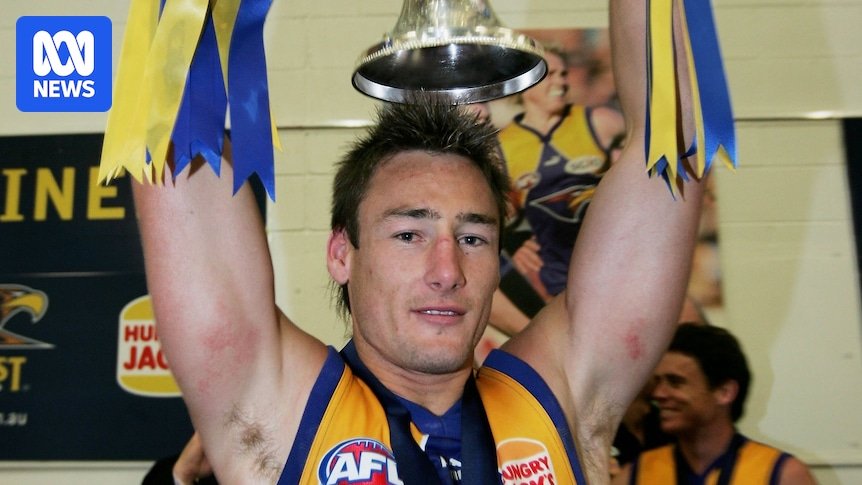
The best friend of former West Coast Eagles star Adam Hunter, who suffered from the brain condition chronic traumatic encephalopathy (CTE), has written to the AFL Commission claiming it has “failed” in its duty of care to players.
Hunter’s friend Dave Andrews has sent a letter to the AFL Commission, which is chaired by Craig Drummond, saying more needs to be done to protect current and future footballers from CTE.
“You have let him down,” Mr Andrews wrote in a five-page letter that addressed Hunter’s sacrifice for the game and called on AFL management to better inform their players about the risk of CTE.
Hunter, who was suffering from CTE when he died last year, was at the center of a Four Corners investigation which revealed 33 Aussie Rules players had now been diagnosed with the brain disease.
CTE is associated with repeated blows to the head and can only be diagnosed after death.
“The responsibility lies with the organization”
In a Monday evening report, AFL chief executive Laura Kane said it was “not our job to report on every aspect of risk that exists in our game” and it was a “shared responsibility”.
Ms Kane’s words prompted Mr Andrews to write a letter in which he stated:
“I am not a lawyer, but I know enough to tell you that the position that Ms. Kane has articulated on national television is untenable. The weight of scientific evidence linking repeated head impacts to CTE is significant and growing.
“The responsibility to inform, protect and ensure safe gaming systems lies with organizations, not players. Ms. Kane’s Four Corners statement is directly inconsistent with that commitment at every level of the game.”

In a letter sent to the AFL Commission, Dave Andrews says more needs to be done to protect players from CTE. (Getty Images: Mark Dadswell)
Mr Andrews, a business manager, also sent letters on Thursday to AFL chief executive Andrew Dillon and AFL Players’ Association boss James Gallagher, West Coast Eagles chairman and Fortescue boss Elizabeth Gaines, as well as the chairs of ASIC and WorkSafe Australia, Victoria and Western Australia, as well as the junior and local football clubs Hunter played for.
Mr Andrews says he has called on the AFL to act and that the league’s position is similar to James Hardie’s asbestos scandal, where the company knew about the dangers but failed to warn its workers.
“The parallel with James Hardie is inescapable,” Mr Andrews writes.
“The directors and officers, who were aware of the health responsibilities associated with asbestos exposure, breached their duty of care by failing to properly disclose and address those risks. The AFL Commission and affiliated club boards are in a similar position, aware of a progressive, fatal neurodegenerative disease linked to the core activities of their sport, affecting dozens of former participants at all levels of the game, and choosing an attitude of minimization rather than active disclosure and protection.
“I ask the AFL Commission and the management of each club to stop treating the duty of care as a discretionary issue that should be divided or postponed. This is a commitment that cannot be delegated.
“Adam cannot be brought back. But the AFL, WAFL players currently on your books and the kids running in South Bunbury on a Saturday morning, those training today, those drafted next year, those playing community football under your leadership, deserve advice at every level that treats their brain health for what it is: a predictable risk that the law requires you to act on urgently, transparently and comprehensively.”
Do you know more?
- Contact Jessica Halloran at Halloran.Jessica@abc.net.au
- If you require a more secure connection, select the option on confidential tips page.
Pay to play
In the letter, Andrews wrote that Hunter “was always there for his teammates, always wanting to get the ball when the game was on the line.”
He said Hunter’s dedication allowed him to build a fine career, winning the premiership in 2006 and playing 151 AFL games.
“That determination took him from South Bunbury to the Swan District to the Eagles and back again,” Mr Andrews writes.
Loading…
“It also meant that he never complained or questioned the damage the game was doing to his brain because persistence was everything to him.
“The organizations he played for and the directors of those organizations had a duty of care to him that matched his persistence and dedication to them.”
Read more about risks in contact sports
Mr Andrews signed the letter as “grieving best friend”.
Joan Brown, Hunter’s mother, confirmed to the ABC on Thursday that the AFL had yet to contact them as they revealed the harrowing details of her son’s suffering from CTE. Ms Brown believes the AFL is “in denial”.
Hunter, who was just 43, died last year.

Adam Hunter was suffering from brain disease (CTE) when he died last year. (Getty Images: Ryan Pierce)
Those who suffer from CTE may show signs of depression, anxiety, memory loss, cognitive problems, aggression and addiction, including drug and alcohol abuse.
Later in his life, Hunter struggled with drug addiction.
While some sports physicians have attempted to link the pathology of CTE to drugs and alcohol abuse, neurologists such as Michael Buckland reject this notion.
Loading…
In a Four Corners report, Dr Buckland outlined how some health professionals closely involved with contact sports may be “blaming the victim” when it comes to CTE and football.
“There may be a culture of victim blaming, but there is no evidence that drugs and alcohol cause CTE; in fact, there is evidence to the contrary.
“I’m a little puzzled as to why doctors associated with sports keep coming up with what seems to be an excuse… it’s their fault they have it… it’s not the code’s fault.”
Player Health and Safety
The AFL has repeatedly stated that health and safety is the code’s highest priority.
Over the past two decades, the league says it has made more than 30 rule changes to protect players’ brain health.
The AFL only officially recognized the link between the game and CTE in April 2023.
Seven months later, the coroner investigating the death of former Richmond player Shane Tuck also recommended AFL limited contact training to reduce the risk of concussion for players, which will be introduced from the start of pre-season training in 2027.
The AFL does not have a formal CTE policy, but Ms Kane said the league had informed players of the risks involved.
Laura Kane says the AFL is committed to researching the game’s impact on players’ brain health. (Four Corners: Ryan Sheridan)
In a statement to the ABC, an AFL spokesman said they had not yet received Andrews’ letter in the post, but when they did they would consider it.
An AFL spokesman confirmed player safety is the game’s top priority.
“The AFL’s highest priority is the health and safety of all players and we continue to undertake significant work to make the game safer,” an AFL spokesperson said. “As an industry, we continue to learn, evolve and grow to do everything we can to keep players and the game as safe as possible.
“Head injury is a consideration in all contact sports around the world and as the professional sports body that governs contact sports, the AFL has clear governance, policies and guidelines for how our game is played.
“Significant resources have been devoted to better understanding the link between repeated head injuries and neurodegenerative diseases, and over the last two decades the AFL has made more than 30 changes to the rules of the game, as well as match review guidelines and Tribunal guidance, to further protect the safety of players in the game, and we as a league continue to be guided by medical experts on this issue.”
The AFL said that as expert medical research has evolved, so have its rules and guidelines. He added that contact training will soon be reduced.
“Making the game safer is a shared responsibility across our industry,” an AFL spokesperson told the ABC.
“Through the newly established Contact Training Advisory Group, clubs are currently working with the AFL on what training restrictions will look like in 2027.
“Every year, the AFL Chief Medical Officer, supported by the wider AFL medical team, provides our AFL and AFLW playing cohorts with formal education on concussion, long-term risks and symptoms.
“The AFLPA also plays a key role in supporting, training and communicating directly with former players.”
Watch Four Corners’ full investigation into the AFL’s brain injury crisis on the channel ABC iview.
Loading…