
Why America Has No High-Speed Rail — And Why That May Be Changing
CNN — American railroads once powered an industrial empire, but passenger rail has lagged behind the rest of the world for decades. Now, private ambition and public frustration are colliding in ways that could reshape U.S. transportation.
Brightline’s Bold Gamble on American Rails
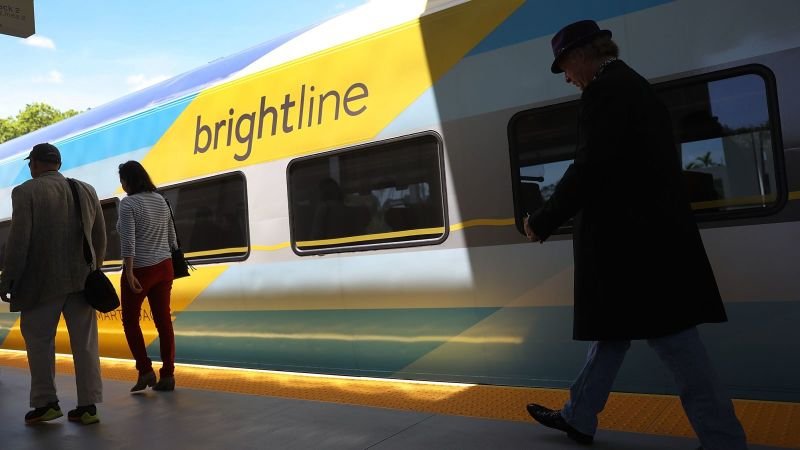
Founded in 2012, Brightline became the first private intercity passenger rail operator in modern U.S. history, running bright yellow trains between Miami and Orlando at speeds approaching high-speed rail standards. The company’s ambitions extend far beyond Florida: it is developing a Brightline West route linking Las Vegas to Rancho Cucamonga, on the outskirts of Los Angeles, with trains capable of reaching 200 mph (320 km/h) — true high-speed rail by global standards.
Yet the venture hit a wall financially. Brightline filed for Chapter 11 bankruptcy last month after failing to generate enough revenue to cover its debts. The company insists it will continue operating its Florida service and push ahead with the Las Vegas–Southern California line, arguing that the restructuring will reduce debt without costing taxpayers.
A Global Outlier in Passenger Rail
High-speed passenger rail is routine across much of the world — from Japan’s Shinkansen and France’s TGV to China’s vast network and emerging systems in Morocco. The United States stands as a striking exception: no U.S. train currently meets the international definition of high-speed rail, which requires sustained speeds of at least 240 km/h (150 mph) over significant distances.
The reasons are deeply rooted. America’s car culture is one factor, but the decisive one, according to rail advocates, is chronic underinvestment. Lou Thompson, a prominent rail policy figure who helped create Amtrak in the 1970s and later advised the World Bank, put it bluntly: foreign governments “wanted high-speed rail and were willing to pay for it. Our government never fulfilled either condition.”
Highways, Airlines, and the Lobby That Shaped a Nation
Government support flowed overwhelmingly to the interstate highway system and commercial aviation. That was partly practical — post-World War II America needed reliable ways to move people and goods across a rapidly expanding country. But it was also the result of powerful industries: automakers, oil companies, and construction firms behind roads; airlines and aerospace giants behind aviation.
According to Andy Kunz, CEO of US High Speed Rail, this pressure relegated high-speed rail to a “second-class” funding tier. The result is an infrastructure gap that persists today.
Geography, Demand, and the Economics of Distance
The U.S. is vast, and its major cities are widely spaced. Thompson explains the core problem: once destinations exceed roughly 400 miles (640 km), air travel becomes faster — and in Europe and Japan, most major cities sit within that distance. That proximity drives ridership numbers that make high-speed rail economically viable: Japan’s Shinkansen carries hundreds of millions annually; projected peak demand for California’s system is only 30–35 million. Amtrak’s Acela between Washington and Boston carries about 12 million.
“When you reach hundreds of millions or billions of riders a year, the economic equation changes dramatically,” Thompson said.
What Exists Today — and Its Limits
The Acela NextGen, which began service just weeks ago, reaches 160 mph (257 km/h) but only on short stretches. Brightline’s Florida trains top out at 125 mph (200 km/h), but only over a 38-mile segment near Orlando. Neither qualifies as true high-speed rail, yet both represent progress.
Brightline reported 1.8 million passengers in Q2, up 16% year-over-year. The company claims it was operationally profitable in some months and that its bankruptcy filing should help it move forward. Whether it can attract enough riders to justify the massive Las Vegas–California buildout remains an open question.
California’s Stalled Dream
The most prominent public high-speed rail project in the U.S. — linking Los Angeles and San Francisco — is years behind schedule and billions over budget. Thompson, who served on an independent legislative review panel, called it “a dead end.” The project’s struggles have become symbolic of why many Americans doubt rail can work at scale.
Private Investment vs. Public Good
Kunz remains hopeful that a successful Brightline West line could spark demand elsewhere. But Thompson warns that private capital alone cannot solve the problem: building and running high-speed rail without significant government support is not realistic.
“The value of high-speed rail is partly for the riders… but it’s partly about societal benefits — cleaner air, less noise, greater safety, better land use,” Thompson said. “There are public benefits passengers won’t pay for and shouldn’t have to.”
The debate over American rail is no longer theoretical. With Brightline moving forward despite bankruptcy, Acela’s debut, and California’s troubled project still alive, the next few years will test whether the U.S. can finally join the high-speed rail world — or whether geography, politics, and economics will keep it sidelined.
Transportation, News, Business, Finance, Government, Travel, Industrial, Society, Infrastructure, Rail Transit, High-Speed Rail, Brightline, Amtrak, Acela, US High Speed Rail, California High-Speed Rail, Las Vegas, Miami, Orlando, Los Angeles, Rancho Cucamonga, San Francisco, Boston, Washington, Japan, France, China, Morocco, Chapter 11 Bankruptcy, Passenger Rail, Intercity Rail, Urban Mobility, Sustainability, Public Policy, Private Investment, Infrastructure Development, Transportation Policy, Environmental Benefits

