
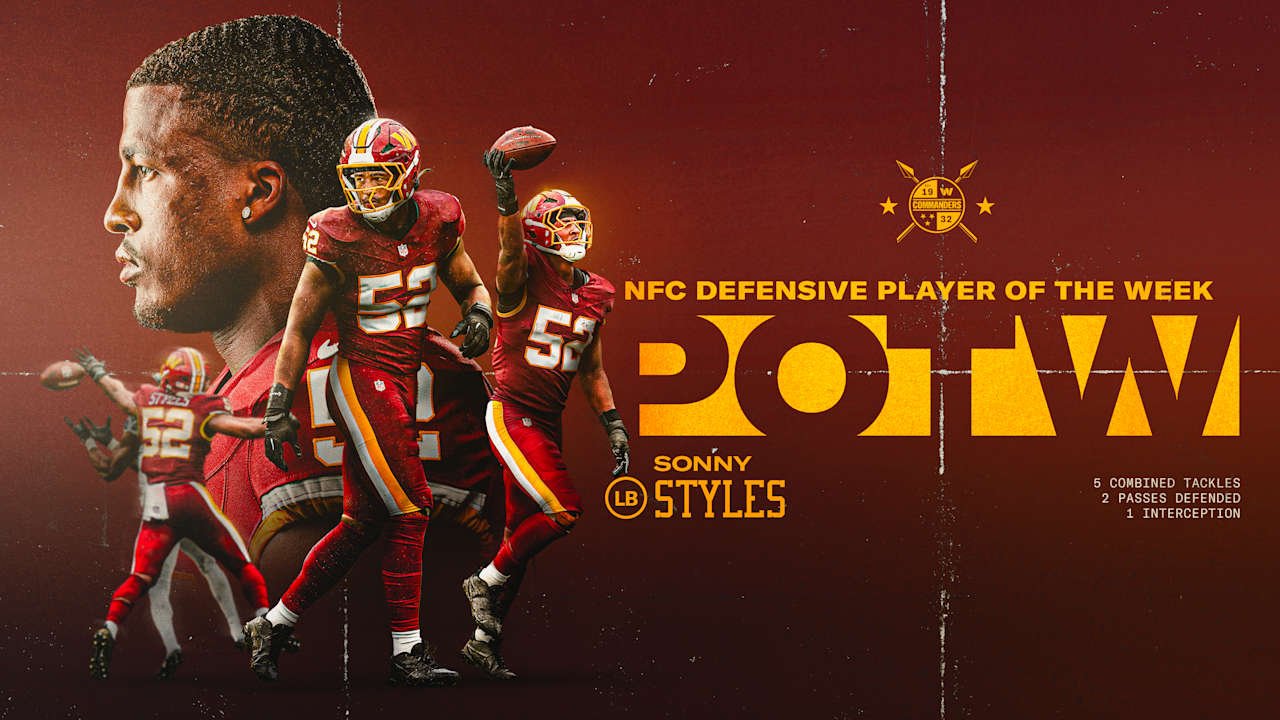
Sonny Styles Earns First NFC Defensive Player of the Week Honor After Dominant Week 3 Performance
LOUDOUN COUNTY, Va. – Washington Commanders linebacker Sonny Styles has been named the NFC Defensive Player of the Week for his outstanding play in the team’s Week 3 victory over the Seattle Seahawks, the National Football League announced today. The honor marks the first individual weekly award of Styles’ NFL career and adds another notable chapter to the history of Commanders defense.
The recognition caps a standout defensive effort by the rookie, who became the first Washington player to receive the NFC Defensive Player of the Week honor since defensive end Ryan Kerrigan won it in Week 1 of the 2020 season. Styles also continues a proud lineage, becoming the first linebacker in franchise history to earn the distinction since Keenan Robinson in Week 7 of the 2014 season.
Sonny Styles’ Week 3 Statistical Performance
Styles made his presence felt on every level of the defensive stat sheet during Washington’s win over Seattle. His performance was particularly versatile, showcasing coverage skills, ball-hawking instincts, and run-stopping ability in equal measure.
He finished the game with five total tackles, including four solo stops, one interception, one forced fumble, one quarterback hit, and two passes defensed. According to league statistics, Styles was the only player in the entire NFC during Week 3 to record the combination of an interception, a forced fumble, and multiple passes defensed in a single game.
Week 3 Defensive Numbers
| Statistic | Total | Details |
|---|---|---|
| Total Tackles | 5 | 4 solo, 1 assisted |
| Interceptions | 1 | Pick of the week for NFC |
| Forced Fumbles | 1 | Ball security disruption |
| Passes Defensed | 2 | Multiple defensed for the week |
| Quarterback Hits | 1 | Pressure applied |
A Historic Milestone for Washington Rookies
The award carries significant historical weight, as Styles is the first rookie in franchise history to earn NFC Defensive Player of the Week honors since the award’s inception in 1984. He joins an exclusive group of first-year players who have achieved the feat, including Champ Bailey, Chris Horton, and Brian Orakpo.
His achievement is even more rare within the context of the last decade. Styles is the first rookie linebacker to receive the award since Edgerrin Cooper did so in 2024. Notably, he is also the first rookie quarterback or defensive player to win an NFC Player of the Week honor for Washington since QB Jayden Daniels secured the distinction in 2024.
On a specific statistical basis, Styles became the first rookie in franchise history to register an interception, a forced fumble, and multiple passes defensed in a single game. This unique combination had not been matched by any rookie in the NFL this season until Styles’ performance.
The Legacy of Commanders Linebackers
Styles’ selection places him among the most respected defenders in the organization’s history. He joins Wilbur Marshall, Ken Harvey, Brian Orakpo, and Keenan Robinson as the only linebackers in franchise history to earn NFC Defensive Player of the Week honors.
While other defenders have received weekly or monthly recognition, Styles’ accolade stands apart. For instance, LB London Fletcher was awarded an NFC Defensive Player of the Month Award but never earned a weekly honor with Washington. Similarly, defensive end Chase Young won NFC Defensive Player of the Month in 2020 but never earned a Player of the Week honor. This makes Styles’ award a rare and special distinction for a linebacker in the Commanders’ defensive rotation.
Styles is the first Washington linebacker to earn NFC Defensive Player of the Week since Keenan Robinson in 2014 and joins Marshall, Harvey, Orakpo, and Robinson as the only linebackers in franchise history to earn the distinction.
NFC-Wide Context and League Comparisons
Beyond the organization, Styles’ performance stood out across the entire conference. He is the first player in the NFC to record an interception, forced fumble, and two or more passes defensed in a single game this season. According to the league, he became the first to accomplish this feat since Jessie Bates did so in Week 10 of the 2025 season.
This places Styles in a very small category of defensive backs and linebackers who can impact the game through takeaways, disruption, and coverage in the same contest. His Week 3 showing against the Seahawks was a comprehensive display of playmaking ability that contributed directly to Washington’s victory.
What This Means for Washington’s Defense
The award serves as a major confidence booster for the Commanders’ defensive unit heading into the remainder of the season. Styles’ ability to create turnovers while maintaining solid coverage and tackling has added a dynamic element to the lineup that opponents must account for.
With 39 players having received the NFC Defensive Player of the Week honor since 1984, Styles has now joined that list, making him part of the broader Washington football legacy. His rise from rookie to conference weekly honoree in just his third game underscores the talent the team secured and sets a high bar for his continued development in the 2025 season.
The Commanders will look to build on this momentum as they navigate the rest of their schedule, with Styles’ award signaling that the young defense is ready to compete at a high level in the NFC.
Sports, News, People, Washington Commanders, Sonny Styles, NFL, NFC Defensive Player of the Week

