
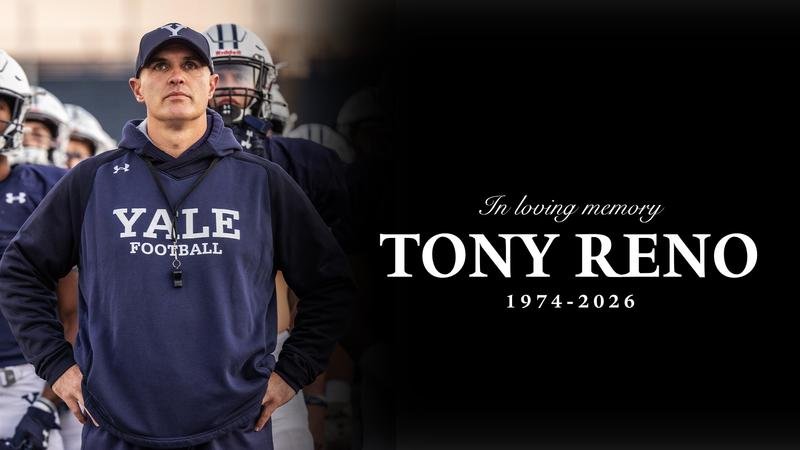
Yale Football Legend Tony Reno Dies After 14 Seasons as Head Coach
New Haven Mourns a Transformative Leader Who Redefined Bulldog Football
NEW HAVEN, Conn. — Tony Reno, the Joel E. Smilow ’54 Head Coach of Yale Football for 14 seasons and one of the most successful coaches in the program’s 150-year history, has died. Yale Athletics announced the loss Tuesday, remembering a leader whose impact extended far beyond the 83 victories that rank second all-time in program history.
“Today, we are deeply saddened by the loss of an extraordinary member of the Yale Athletics family,” said Victoria M. “Vicky” Chun, Thomas A. Beckett Director of Athletics. “Tony Reno devoted his life to serving others and approached every day with humility, compassion, and purpose. He believed deeply in the power of mentorship and invested wholeheartedly in the success and well-being of his players, colleagues, and friends. While his accomplishments on the football field were remarkable, it is the relationships he built and the lives he changed that will define his enduring legacy.”
A Championship Pedigree Built Over 14 Seasons
Appointed head coach in January 2012, Reno guided the Bulldogs to five Ivy League championships — 2017, 2019, 2022, 2023, and 2025 — restoring Yale to the summit of Ancient Eight football and establishing the program as a consistent national contender in the Football Championship Subdivision (FCS).
Five Ivy Titles in Eight Seasons
The championship run began in 2017, Reno’s sixth season, and accelerated in his final years. The 2022 and 2023 titles marked the program’s first back-to-back championships since 1979-80. His final season in 2025 produced perhaps the most dramatic chapter: Yale captured the Ivy crown and earned the conference’s first automatic berth to the NCAA FCS Playoffs, then rallied from a 21-point deficit to defeat Youngstown State 43-42 in a first-round thriller before falling in the second round. The Bulldogs finished the season ranked No. 13 nationally.
Dominance Over Harvard
No rivalry statistic better captures Reno’s competitive fire than his record against Harvard. In his final nine meetings with the Crimson, Yale won seven — a stretch that flipped the narrative of a series long defined by Harvard’s recent dominance. The victories were often signature Reno performances: disciplined, physical, and decided in crucial moments by players who had internalized his standards.
National Recognition and Historic Playoff Breakthrough
Reno earned Ivy League Coach of the Year honors in 2022 and was twice named the Jack Grinold Division I Coach of the Year by the New England Football Writers. His 2025 staff was recognized as the Ivy League Coaching Staff of the Year. The 2025 playoff appearance — Yale’s first in the FCS postseason — represented the fulfillment of a program-building vision that began with his hiring over a decade earlier.
Philosophy: Developing Men, Not Just Players
Colleagues and former players consistently describe Reno’s approach as paradoxical: intensely demanding yet deeply personal. He held players to standards they often didn’t believe they could meet, then provided the support to help them reach those standards.
“Tony was a man who valued the important things in life. Family always came first, and that was evident in the special family he built and the love the Reno family shares,” said Kevin Cahill, who succeeded Reno as Joel E. Smilow ’54 Head Coach of Football. “As a coach, Tony loved his players and held them to a standard they often didn’t know they were capable of reaching. He was hard on them and demanding, but every day, they knew he cared about them. It was never about him or simply about winning championships; it was about developing young men and leaders and helping them become the best versions of themselves. Along the way, we won a lot of football games.”
A Legacy Measured in Lives Changed
“Coach Reno understood something generations of us who played at Yale know deeply: Yale Football transforms young men’s lives,” said Patrick A. Ruwe, M.D. ’83, ’87, President of the Yale Football Association. “That transformation isn’t a tradition — it’s the purpose. He was an extraordinary coach, but his real legacy is how he deepened that purpose — teaching discipline, resilience, accountability, and leadership, and creating opportunities that changed the trajectory of his players’ lives.”
Academic Excellence and NFL Pathways
Under Reno’s leadership, Yale student-athletes excelled in the classroom as consistently as on the field. Six Bulldogs earned the Asa S. Bushnell Cup as Ivy League Player of the Year during his tenure. Perhaps the most notable professional product of his program is linebacker Foyesade Oluokun, who has established himself as a standout in the NFL. Numerous other Reno-coached players have continued their careers professionally, testament to a development system that prepared athletes for the next level while prioritizing their Yale education.
From Assistant to Architect: The Complete Yale Journey
Reno’s Yale story began long before his 2012 promotion. A Massachusetts native, he spent more than a decade on the Bulldogs’ coaching staff under Jack Siedlecki, rising to assistant head coach and helping guide Yale to the 2006 Ivy League championship. That institutional knowledge — understanding Yale’s unique academic culture, admissions constraints, and alumni expectations — proved invaluable when he assumed the head role. He didn’t need to learn the place; he needed to elevate it.
Colleagues across college football admired Reno for his integrity and humility. Opponents respected his teams’ preparation and discipline. Alumni embraced him as a steward of the program’s traditions. Former players — generations of them — describe him as a lifelong mentor.
Tributes Reflect a Coach Who Put People First
The outpouring from the Yale community and beyond highlights a consistent theme: Reno’s success was a byproduct of his values, not the other way around. His teams played with a distinctive identity — smart, tough, resilient — that mirrored his own character. The 2025 playoff run, with its dramatic comeback against Youngstown State, felt like a fitting final chapter: a team that refused to quit, coached by a man who never asked more of his players than he asked of himself.
Family at the Center
Reno is survived by his wife, Toni, and their three children — Dante ’29, Angelina ’28, and Vince. The family’s deep connection to Yale (two children are current or future students) reflected Reno’s belief in the institution’s mission. Those who knew him best speak of a man who coached with the same intentionality he brought to fatherhood: present, demanding excellence, and rooted in love.
An Enduring Standard for Yale Football
Tony Reno leaves behind a program transformed. When he arrived as head coach in 2012, Yale football was searching for its modern identity. Fourteen years later, it stands as a model of sustained excellence in the FCS — academically elite, competitively fearless, and culturally grounded in the development of the whole person. The five championship banners, the 83 victories, the playoff breakthrough, the seven wins over Harvard in nine years — these are the measurable achievements. The immeasurable one is the standard he set: that a football program at Yale can be about something larger than football, and that winning the right way is the only way worth winning.
The Yale Athletics community extends its deepest condolences to the Reno family and all who knew and loved Tony. His legacy will endure through the countless lives he touched and the lasting impact he made on Yale Football and Yale University.
News, Sports, Education, People, Society, Yale University, Yale Football, Ivy League, FCS Football, College Football, Coaching, Obituary, Tony Reno, New Haven, Connecticut, Leadership, Mentorship, Student-Athletes, Championship, Harvard-Yale Rivalry, Foyesade Oluokun, Jack Siedlecki, Victoria Chun, Kevin Cahill, Patrick Ruwe, Asa S. Bushnell Cup, Jack Grinold Award, NCAA FCS Playoffs, Youngstown State

