
Lucas Museum of Narrative Art Opens in Los Angeles After Two Decades of Planning
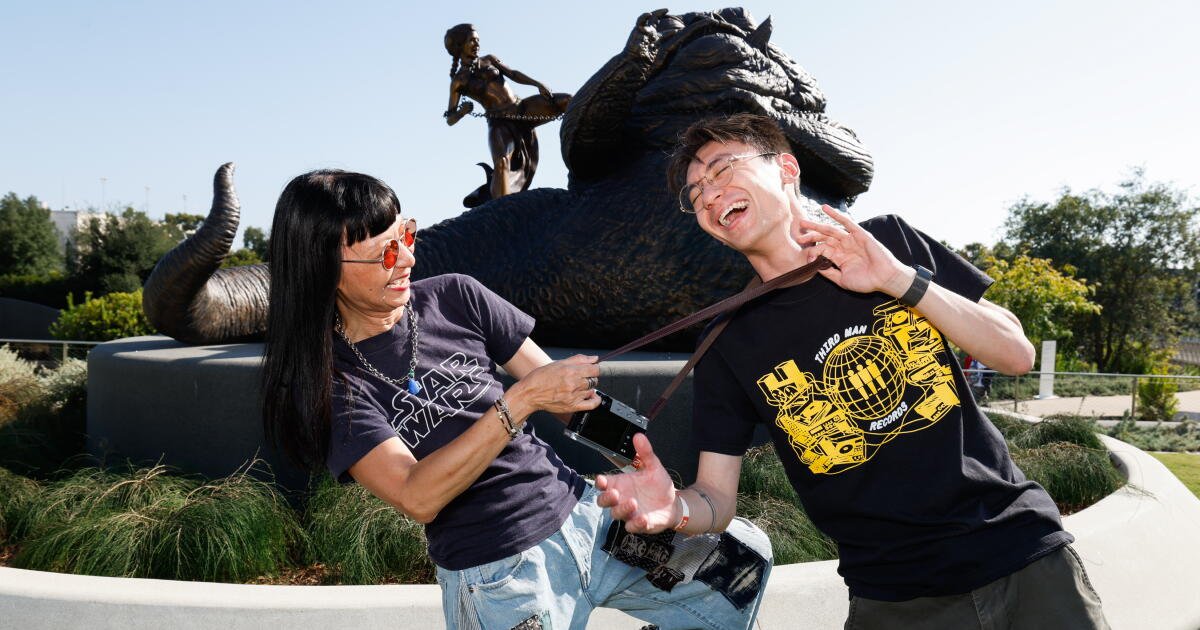
After more than two decades of planning and years of construction, the Lucas Museum of Narrative Art opened to the general public on Tuesday, transforming a vast Exposition Park campus that had been nearly empty during weeks of press previews into a bustling destination filled with eager fans, including some who traveled across oceans to see what all the hype was about.
A Museum Dedicated to Illustrators and Storytellers
Co-founders George Lucas and businesswoman Mellody Hobson gave remarks to the first 100 visitors—students from USC, Los Angeles Technology Center, Otis College of Art and Design, and Los Angeles City College—who were handed free tickets. Lucas spoke about spending more than 50 years collecting the work of artists who do not always get their due, including illustrators, cartoonists, muralists, and painters. Hobson described the institution as a museum of the “people’s art,” emphasizing that the images are illustrations of the beliefs people live with every day.
Star Wars Draws Crowds, but the Collection Runs Deeper
Museum leaders have said that “Star Wars” artifacts account for about 7% of the 100,000 square feet of gallery space, yet franchise enthusiasm was unmistakable on opening day. A Stormtrooper drove by on a flatbed truck, R2-D2 greeted visitors in the courtyard, and many attendees wore Princess Leia buns and Yoda ears. Still, the building designed by Ma Yansong and the broader collection of narrative art proved to be the main attraction for many.
Visitors Traveled From Around the World
Among the earliest guests was Alden Chang, 32, a green product engineer from Taiwan who flew 6,800 miles to thank Lucas and Hobson. Chang said meeting them was like a dream come true and noted that he had written an academic paper examining “Star Wars” fan culture in Taiwan. Others made the pilgrimage from Portland, Korea, and across Los Angeles, reflecting the museum’s broad cultural reach.
Local Residents and Architecture Enthusiasts
C.S. Lee, 54, an actor from Koreatown, recalled seeing “Star Wars” at age 4 in Hawaii and said the museum’s curves, light, and sculpture garden made him appreciate living in Southern California. Marc Downing, 71, and Robert Meier, 70, marveled at the ultra-modern design, with Meier noting that he used to see Lucas and his family at restaurants in Marin County. Matthew Haak, 26, and Andrew Liu, 26, were not “Star Wars” fans but came specifically to admire the organic curvilinear architecture and expensive design details like light coves.
Cosplayers, Art Lovers, and Working Illustrators
Nicole Garcia, 24, and Veronica Antonucci, 40, arrived in cosplay and were thrilled to discover works beyond the franchise, including “Fritz the Cat” and a Frida Kahlo piece. Shalonda Dean, 47, and Nikki Foster, 45, were moved by Norman Rockwell’s “The Problem We All Live With,” with Dean connecting the painting’s depiction of a Black girl to ongoing societal barriers. Vincent Zabierowski, 23, a host at the Skywalker Grill and freelance illustrator, praised the graphic novel collection, Jack Kirby works, Art Nouveau pieces by Alphonse Mucha, and the Diego Rivera mural.
Criticism and Reflection
The museum has drawn loads of applause but also plenty of criticism, mostly for its lack of context via wall text and for displaying art that not everyone agrees should be elevated. Janet Jacobs, 62, an architect visiting with her son, wished some pieces were explained more thoroughly and pointed out the irony of a storytelling museum with no clear storyline. Despite the critiques, many visitors expressed hope that future generations would grow up experiencing museums and creating art themselves.
Arts, Communities, Education, Entertainment, Hobbies, Leisure, Literature, News, People, Society, Travel, Museums, Star Wars, Architecture, Los Angeles, Narrative Art, Illustration, Pop Culture, Cosplay

