
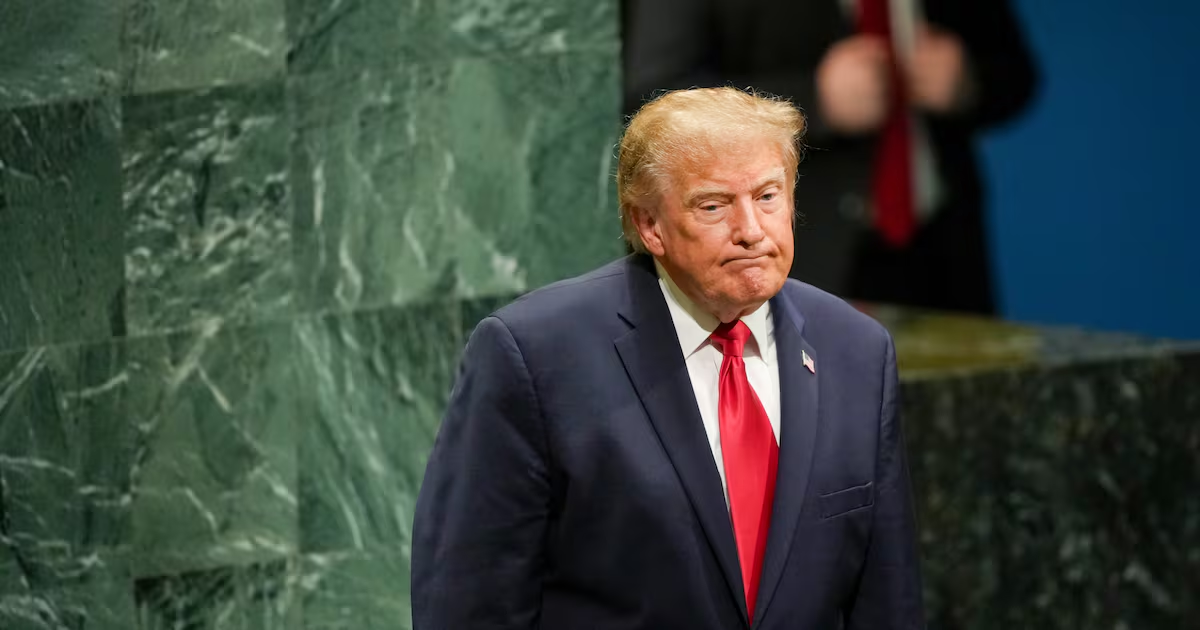
Trump Declares Mexico’s Drug Cartels a Global Threat at UN, Reshaping Hemispheric Security Doctrine
The dramatic escalation in Washington’s framing of Mexican drug cartels as a global security threat — rather than a bilateral concern between the United States and Mexico — has fundamentally altered the geopolitical calculus of the hemisphere. President Donald Trump‘s remarks at the United Nations General Assembly represented far more than rhetorical escalation: they constituted a doctrinal shift that reclassifies organized crime in Mexico as a multinational emergency demanding collective action, potentially unlocking the door to direct military intervention under Washington’s newly articulated security architecture.
President Claudia Sheinbaum found herself in an untenable position following the address, caught between defending Mexican sovereignty and confronting the uncomfortable reality that territorial control in several of the nation’s most critical states has eroded significantly. The president’s own government has long maintained that cooperation with the United States must rest on mutual respect, shared responsibility, and trust — principles that sit awkwardly beside a U.S. president who publicly characterized Mexico as “the epicenter of the violence of the cartels” and described the Sheinbaum administration as weak and incapable of reclaiming lost ground.
From Bilateral Dispute to Multilateral Crisis: The Strategic Reclassification
The most consequential element of Trump’s address was not its volume or its fiery tone — though both were considerable — but its deliberate repositioning of Mexican drug cartels within a global security framework. Rather than addressing this as a matter between two neighboring nations, Trump presented the narcotics trafficking organizations as a threat to the international order, comparable in scale and methodology to the Islamic State. In his words, the cartels were “enemies at war against civilization,” deploying “murder, rape, torture, and extortion as instruments of terror.”
Trump devoted 303 words — whether direct or indirect — to Mexico and its cartels, a figure dwarfed by the 1,152 words he reserved for Iran, which remained the speech’s primary target. Yet the proportional weight assigned to Mexico was strategically calibrated. With the two dominant organizations — the Sinaloa Cartel and the Jalisco New Generation Cartel — reportedly operating in approximately one hundred countries across five continents, the president’s argument that this constitutes a worldwide problem gained a veneer of logistical plausibility. The message to the 126 heads of state and government assembled in the General Assembly hall was unambiguous: what happens in Mexico is not Mexico’s problem alone.
The analogy to ISIS, while imprecise by most analytical measures, served a specific rhetorical purpose. ISIS established a territorial caliphate and constructed a functioning parallel state — feats the Mexican cartels have not achieved, despite their extensive territorial influence maintained through corruption, intimidation, and the provision of social services that the Mexican state has failed to deliver in vulnerable communities. What Trump sought was not analytical precision but a conceptual threshold: by equating cartels to the most reviled terrorist organization of the modern era, he elevated the issue beyond bilateral negotiation into the realm of global emergency response.
“It is unacceptable for the United States to share a 3,200-kilometer border with territory controlled by cartels. Mexico must regain control of its territory from those enemies of humanity.” — Donald Trump, UN General Assembly
The “Epicenter” Doctrine and Its Territorial Implications
The phrase “epicenter of cartel violence” carried more weight than any individual statistic or policy proposal. It functioned as a synthesis — a single concept that encapsulated the Trump administration’s revised understanding of the Mexico situation and, by extension, its justification for expanded military engagement. The emphasis on territorial control, while not entirely new in American discourse about Mexico, was embedded within a broader narrative of reasserting U.S. economic and military power on the world stage, deployed through extraordinary measures against extraordinary threats.
This framing is critical because it opens doctrinal space for what had previously been unthinkable: direct U.S. military action on Mexican soil against designated criminal organizations, potentially coordinated with regional allies through the Shield of the Americas initiative. By characterizing the cartels as “combatants” comparable to enemy forces, Trump’s language effectively invokes laws of armed conflict rather than law enforcement protocols, fundamentally transforming the operational paradigm.
Sheinbaum’s Sovereignty Defense Meets a Reconnaissance Problem
President Sheinbaum has consistently framed Mexico as a sovereign state whose territorial challenges from organized crime cannot be resolved unilaterally — or through foreign intervention. Her position emphasizes that Mexican drug trafficking organizations are transnational in nature, operating from sanctuaries within Mexico while maintaining global networks that no single nation can address alone. This argument carries logical weight, but it faces a significant credibility gap when confronted with domestic realities.
More than two years of devastating conflict within Sinaloa have demonstrated conclusively that the Mexican government struggles to project authority even within a single state where a major cartel faction has declared war against the other. Sheinbaum’s own controversial characterization of Sinaloa’s violence as stemming from the capture of Ismael “El Mayo” Zambada inadvertently served as a testament to the narco-power structure’s reach — an unintentional tribute to the pax narca and an implicit acknowledgment that the preceding administration under Andrés Manuel López Obrador may have inadvertently benefited the Sinaloa Cartel’s political ambitions, including alleged involvement in the 2021 gubernatorial elections.
The tension is stark: Sheinbaum demands respect for sovereignty from the United States while effectively conceding that sovereignty has been compromised in Sinaloa, Jalisco, Michoacán, Guerrero, and other regions where cartel presence is pervasive and state authority is nominal at best. Trump’s rhetorical strategy exploits this discrepancy, converting it from a diplomatic awkwardness into legal and moral justification for intervention.
Absence as Strategy: Sheinbaum’s Missed Opportunities
One of the most consequential — and arguably preventable — elements of this crisis is Sheinbaum’s conspicuous absence from the UN General Assembly and the G20 summit scheduled for December in Miami. Rather than traveling to New York to counter Trump’s narrative through bilateral meetings with other world leaders and to underscore that Washington’s classification of the cartel phenomenon within a hemispheric security doctrine is partial and politically motivated, the president remained in Mexico to oversee the ruling party’s candidate selection process.
This decision reveals what critics have described as a fundamental miscalculation of priorities. By choosing domestic political management over international diplomatic engagement at a moment of acute geopolitical tension, Sheinbaum ceded the narrative entirely to the United States. The result is that Trump’s characterization of Mexico’s security situation — flawed as it may be in its specifics — stands largely uncontested in the global forum where it was made.
The president’s reliance on daily morning press conferences (“mañaneras”) as the primary vehicle for communicating Mexico’s position has proven insufficient for a crisis of this magnitude. What was once effective as a domestic communication strategy has become, as the article’s analysis notes, “the talk of the world” — a phenomenon that reflects both the global attention focused on Mexico and the limitations of a communication approach that may not scale to the demands of multilateral diplomacy.
The Sheinbaum Paradox: Sovereignty Demanded, Sovereignty Lost
At the heart of the current impasse lies what might be called the Sheinbaum Paradox — the irreconcilable tension between the president’s public insistence on territorial sovereignty and the observable reality of state retreat from significant portions of national territory. This paradox has existed in various forms for decades, but the current moment has sharpened it considerably.
The international context compounds the difficulty. UN Secretary-General António Guterres has himself noted that the world is experiencing moments when international law is being trampled — a statement that neither validates nor condemns but rather describes a chaotic environment in which established norms are fraying. Within this context, Sheinbaum’s principled defense of sovereignty faces headwinds from both external pressure and internal weakness.
- Internal consensus fractures over Morena politicians facing criminal charges in both Mexico and the United States
- Public perception of government incapacity in key security indicators
- Diplomatic isolation resulting from the absence of a coherent international counternarrative to Trump’s framing
- The growing perception that drug trafficking organizations have achieved de facto territorial governance in multiple states
Geopolitical Reordering and the Shield of the Americas
Trump’s UN address did not exist in a vacuum. It must be understood within the broader context of the administration’s hemispheric strategy, which includes the Shield of the Americas initiative — a framework for coordinating regional security responses that could, in theory, deploy U.S. and allied military resources against threats identified as transnational. By framing Mexican cartels as a global rather than bilateral problem, the administration has created the conceptual architecture for such deployment.
The comparison to Venezuela’s Nicolás Maduro regime is instructive. Trump has suggested that external adversaries have infiltrated cartel structures, blurring the line between criminal enterprise and geopolitical threat. This framing mirrors pre-existing justifications for intervention in Venezuela and provides additional legal and rhetorical cover for expanded operations in the Mexican context.
| Dimension | Bilateral Framework | Multilateral Framework |
|---|---|---|
| Nature of Problem | Shared challenge between US and Mexico | Global security threat requiring collective response |
| Legal Basis | International law, bilateral treaties | Security doctrine, collective defense frameworks |
| Military Response | Law enforcement cooperation | Potential direct military action under security doctrine |
| Sovereignty Implication | Respects territorial integrity | Justifies external intervention in crisis zones |
Limited Maneuvering Room and the Path Forward
Sheinbaum’s room for diplomatic maneuver has contracted considerably. The combination of internal political pressures — including corruption allegations against Morena figures in both countries — and the external rhetorical offensive mounted from Washington has created a moment of acute vulnerability. Yet the administration has not been entirely passive, and some observers note that quiet diplomatic channels may be operating beneath the surface of public rhetoric.
The fundamental question that remains unanswered — and unanswerable in the short term — is whether Mexico can reclaim territorial control without external military assistance, and whether the United States will accept a diplomatic solution that preserves the appearance of Mexican sovereignty while effectively subordinating Mexican security policy to American strategic objectives. The 303 words Trump devoted to Mexico at the UN represent an opening salvo in what could become a sustained geopolitical confrontation whose resolution will shape the hemisphere for years to come.
The analytical lens through which this crisis is examined carries significant weight: it touches on fundamental questions of sovereignty, security, international law, and the evolving nature of state power in the twenty-first century. Whether the cartel phenomenon in Mexico represents a terrorist threat comparable to ISIS or a complex law enforcement challenge amplified by geopolitical rhetoric may ultimately depend less on the facts on the ground than on the political will to act upon particular interpretations of those facts.
News, Government, Politics, Society, International Relations, Controversial, US-Mexico Relations, Drug Policy, Hemispheric Security, Geopolitics, Trump Administration, Sheinbaum Administration, Sinaloa Cartel, Jalisco New Generation Cartel, UN General Assembly, Shield of the Americas

